
The Three Kashmirs
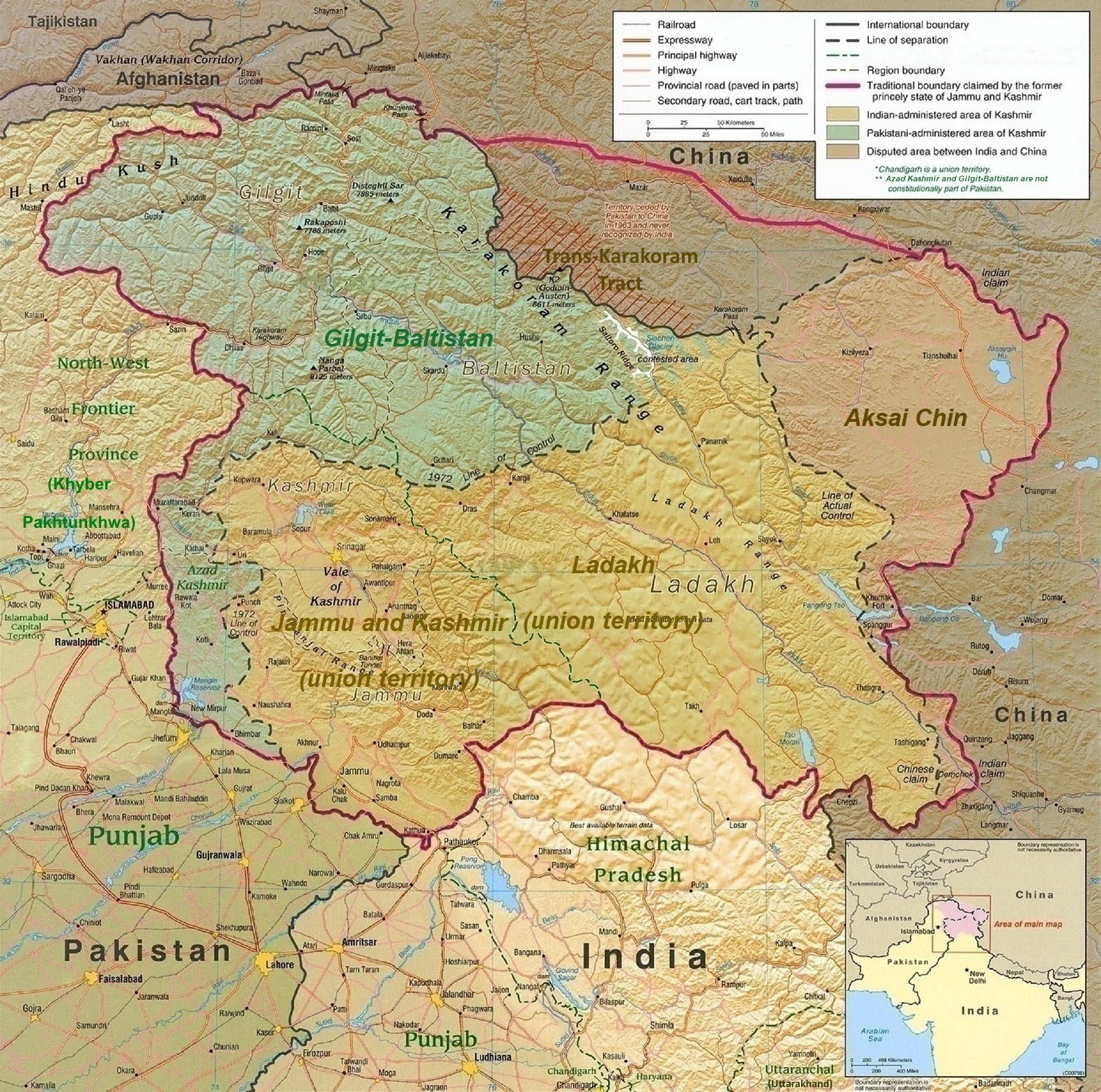
Many people or most people especially in the sub-continent have a view and a version on Kashmir. And many or most outsiders are actually not really aware of the Kashmir they talk about. There is this whole “Paradise on Earth” narrative which talks about the physical beauty of this Land and its People. And then of course there is the Political narrative on this as i call it “Cursed Land” with hundreds of Thousands killed and displaced. But as usual my concern is mostly Geographical. As in how well do People understand the Geography of Kashmir.
Over the years ive realised there are Three Kashmirs in popular perception and all of them are called the same. Kashmir. And people often get confused about the same. Well there is a Geographical Kashmir, there are Administrative Kashmir (s) and Political Kashmir. And since everyone and their Doggy is an expert on Kashmir Ill once again for the simple matter keep stuff easy to understand stick to the time of Partition of the Subcontinent and the “Partition” of the erstwhile Riyasat E Jammu and Kashmir. And for the same I will use a Map issued by National Geographic from 1942 which shows the areas Ruled directly by the British as well as the Princely States which were indirectly run by the British through the Maharajas / Rajas / Thakurs / Zamindars etc.
And the Map also shows the essential administrative units of the states.
Jammu Province: Districts of Jammu, Jasrota (Kathua), Udhampur, Reasi and Mirpur.
Kashmir Province: Districts of Kashmir South (Anantnag), Kashmir North (Baramulla) and Muzaffarabad.
Frontier Districts: Wazarats of Ladakh and Gilgit.
Internal Jagirs: Poonch, Bhaderwah and Chenani.
In the 1941 census, further details of the frontier districts were given:
Ladakh Wazarat: Tehsils of Leh, Skardu and Kargil.
Gilgit Wazarat: Tehsils of Gilgit and Astore
Frontier Ilaqas: (under the Gilgit Agency) Punial, Ishkoman, Yasin, Kuh-Ghizer, Hunza, Nagar, Chilas.
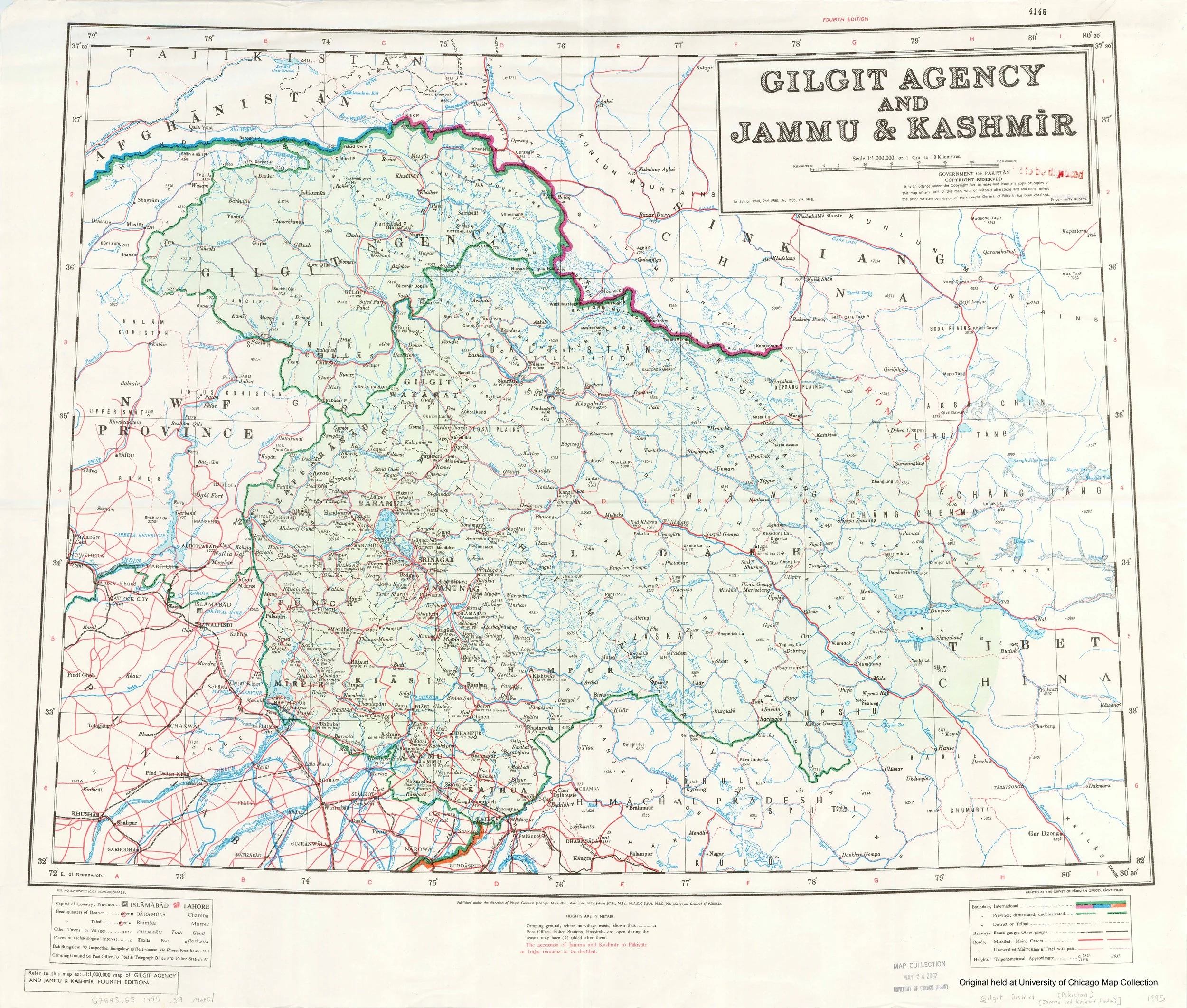
The above is from Wikipedia but it gives a good idea of how the State was politically divided into administrative Units when it was a Princely State. This Princely state was often referred to in its entirety as “Kashmir” and even till today many people think of it as the same. From Gilgit to Mirpur and from Muzaffarabad to the farthest end of Ladakh bordering Tibet everything was Kashmir. And once upon a time I imagine all the Residents fancied being called Kashmiris. For some reason there was something exotic which was attached with the name Kashmir. I experienced this in my Childhood and even now when you tell people that you are from Kashmir. No wonder all the Mirpuris from across the LoC refer to themselves as Kashmiris. This was like the First Kashmir. The all Encompassing Riyasat e Jammu and Kashmir. Basically a construct of the Sikh Empire and shaped by the Dogras.
And then there is the second Kashmir, which was called the Kashmir Province back then and the Kashmir Division after Independence. Prior to Indpendence there was Kashmir North ie Baramulla and Kashmir South ie Anantnag and added to it was Muzzafarabad District along the Jehlum as it flowed down towards the Punjab. But at the time of Independence most of Muzzafarabad fell on the other side of the LOC so what was left was a Uri area plus the rest of Baramula and of course the Anantnag District. At the time of Patition our Village was a located in the Uri Tehsil of Baramulla District. We were very much a part of this Second Kashmir historically.
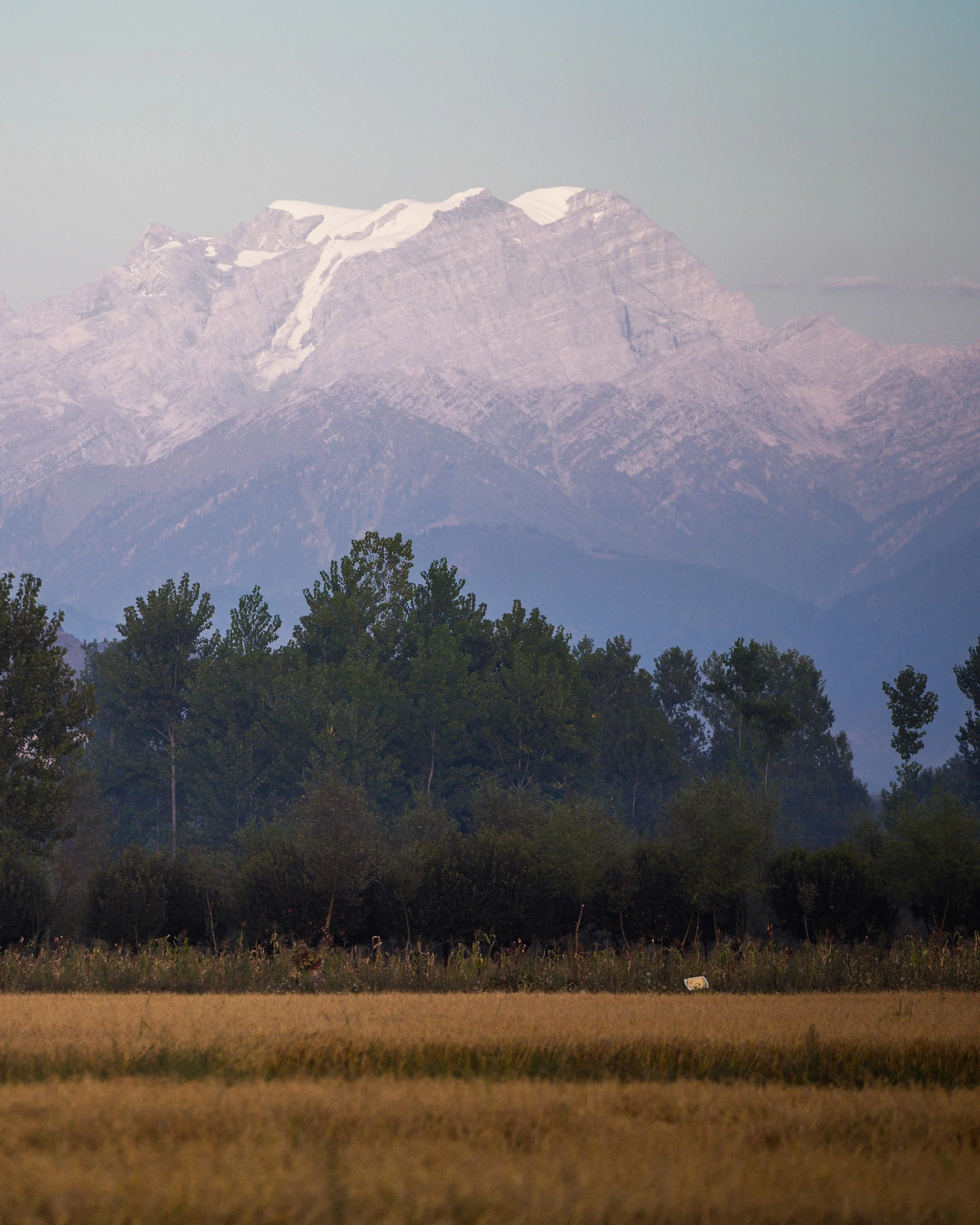
And then finally there is the Third Kashmir. The actual Geographic and Lingual Kashmir which is basically the Valley of the Jehlum and flanked on one side by the Pir Panjals and on the other side by the Great Himalayan Range. This is the famed Vale of Kashmir that for centuries was a source of fascination for outsiders. Classically on an East West alingment the Valley stretches all the way from say Verinag to Baramulla whereon the Valley disappears and is replaced by the Jehlum Gorge. This Third Kashmir is the one I grew up in as a “Kashmiri” who nonetheless couldnt speak Kashmiri but we were a Punjabi speaking Linguistic Minority. There are other “Kashmiris” here who’s Mother Tongue isnt Kashmiri like Punjabi Muslims and Gujars and even Ladakhis and Purigis but many of them speak Kashmiri fluently.
That being said i kinda find it amusing that many Pakistanis talk of thier “Kashmir” which in their imagination is what I would call the Kishanganga Valley and my Pakistani friends call the Neelum Valley. Technically that Valley isnt really a part of Kashmir. Neither Geographically nor Linguistically. However some Geographers do regard the Kishanganga as the North Western and Western edge of Kashmir though it is a different Valley. Do remember unlike other sub Valleys of Kashmir like the Lidder Valley and the Sindh Valley getting to the Kishanganga Valley includes crossing High Passes with historically the main one being Rajdhanigan Pass which once stood on the “Silk Route” which connected Kashmir with Gilgit and Skardu in Baltistan.
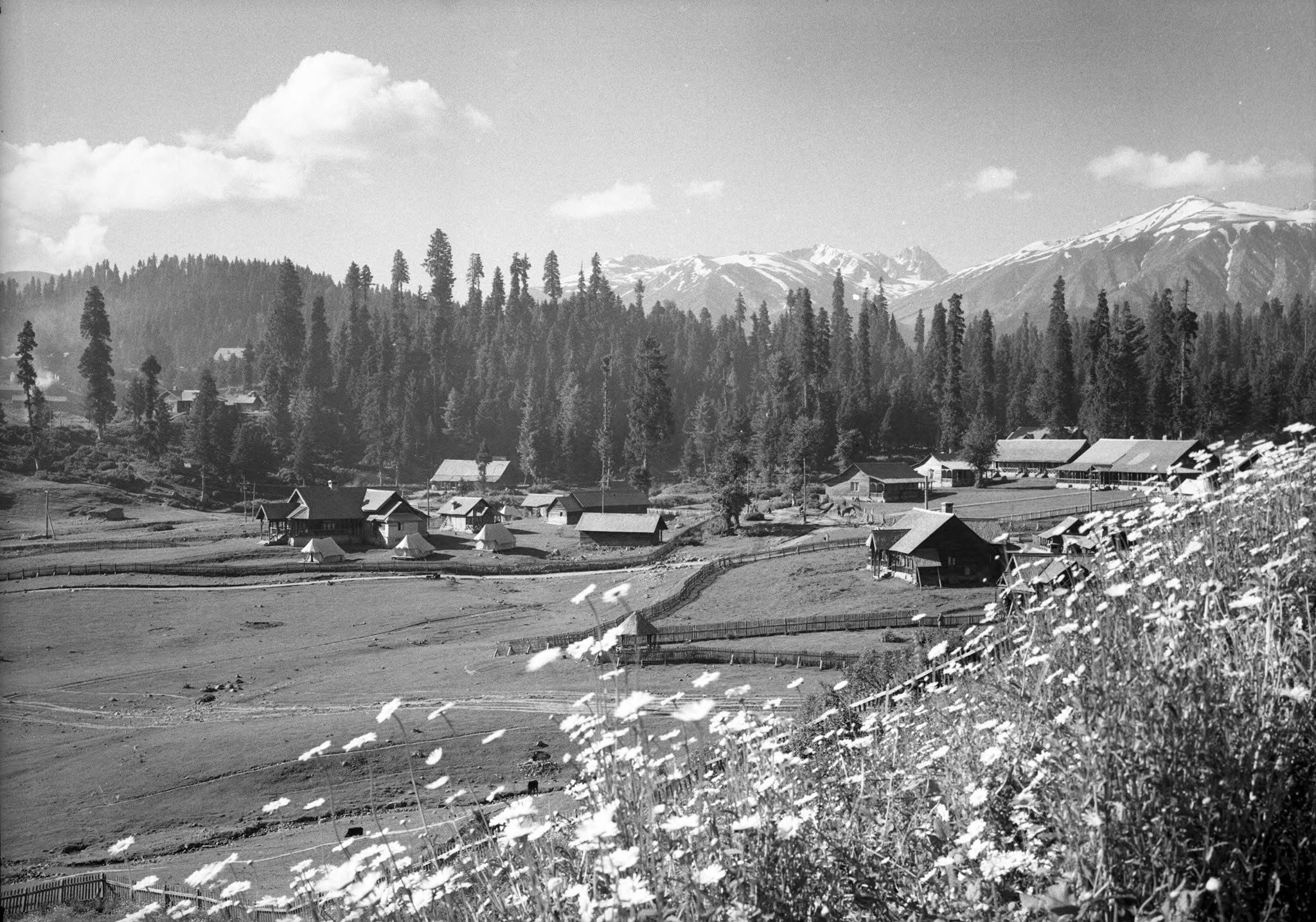
That being said the fascination that people have with Kashmir and assumed Kashmirs is indeed an enduring one even when the term is used for different Geographies in the same Region. And as a parting shot i always wondered which part of Kashmir fascinated people the most. And to work on this puzzle i first eliminated areas in Kashmir which are similar to other Geographies in Western Himalayas. Like there would be many Alpine Meadows like Gulmarg all over the Western Himalayas and there would be valleys like the Sindh and the Lidder. After many years the realisation dawned on me that it was most probably my Hometown Srinagar which fascinated visitors the most. With the Jehlum, the Lakes, the Zabarwan Mountains, the Karewas, the Gardens, the Orchards and the Forests it was and still is unique. Something which has no equal on the Planet as I would say.
Chisoti : The Anatomy of a Disaster
Chisoti in Kishtwar in the Jammu Division of the UT of Jammu and Kashmir has been in the news because of the tragic Events of August 14 which took the lives of well over a 100 people. Rescue operations are still on though finding anyone alive in the Debris would be a matter.
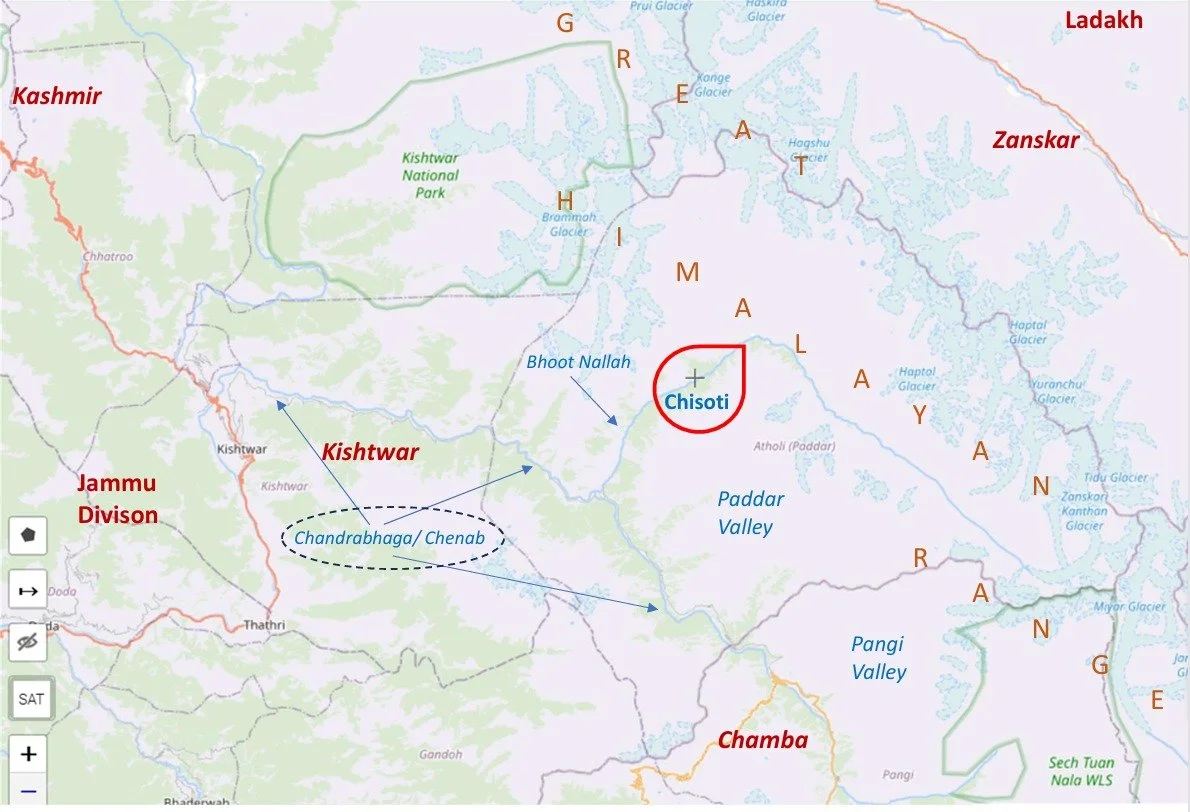
I looked at this incident a little deeply as this area is an extremely interesting one in Geographical, Cultural and Anthropological contexts and I have visited the larger Paddar Valley and was hoping to drive all the way to Chisoti now and to Machail in the future. Most people wouldnt understand the location of Kishtwar let alone that to Chisoti so I added a Map that helps. And coming in the wake of a similar disaster at Dharali in Uttarakhand as well other incidents of Cloud Bursts and Flash Floods it got me thinking.
And when you need you understand such tragedies you need to look at the Geography of the area. The main River on the banks of which Chisoti is located is the Bhut Nallah but the Flood in wake of the Cloud burst came through the Chisoti Nallah which is a small Nallah which joins the Bhut Nallah. Just as i suspected in case of Dharali such a devastating surge of Water isnt the work of a Cloud Burst alone. Its the deadly Glacial Lakes Outflow Floods. To explain in simple terms when Glacier melts then the water flows and sometimes it forms little Lakes within the Glacial Moraines. These Lakes keep growing in size as more Water is added and sometimes when the Water pressure in the Lake grows too much the retaining Moraines give way and the Water rushes down in a great deluge.
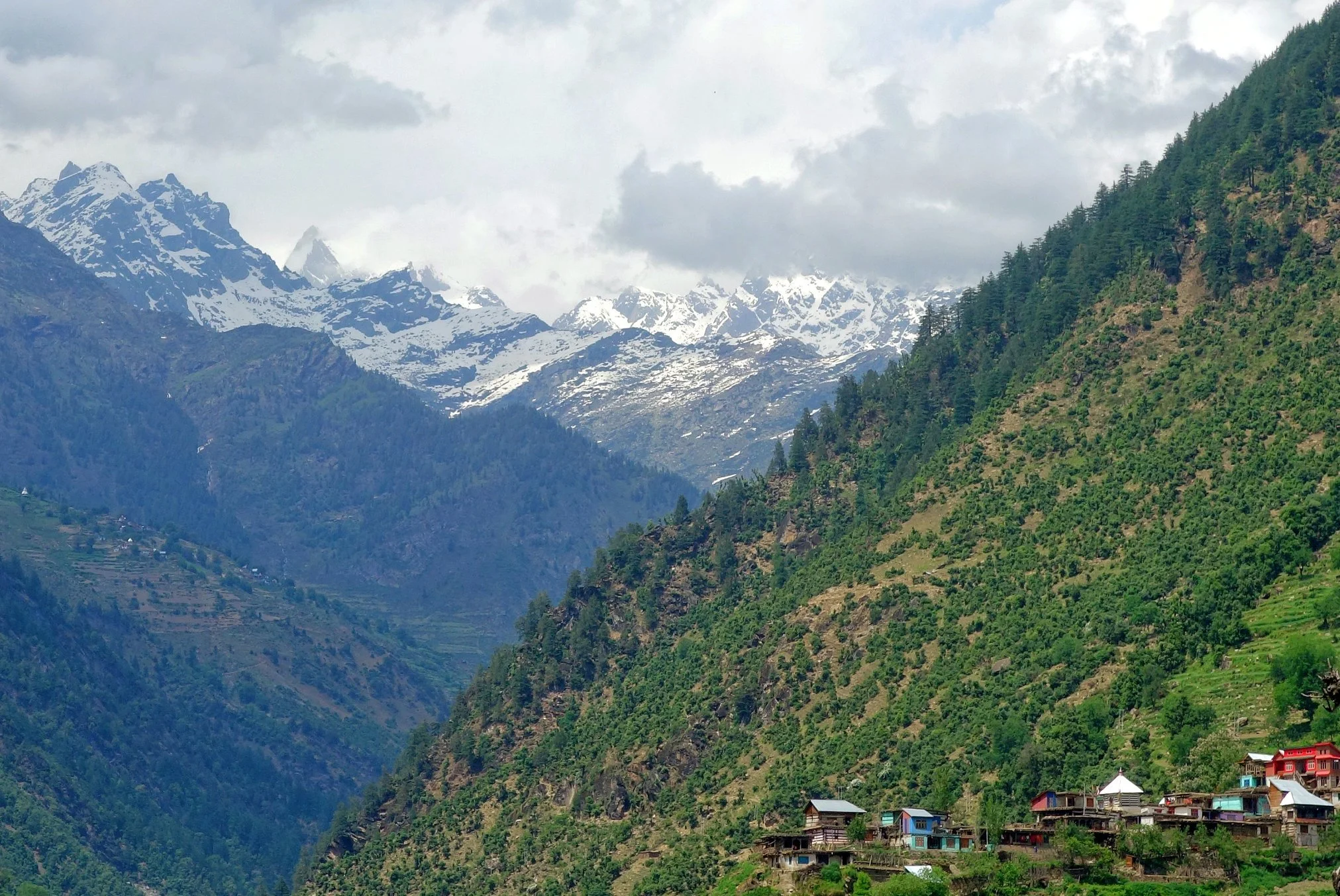
Now in recent years this is becoming more common because of Global warming as Glaciers are melting at the faster Rate and the size of these Lakes is growing and this combined with a Cloudburst in which large quantities of Precipitation is added to the these already burgeoning Lakes makes them burst the Banks and the result is a cataclysmic tragedy like the one which occurred at Chisoti. If you look at the Map you will notice that above Chisoti the Chisoti Nallah comes down from the Glaciers around the Arjuna Peak (around 6050 M and known in the Mountaineering Circles). I think there was some Glacial Lake here which burst as a result of the Cloudburst and this caused the Event.
Scientists have for ever been highlighting the Dangers that GLOFs pose to Human populations that live in their proximity and incidentally the Himalayan Region in India is the one highlighted as the most risky. Infact there was a Study published in Nature on the subject, a link to which I'm providing in the comments.
That being said the vast devastation caused in Human lives lost has other factors involved as well. Most of the victims were Pilgrims going for the Machail Yatra and Chisoti is an important pitstop on the way as the Road which is supposed to connect Gulabgarh with Machail has been under construction for atleast a Decade. And now it had reached till Chisoti and a Bridge was/is under construction there for the onward Journey. Would like to mention that I had gone on this Road six years back and it has progressed only a few kilometers till now. Our Sarkari snails and Local Politics at work.
Apparently each Village wants to enjoy the financial Gains of being the last Roadhead on this Pilgrimage. So as of now Chisoti was enjoying that privilege. So all the Taxis were Parked at the Road head end near the point the Bridge was being built and a busy Market was there and if that wasnt enough there was a Bhandara / Langar being held there and the incident took place around what was Lunch time for many people. Hence the number of people present there were much more than there usually are. All these factors combined caused this Tragedy and may all the departed Rest in Peace.
My first point is why run a Religious Yatra in the middle of the Monsoon Season in an area susceptible to such Events. BTW its pertinent to mention that a Flash Flood had struck Chisoti in 2021 and the Bridge was washed away. Maybe the Organisers should look at changing the Dates because as and when the Road goes all the way to Machail there would be a manifold increase in the number of people joining the Yatra. Secondly the Authorities should look at limiting the number of Pilgrims as well. Thirdly they should pay more attention to Weather Forecasts and of course get a Survey done of the Glacial Lakes. But we know not to have Expectations from the Sarkar.
More on this Subject some other time.
A Journey to Galwan Valley
Five years ago the Galwan Valley was in the News for the wrong reasons after a deadly clash between the Indian and Chinese Armies in the Valley located in Ladakh lead to many deaths on the contentious Border between the two countries in wake of continued Chinese intrusions into Indian territory.
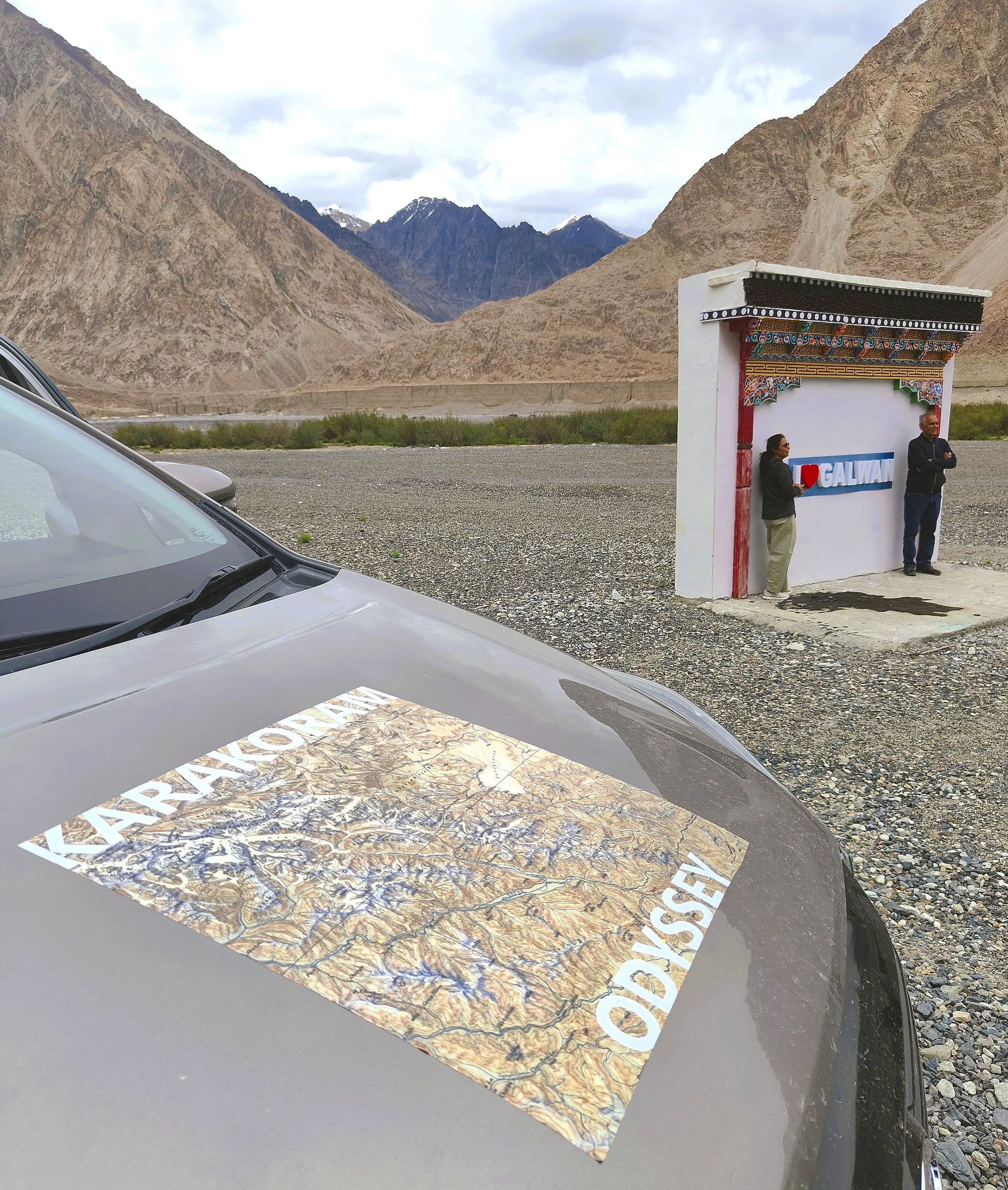
This area along the Shyok River, of which the Galwan Nallah or the Galwan River which forms the Galwan Valley has been off limits to Civilians since long but now the Indian Government has decided to open up the area for Civilians and we were amongst the First Civilians to venture into this beautifully desolate part of the Eastern Karakorams in Ladakh. Earlier Civilians could only venture upto the Village of Shyok from where the Shyok River takes a U turn and flows in a Northerly direction.
Five years ago the Galwan Valley was in the News for the wrong reasons after a deadly clash between the Indian and Chinese Armies in the Valley located in Ladakh lead to many deaths on the contentious Border between the two countries in wake of continued Chinese intrusions into Indian territory.

This area along the Shyok River, of which the Galwan Nallah or the Galwan River which forms the Galwan Valley has been off limits to Civilians since long but now the Indian Government has decided to open up the area for Civilians and we were amongst the First Civilians to venture into this beautifully desolate part of the Eastern Karakorams in Ladakh. Earlier Civilians could only venture upto the Village of Shyok from where the Shyok River takes a U turn and flows in a Northerly direction.

We undertook the Journey on the 16th of June as a part of our Karakoram Odyssey though the original opening Date has been postponed from June 15 earlier to July 15 due to unavoidable circumstances. No Special Permits are required for visiting the Galwan Valley but do get your Inner Line Permits in place.Please note that you have to report at the Shyok TCP (Traffic Control Point) before 10 AM as no one would be allowed beyond 10 AM to travel any further into the Shyok Valley. And you are not allowed to stay at the Galwan Memorial beyond 3 PM.

On the whole the Journey from Shyok to the Galwan River is around 120 kms and takes around 3 Hours and its mostly a good Road surface. Please note that the complete stretch is bereft of any inhabitation except for Army Camps on the Road which are also far apart. Please carry enough Drinking Water and Light Snacks Munchies Chocolates when you embark on this Journey.

Historically this Route along the Shyok River was the traditional Winter Route on the Silk Route Trade as the Traders used to walk on the Frozen Shyok River further up North to the point where the Chang Chenmo River met the Shyok. From the Chang Chenmo side it was connected to Tibet and China. From hee one could walk all the way to Daulat Beg Oldie and up the Karakoram Pass into the Trans Karakoram and Central Asia on their way to Kashgar and Yarkand.
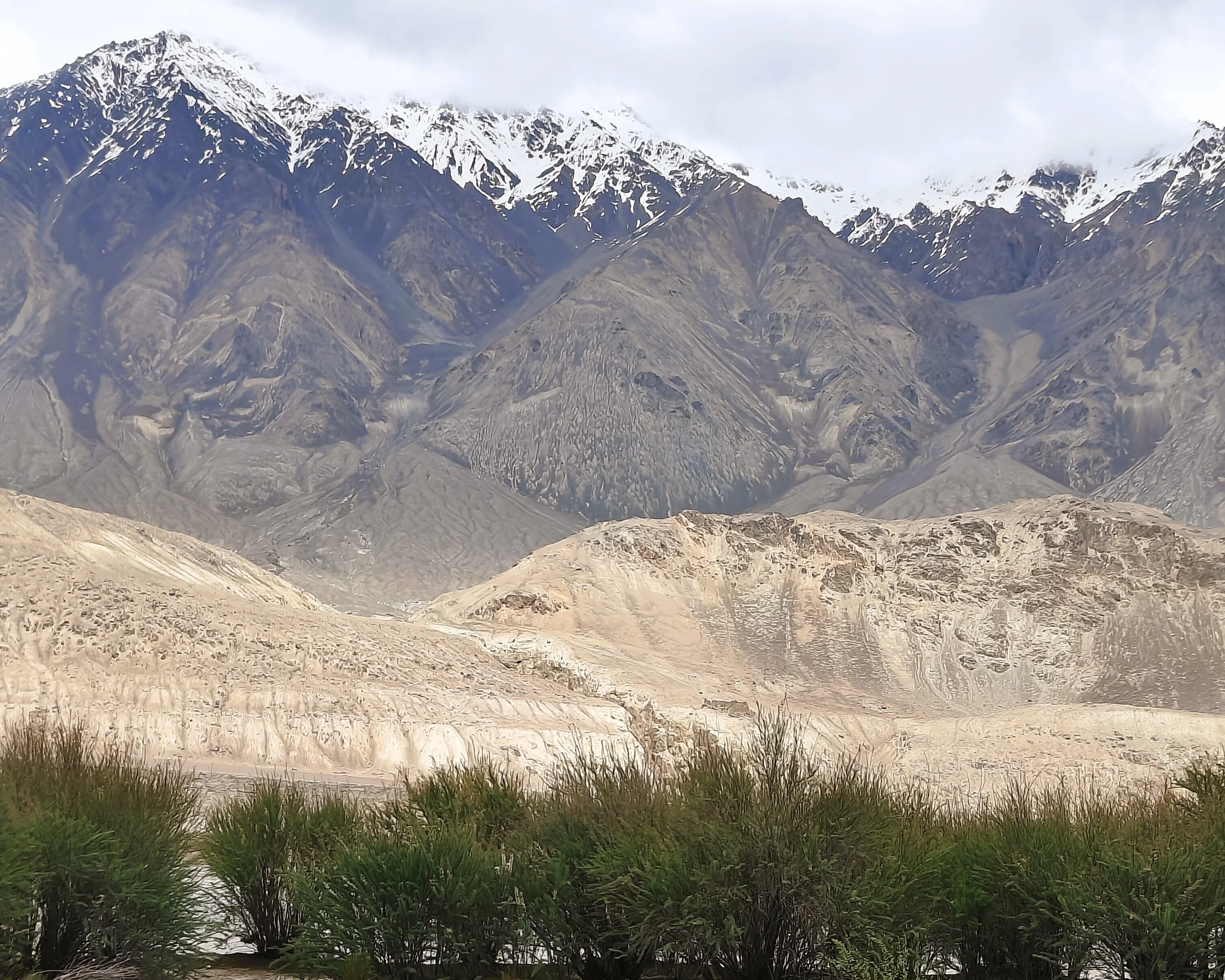
There are still signs of this Track as one drives towards Galwan on the other side of the River. There are also remains of an Old Mud Fort which housed Tax Collectors on the Route. There is also a small Monastery, Tarsing Karmo Monastery, on the way under a Rock. There is another interesting point on the way where as per local legends a Golden Fish can be seen by those Pure at Heart.
What appealed to me was the complete desolation of the place in spite of the Shyok River flowing through the Valley. This is a part of Eastern Karakorams where we were lucky to be amongst the first civilians to witness this enchanting Valley.
You can explore other such places like the Siachen Base Camp and the Turtuk Thang area as a part of our Karakoram Odyssey where we cover the Karakorams in Ladakh which most people are unaware of.
Ten Offbeat Locations in Kashmir
Ten Offbeat Locations in Kashmir
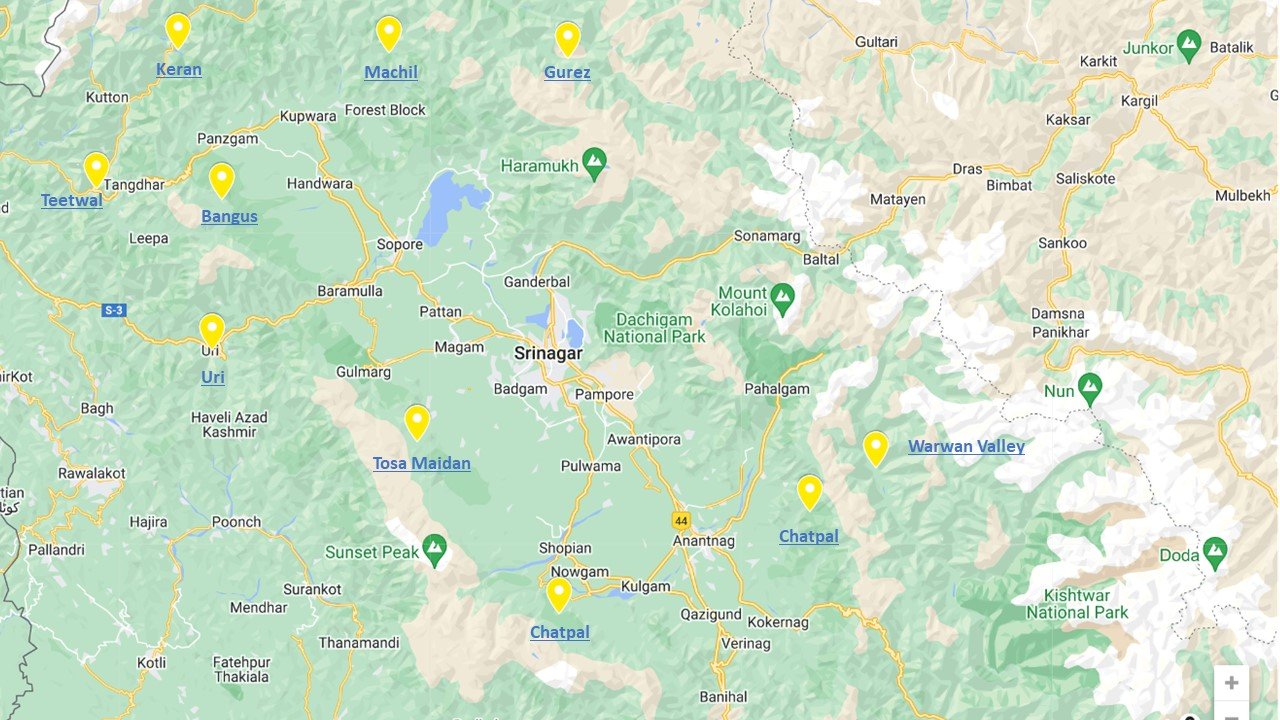
Kashmir, the Paradise on Earth as some call it hs been fortunate to have witnessed the arrival of Tourists in their thousands in the last few Years. Peak Seaon in the Summers when the Heat scorches the Plains hordes of Tourists rush North into the coller and rejuvenating climes of Kashmir.
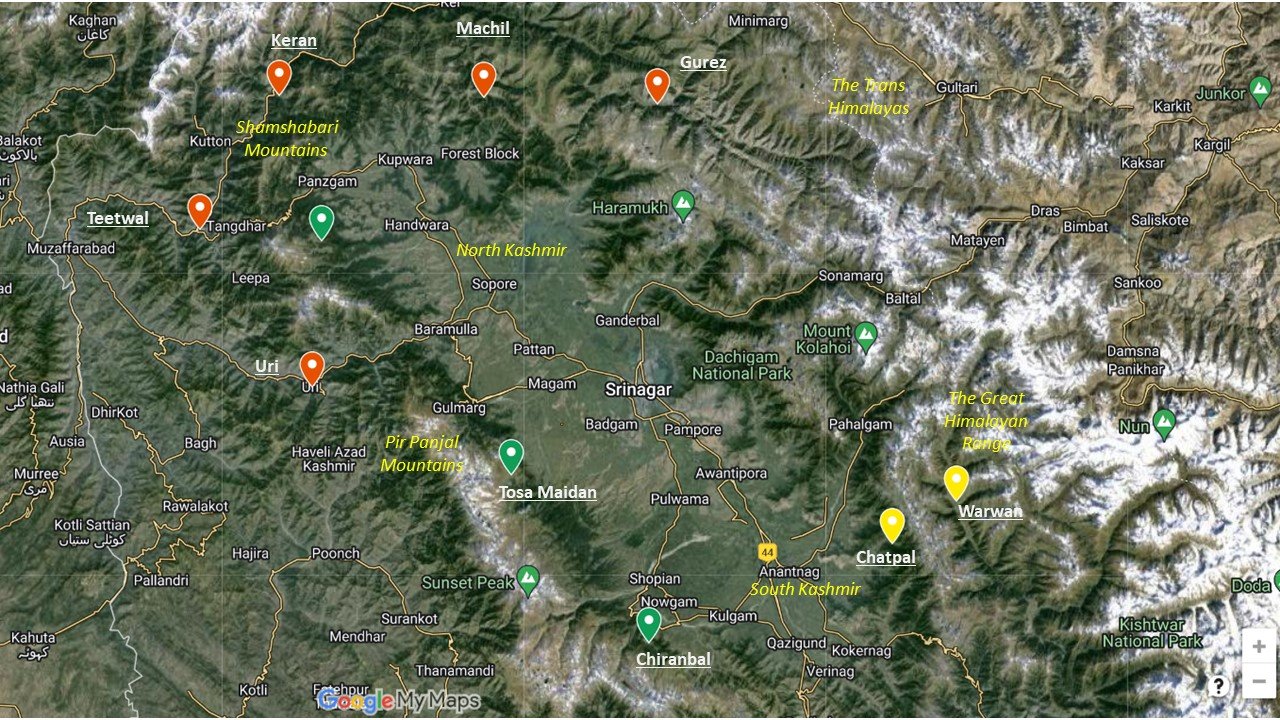
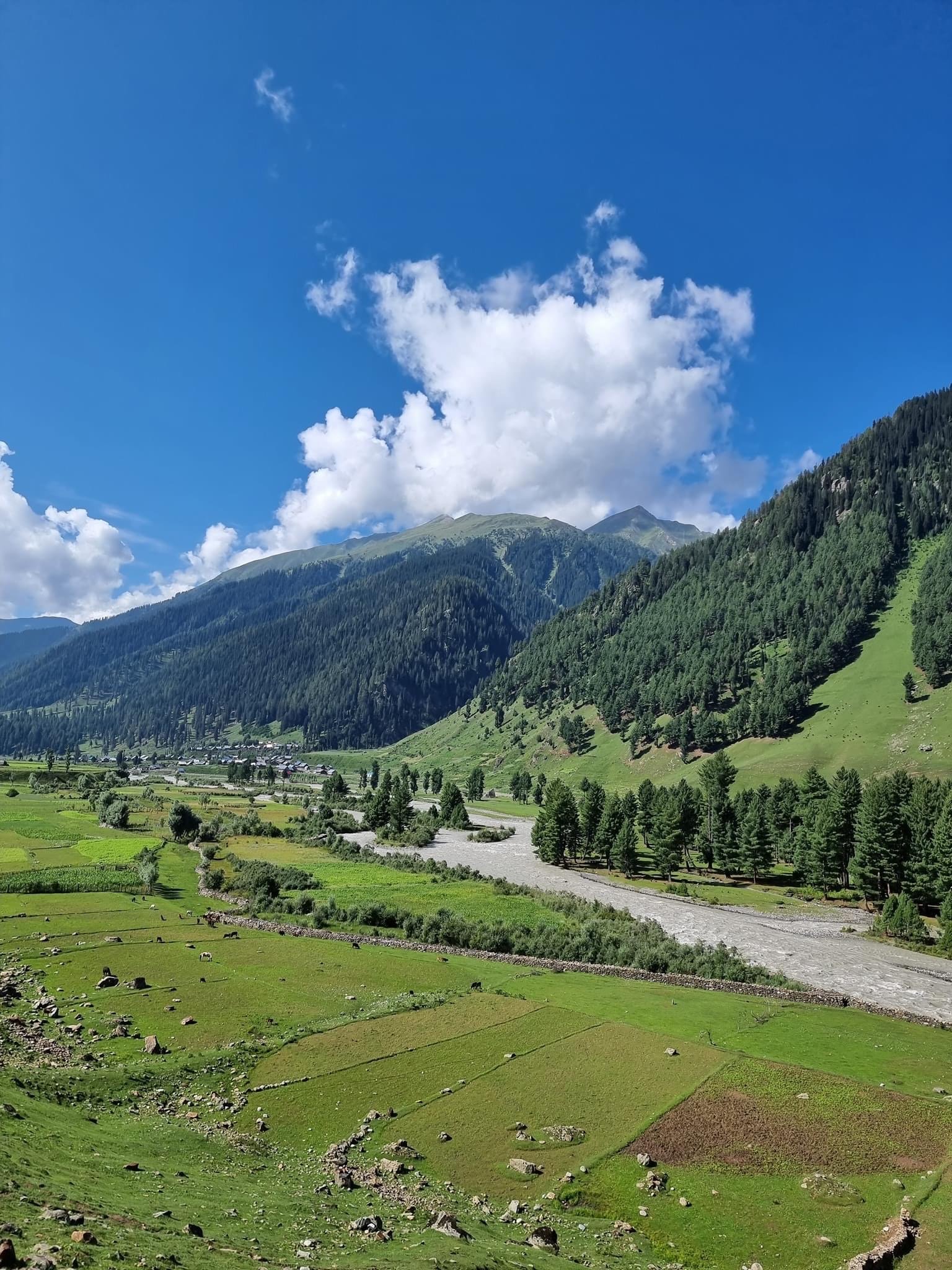
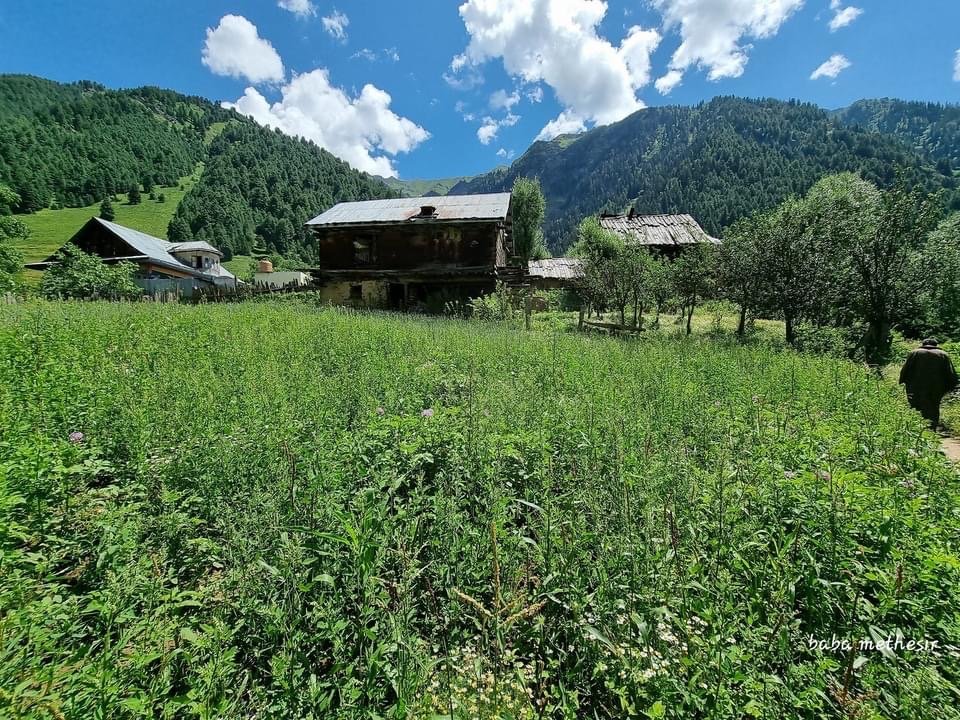
Warwan Valley
n the Inner Himalayas lies a beautiful Region so remote that most people haven't even heard of it forget about going there. Kishtwar itself is remote and always under the shadow of Kashmir but this part of Kishtwar which lies next to Kashmir on one side and the Suru Valley of Ladakh on the other side is probably one of the last great wildernesses in the Inner Himalayas. This is the Warwan- Marwah - Dachchan belt lies along the Maru Wadwan River or as its also known Warwan / Marwah (Marev) / Marsu Dhar River along different parts of its course, which is a major tributary of the Chenab. These three sub parts of this Region all lie along the same River and offer a rare insight into how people lived maybe many years ago. Sandwiched between the Pir Panjals and the Great Himalayan Range this is a Region few outsiders have set foot.





https://travelthehimalayas.com/kiki/warwan-marwah-dacchan-the-last-inner-himalayan-wilderness
Gurez Valley
The beautiful Valleys of Gurez and Tulail are located within the folds of the Great Himalayan Range in the beautiful Valley created by the Kishanganga River as it runs down its course from its point of origin at the Kishansar Lake located in the Mountains above Sonamarg. The access to the Gurez Valley is via the Razdan Pass and the Road from Srinagar winds its way along the Wullar Lake and then from Bandipora the climb starts to Tragbal and further to the Razdan Pass.
The LOC runs through Gurez and you can see the Border fence at most places in the Gurez and the Tulial Valleys. On one end of the Gurez Valley lies the Village of Bagtore which is one of the last Villages on th Indian side of the LoC. On the other end of the Tulail Valley is the Kaobal Gali which connects this Valley with the Mushkoh Valley in the Drass Region of Ladakh. This used to be one of the main access points into Gurez / Tulail till 1947 after which this Road became off limits for Civilians with only the Army using it.
The Gurez and Tulail Valleys have a distinct Culture and the majority of the people here are Shina and speak the Shina language which is also spoken in the Gilgit Region acrosss the LoC. The Guez / Tulail Valleys are dotted with picturesque Villages with Houses made of Timber just like it has been done for Centuries.
ttps://travelthehimalayas.com/gurez
https://travelthehimalayas.com/kashmir-gurez-bangus
Chiranbal
Chiranbal is a mesmerizing meadow and a rising tourist destination nestled in the Kulgam district of Jammu and Kashmir, India.It's famed for its captivating landscape, boasting a vast expanse of emerald green meadows embraced by snow-capped peaks of the Brahma Sakli mountain range. The Zajinar River, a tributary of the Veshaw River, snakes its way through the meadow, adding to its charm.
Chiranbal offers a haven for nature enthusiasts. The meadows are a tapestry of vibrant greens, interlaced with wildflowers and pine forests. The sight of snow-clad mountains contrasting with the verdant meadows is truly breathtaking. Chiranbal comprises twin meadows - Upper Chiranbal (Haer Chiranbal) and Lower Chiranbal (Bon Chiranbal). Upper Chiranbal is placed at a slightly higher elevation and boasts a captivating panorama.
The ideal time to visit Chiranbal is during the summer months (June to September) when the weather is pleasant, and the meadows are adorned with wildflowers. While limited accommodation options exist in Chiranbal, most visitors opt for camping or guesthouses in nearby villages.


Chatpal
Chatpal is a picturesque village nestled amidst the mountains in the Shangus district of Kashmir, India. Unlike other tourist destinations in Kashmir, Chatpal offers a tranquil escape, untouched by commercialization. It's ideal for travelers seeking peace and serenity in nature's embrace.
Chatpal boasts breathtaking natural beauty. Lush green valleys, cascading streams, and snow-capped mountains in the distance create a postcard-perfect landscape. The fresh mountain air and the gentle murmur of streams will leave you rejuvenated.
The village offers a glimpse into the simple and traditional way of life in Kashmir. You can interact with the locals, learn about their culture, and savor delicious home-cooked meals.For adventure enthusiasts, Chatpal offers trekking trails that take you through meadows, forests, and to viewpoints offering stunning vistas of the valley.
Bangus Valley
https://travelthehimalayas.com/bangus
https://travelthehimalayas.com/cover-bangus
https://travelthehimalayas.com/keran
Teethwal
Teethwal and Tangdhar are located in the Karnah Valley which lies across the Shamshabari Mountains and you cross over from the Sadhna or the Nastachun Pass which is probably one of the most fiercely guarded Mountain Passes in the Country. That's not surprising especially if you remember the Battle of Tithwal and the fact that Two Param Vir Chakras were conferred during the Battle.
Crossing over the Pass you descend into the beautiful Tangdhar Valley with its green verdant fields and Houses spread over a large area. And the people of this area are mostly Pahadi instead of Kashmiri. You first need permission to come till Tangdhar and then from the Tangdhar Police Station you need another permission to go to Tithwal which lies right at the LoC.
Tithwal itself is a peaceful Village by the River with POK right across the River with a Restaurant along the main Road from where People from the other side look down on the people on the other side.


https://travelthehimalayas.com/teethwal-tangdhar
Machil
The Machil Valley lies on the Northern fringes of the Kashmir Valley in the District of Kupwara. Its nestled around the Machil River and in geographical terms its stands North of the Lolab Valley across the Zamindar Gali, a Pass that needs to be crossed in order to get into the Machil Valley. It lies close to the Line of Control and as such the access is limited. Its nonetheless a beautiful area which is like a mix of Lolab Valley to the South and Gurez Valley to the East.
Machil or Matsil as its called was always a fascinating little place for people since they read about its beauty and remote location. Though the Civilian Authorities and the Army call it Machil or Machal (not to be confused with Machail of Paddar, Kishtwar) the locals call it Matsil. The name is derived from the Dardic word for Fish. Its said that once upon a time the Matsil River which drains the Valley was full of Fishes.
Machil Valley is accessed via the Z Gali or the Zamindar Gali over the Shamshabari Mountain Range. Its called the Zamindar Gali as in the olden times many people in Lolab used to have Land in Matsil where they used to grow Crops in the summertime. Over time some of these people settled here. Also as per the Gazzette of 1890 this area was often raided by Chilasis (yes from Chilas) so that also kept people away though the area is awash with Gujjars and Bakarwals who come here with their livestock for the rich pasturage the Valley offers in the Summers.


https://travelthehimalayas.com/machil
Tosa Maidan
Tosa Maidan is a meadow located in the Kashmir Valley of India, known for its scenic beauty and historical significance. The name translates to "King of Meadows" and aptly describes the vastness of the meadow, sprawling over 65 square kilometers.
Tosa Maidan is situated at an altitude of 10,395 feet (3,167 meters) in the Pir Panjal range of the Himalayas. It's surrounded by dense forests, offering a tranquil escape amidst nature. In summer, the meadows transform into a vibrant green carpet, dotted with wildflowers and the camps of Gujjar shepherds grazing their sheep.


Keran
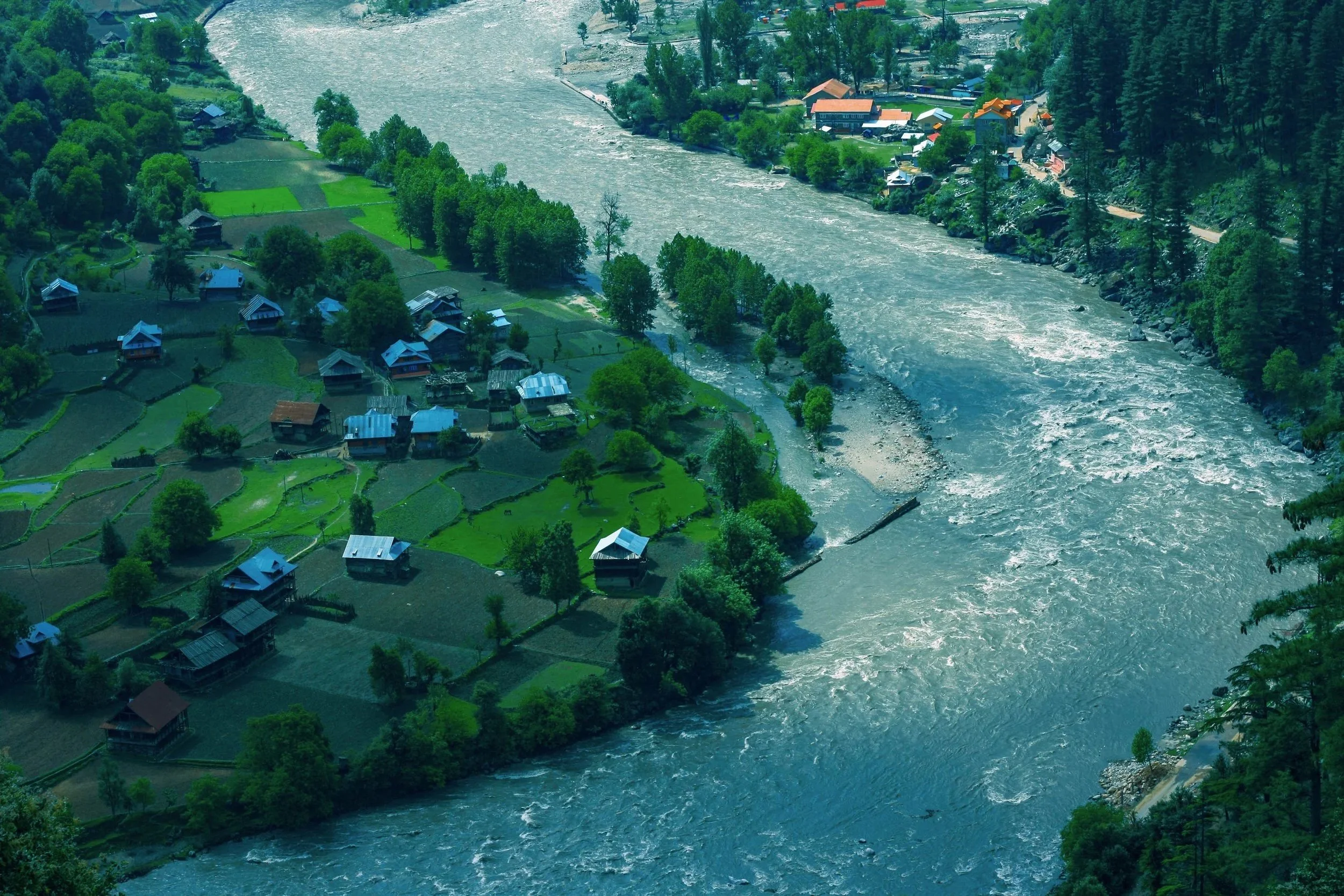
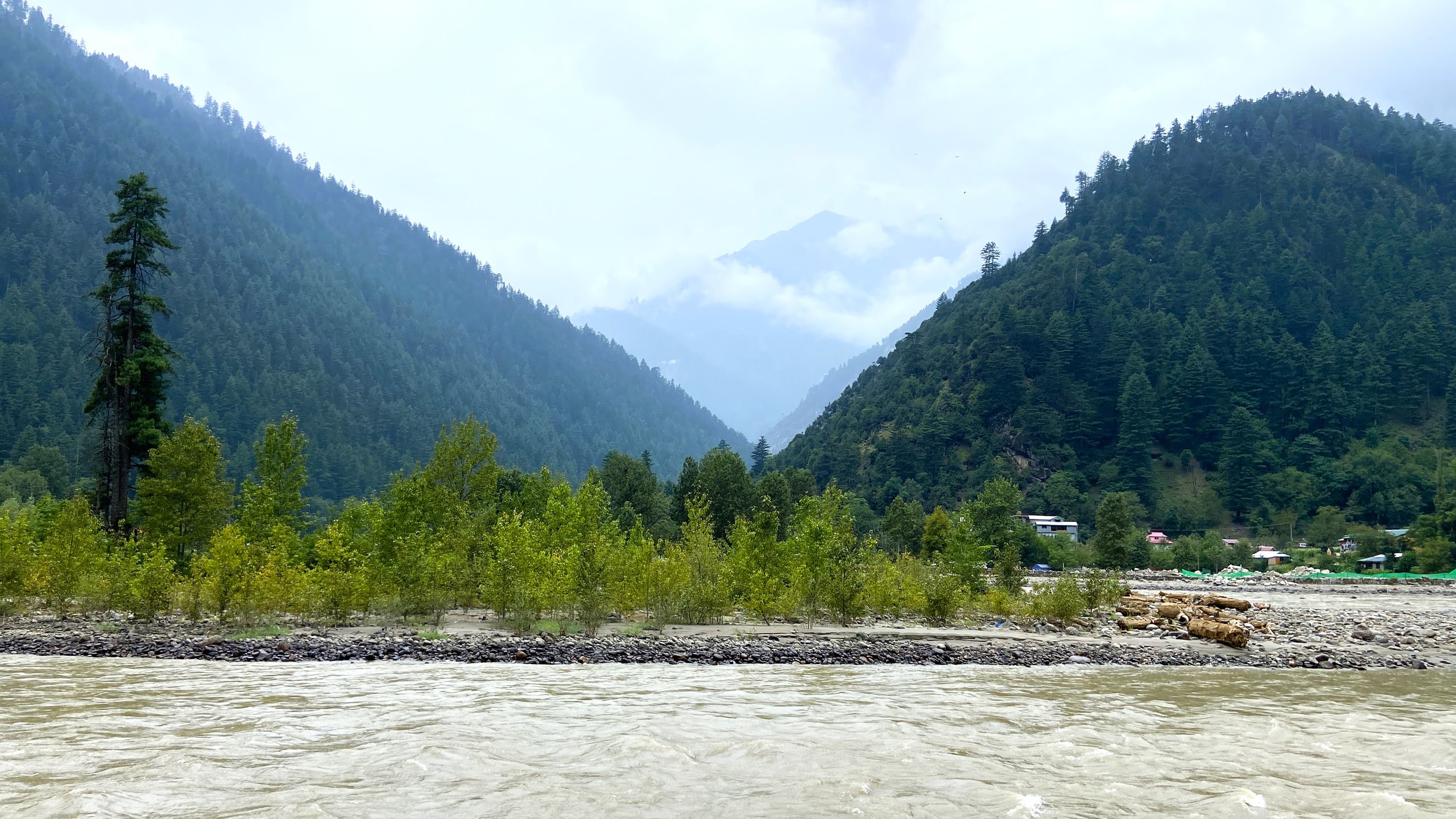
Keran is a Village which lies divided right on the Line of Control with one part in India in the Kupwara District of Jammu and Kashmir and the other part in Pakistan Occupied Kashmir. And the River Kishanganga (called Neelum by the other side) runs through it. Keran is located across the Shamshabari Mountains which one has to cross across the Firkiyan / Firkin / Pharkiyan Gali. At Keran one can view life across the LOC and the Resorts built on th other side of the Line of Control.
Keran : The Village of Keran is said to have been established by Raja Bahadur Khan in the tenth Century. Also located on the banks of the Kishenganaga River, Keran enjoys a majestic view. To reach Keran Valley one has to Pass through the Firkin Gali. It is 37 kilometers towards West from Kupwara. 89 kilometers from Kralpora and 118 kilometers from the state Capital Srinagar. One the way to Keran the other places of interest are Milyal, Raja Ram Mountains, Firkin Village, Kralpora, Trehgam and the Kheerbhawani Temple at Tikker, Kupwara.
From the Firkin Gali a Road link connects it with the Sadhna Top and is known for its mesmerizing and enchanting beauty on both sides of Kashmir. On the way one can witness the lush Green forests, Meadows, Streams and also the Ancient Architecture.


Uri
Uri is a town which is located along the Historic Cart Road along the Jehlum which once connected Srinagar and the Kashmir Valley with Rawalpindi and the Punjab in the Pre Partition Days. However since the Partition came about and following the first Indo Pak War in 1947/48 Uri became the last major Town on the Indian side and the LoC lies beyond Uri.
Uri is now a sprawling and bustling Border Town and with the opening of Tourism spots in and around Uri it stands to attract some Tourists out of the bulk that descends upon Kashmir every year especially in the Summer Months.
The main attraction is the Aman Setu at the Kaman Post, which is a Bridge which connects both sides of the LoC. You can also see the former Indo Pak Border Trade Center at Salamabad which now lies deserted. There are other ares which can be visited around Uri as well.


https://travelthehimalayas.com/kiki/2021/12/14/the-road-to-uri
The Nanga Parbat from the Kashmir Valley

Nanga Parbat from Gulmarg
The Nanga Parbat Massif is the Western anchor of the Great Himalayan Range which stretches from here right upto the Namche Barwa in the East. At 8126 m its also the Ninth Highest Mountain on the Planet and for many Years in the 1800s when Western Explorers first came across this Mountain was considered the highest Mountain in the World. Its local name is Diamer or Deo Mir. One wouldnt blame them due to the sheer perpendiculairty of the Rupal face of the Mountain. The Nanga Parbat Massif consists of a number of different Peaks with the Nanga Parbat being the Highest.

The Peaks of the Nanga Parbat Massif marked
Of course due to the play of History and Politics the Nanga Parbat lies in a part of the former state of Jammu and Kashmir which is under illegal occupation by our Neighbourso we cant really get close to the Peak. But thank God for small mercies that we still have places in the Kashmir Valley from where we can view the "Killer Mountain", named so because of the sheer difficulty it presents to Mountaineers that try and climb this Peak as well as a reference to the great number of People who have lost thier lives while trying to climb this Mountains. Anyways mentioning below a few places in the Kashmir Valley from where one can view the Nanga Parbat.

The Nanga Parbat from the Razdan Pass
First and foremost probably the best view of the complete Massiff is from Gulmarg. Gulmarg is a Meadow in the Pir Panjals at the South Western end of the Valley and the Great Himalayan Range is right across the Valley. Infact technically the Nanga Parbat should be visible from other Meadows in the Pir Panjal. In Gulmarg there is a point called the Nanga Parbat viewpoint. Of course if you move higher to Kongdori or Khilanmarg the view just gets better. Actually even from points below Gulmarg like Kunzer for example you can see the Nanga Parbat on a clear day. Ive even seen an captured the Nanga Parbat while coming down from Tosa Maidan.

The Nanga Parbat on the Horizon while around Gogaldhara
Another point which has great views of the Nanga Parbat is the Zamindar Gali or the Z Gali which connects th rest of the Valley to the Machil area. Actually the Nanga Parbat is visible from all high Points on the Shamshabari Mountains as beyond these Mountains it is by far the most formidable Mountain and dwarfs the entire Geography around. On the Zamindar Gali alos there is a Nanga Parbat view point as well as an observation Tower built for the same.

Hidden in the clouds as seen from the Shamshabari Mountains
Then another place from where you can see the Nanga Parbat is the Razdan Top which connects Kashmir with Gurez. Though only the tip of the Mountain is visible and very few people are aware of the exact point where its visible from. Infact the first time I had gone looking for the Nanga Parbat from the Razdaan Pass I had to use all my Knowledge of Mountain Geography and ofcourse an app helped but still took us sometime to get a view of the Giant. However most peopl who go to Gurez miss this great sight because someone hsto point it out to you otherwise you will just miss it.

A Pic taken from a Flight
Last but not the least you can catch a glimpse of this Giant when your Flight takes off from Srinagar and the day is clear and you know which side to look. Again it just appears for a moment before the Aircraft usually takes a turn towards the opposite direction.

From Gulmarg
Hopefully on your next Trip to Kashmir you would be able to get a Glimpse of this outstanding Mountain.

A Culinary Holiday in Kashmir by Marryam Reshii
A holiday in Kashmir involves much travelling around by car from Srinagar (not only the capital but the base of most visitors), a shikara ride, walking around markets and the Old City – a heritage site in its own right. That’s all very well, but it is convenient to know where you can grab a bite, preferably in the area where you are seeing the sights.
A Great Guide to Eating Around in Srinagar by well known Food Critic Marryam Reshii
You can check out her Website here https://marryamhreshii.com/ And follow her on Instagram @marryam
A holiday in Kashmir involves much travelling around by car from Srinagar (not only the capital but the base of most visitors), a shikara ride, walking around markets and the Old City – a heritage site in its own right. That’s all very well, but it is convenient to know where you can grab a bite, preferably in the area where you are seeing the sights.
From Dalgate to Nehru Park – a distance of approximately 2 kms – is the showpiece road of the city: the Boulevard. One side of the road is lined with hotels and handicraft showrooms; the other side is the Dal, with its unending row of houseboats. This is the nerve-centre of the tourist world and here is where you will find restaurants: Le Delice, Winterfell Café, Stream Restaurant, Lhasa Restaurant, Shamiana Restaurant and many others. Le Delice is the city’s top patisserie, with seating space. All the pastries, donuts and tarts you see in the glassed-in counter are from Le Delice. The sandwiches and snacks on the menu come from the kitchen. The counter and the kitchen are separate entities. Very handy for a cold coffee and an above average quality pastry at down to earth prices. Every hotel on the Boulevard has a restaurant, most of which welcome non-resident guests. You are assured of finding North Indian and a smattering of popular Kashmiri wazwan dishes on the menu.
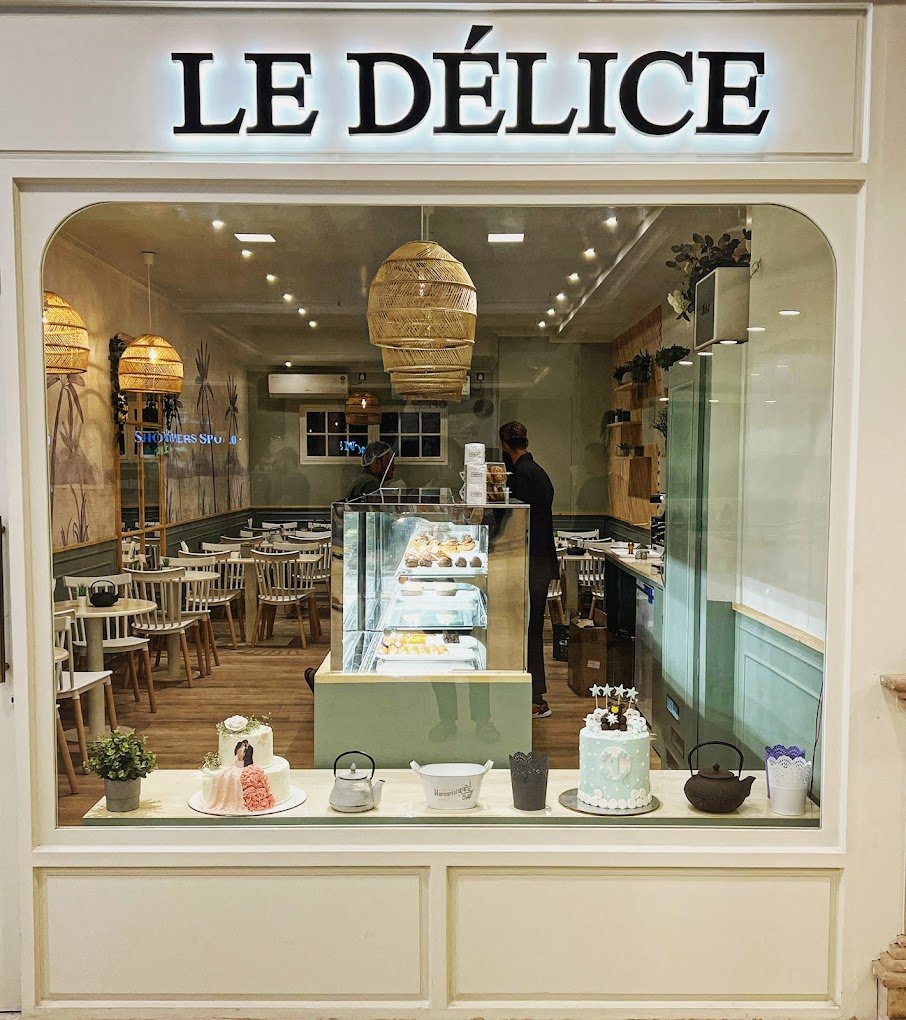
Le Delice at the Boulevard
One iconic Chinese eatery of the 1980s was Lhasa, with its own garden. Of late, it has lost some of its shine, and though it does not overlook the main road, it is both homely and popular. Hotel Imperial Lake View is located at the very end of the Boulevard, opposite Nehru Park and overlooks the largest shikara stand on the Dal, with gorgeous sunset views of the most iconic part of the lake. The food tends to take a backseat, but this is one of the best viewpoints when you want to sit back and drink in the sights.

The inside of the Lhasa Restaurant
At the opposite end of the enchanting Boulevard with its glorious views and endless taxis disgorging excited tourists, is Shamyana Restaurant. You can sit inside the eatery or in the spacious garden. Nearby is Wok to Walk that serves Asian food and is a good spot for people watching because of its floor to ceiling glass walls that affords a picturesque view of the lake and the passers-by.

Shamyana Restaurant at the Boulevad
Other restaurants and cafes in the areas frequented by tourists are located in Dalgate, off Boulevard, and include Jan Bakers, excellent for cookies, tea cakes and chicken patties. There is no seating here. On the M A Road that runs perpendicular to Dalgate is GN Bakery, famous for ginger biscuits, cream buns and savoury biscuits, especially kulchas (Kashmiri shortbread, nothing to do with the kulchas of the plains that are eaten with qorma!) The parallel Residency Road is a cornucopia of restaurants, cafes and bakeries, all unmissable. Tao Café is right opposite the Indian Airlines office (and the polo ground) and is as popular with locals as with tourists. The seekh kebabs here are what sell the most: juicy and with a bite (no toothless nawabs in this part of the country!) Mutton is the favoured meat in Kashmir and in Tao as everywhere else in the city, is what is served. Walk on a bit, under the chinar trees and reach the bustling part of MA Road. Chai Jaai is the most famous tea room around. You can taste salted tea latte here, cream teas, kahwa or even Chinese teas. The snacks are well above the city’s average and being an Instagram-friendly spot, it is always a scuffle to bag a table here.

Dal Gate, Srinagar
Further up the road is the famous Ahdoo’s Hotel, where, on the first floor, you can dine in relative luxury on Kashmiri wazwan. They have a small snacks menu at tea-time when the enormous restaurant is full to capacity with old-time residents of the city. It is the primary choice for locals to host out-of-town friends and for tourists who have the restaurant on the top of their Must Visit list.

Ahdoos Restaurant by Shalini
Downstairs, Crème, part of the hotel, is well-known for pastries and Kashmiri tea-time biscuits. With a tall glass of iced coffee and a pastry, it is a great spot for people-watching. Opposite the road are two unmissable spots for food, both vastly different. Pick and Choose is a supermarket where you can buy selected dishes from the famous wazwan in cans. Great as a memento of your holiday and also as edible gifts. All of them are meat-based. In addition, the Kashmiri spices brand Kanwal has a Kashmiri taste-maker called ver. A spice paste that can be added to cooked dishes like aloo ki sabzi or dal (or meat curry) in the final stage, it will exude the aroma of Kashmiri food at very little outlay (contains garlic). Around the supermarket is a small cul de sac with a strictly local restaurant on the first floor. Called Kareema, it is off the tourist circuit, though right in the heart of the tourist area, and it serves a seven course wazwan. Not a la carte menu: you just grab a seat and the rest works with efficiency and precision. Nobody will ‘walk you through the menu’ because Kashmiri is the language spoken here and the eatery has a slightly rough and ready appeal, but it is very well worth the brusque service.

The Menu from Kareema
From Regal Chowk to the heart of the Old City – the beating heart of Srinagar, situated on both banks of the River Jhelum – is a short ride by auto-rickshaw. Ask to be dropped at Habba Kadal, the second bridge. In the lanes and alleys of the area are a plethora of bread bakers that bake bread in tandoors fastened to the floor. It is one of the most fascinating professions of old and every neighbourhood has several. Breads are made at various times of the day, so any time after 6 am should get you an eyeful. For an outlay of Rs 10, you can buy a tchot or dimpled tchochvoru that has been famously compared to the Jewish bagel. Slathered over with butter, it is a treat that is delightful for its unexpectedness. Needless to say, Habba Kadal is being mentioned here because of its proximity to the hotel district, but bread bakers can be found throughout the Old City. There are two kinds of bakers.

The Janta Bakers at Ali Kadal, Srinagar
Ones who sell cookies and savoury biscuits have brick and mortar stores and can be found in certain places, most prominent being Janta Bakery near Aali Kadal (fifth bridge) and a group of bakeries, some specializing in unique breads not far from the shrine of Shahi Hamadan on the main road at Fateh Kadal. It is on this stretch of road that you will find a couple of famous pakoda sellers. Kashmiri pakodas, collectively called nadru moinj, are a local favourite snack. The rice flour batter makes them crunchy and the fillings are usually sections of lotus stem cut lengthwise and roasted gram. Eaten with spicy, sour onion chutney, this one is messy and spicy. And delicious. Nadru moinj sellers dot the old city, some better-known than others.

The Everest Kitchen, Raj Bagh : Photo Courtesy Parijat Kaul
There are Tibetan-run restaurants in many parts of the city: there is one in Rajbagh called Everest Kitchen, high up on the second floor (good views of the Jhelum River and beyond from the verandah) and Tibetan Momo House in a small cul de sac off Residency Road, next to the State Bank of India, is extremely popular for their soups and noodles. On the other side of the city, enter the historic wall around Hawal (enter through Singeen Darwaza) there is a Tibetan colony that has a dozen tiny eateries, all family run from a room in their homes. Tibetan Kitchen is the best of the lot, but do go around to find your own favourite. Noodles, thukpa, shaphalay and momos are what you can expect here at prices that will not break the bank.

Imran Cafe, Khayyam Chowk
Finally, tujj! It is the name given to the metal skewer on which kebabs are threaded. There are two kinds of kebabs: tikkas and seekh kebabs. They are sold in certain parts of the city. One faces the Dal Lake, a couple of kilometres past Nehru Park and is known as Makkai Point (it used to feature corn on the cob sellers a few decades ago). Full of mobile stalls selling mutton tikkas, the fragrance by the early evening can be discerned even by passing cars. The other place is Khayyam Chowk, at the beginning of the main city. Ignore the dozen or so rough and ready dhabas and head for Imran ‘Café.’ It’s not a café of course, but the smokiest, best marinated tikkas and seekh kebabs anywhere in the city, accompanied by chutneys that used to be well-made in the old days.
Box
Top edible picks
Mutton kanti
Wazwan
Coconut macaroons
Kahwa
Chicken patties
Tchot from a traditional bread bakery
Rajma
Haakh
Trout
Keran : Where a River Runs Through
A Photo Gallery of Keran along the Line of Control in Jammu and Kashmir
A Photo Gallery of the Village of Keran which is divided by the Kishanganga which acts as the Line of Control in this part of Jammu and Kashmir
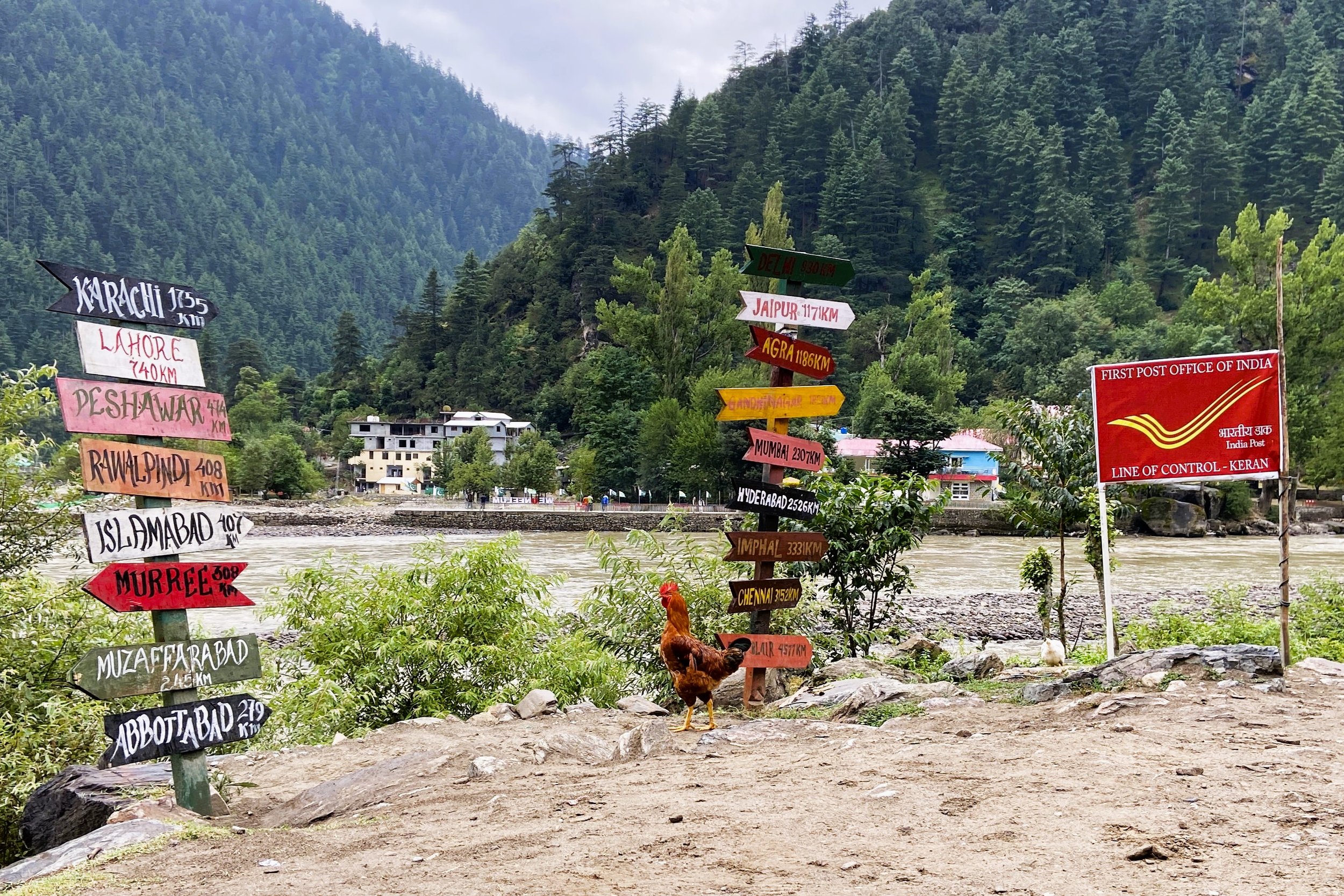
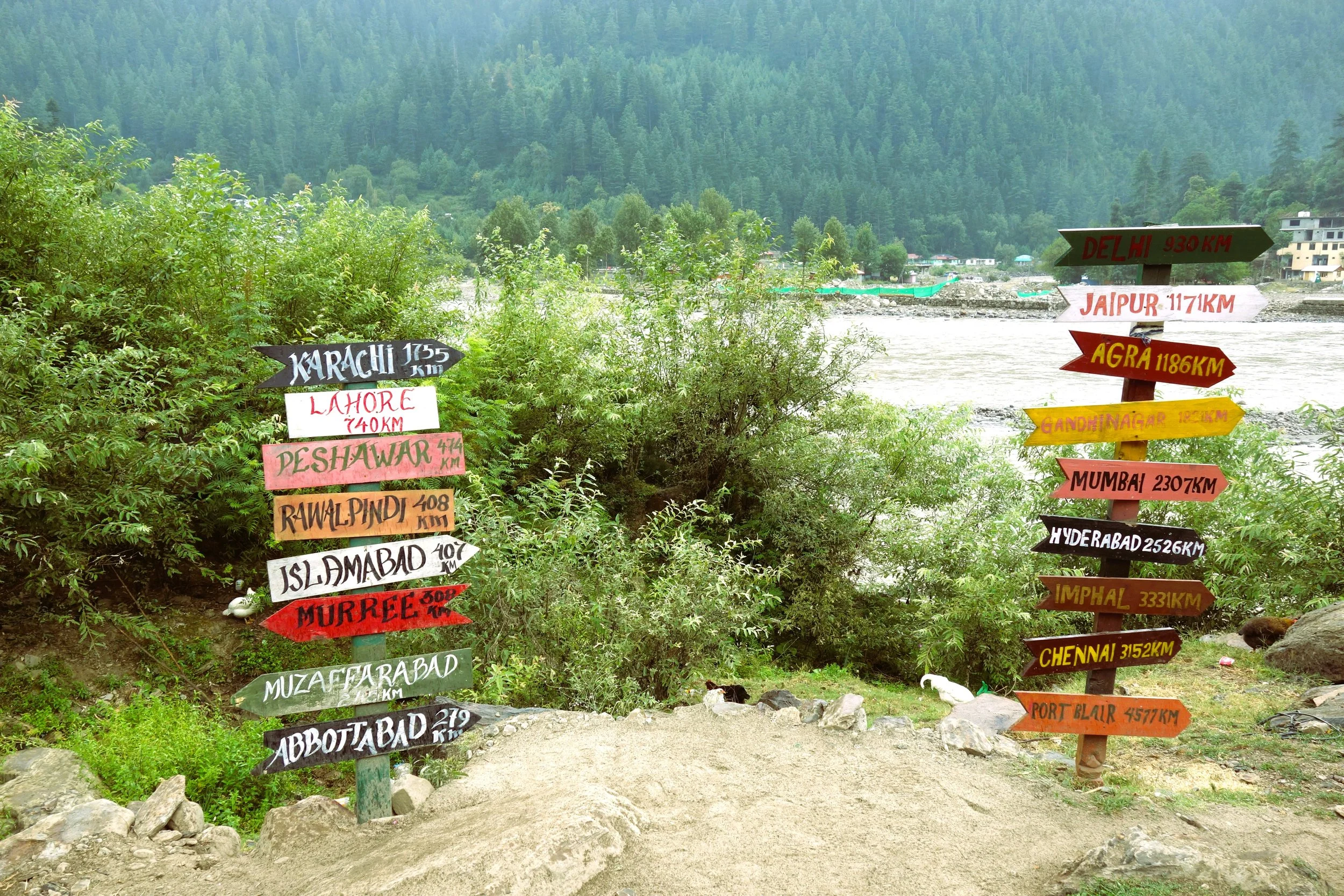
Signages in Keran on the banks of the Kishanganga which is called Neelum by our Neighbours.

The beautiful Kishanganga aka Neelum River at Keran
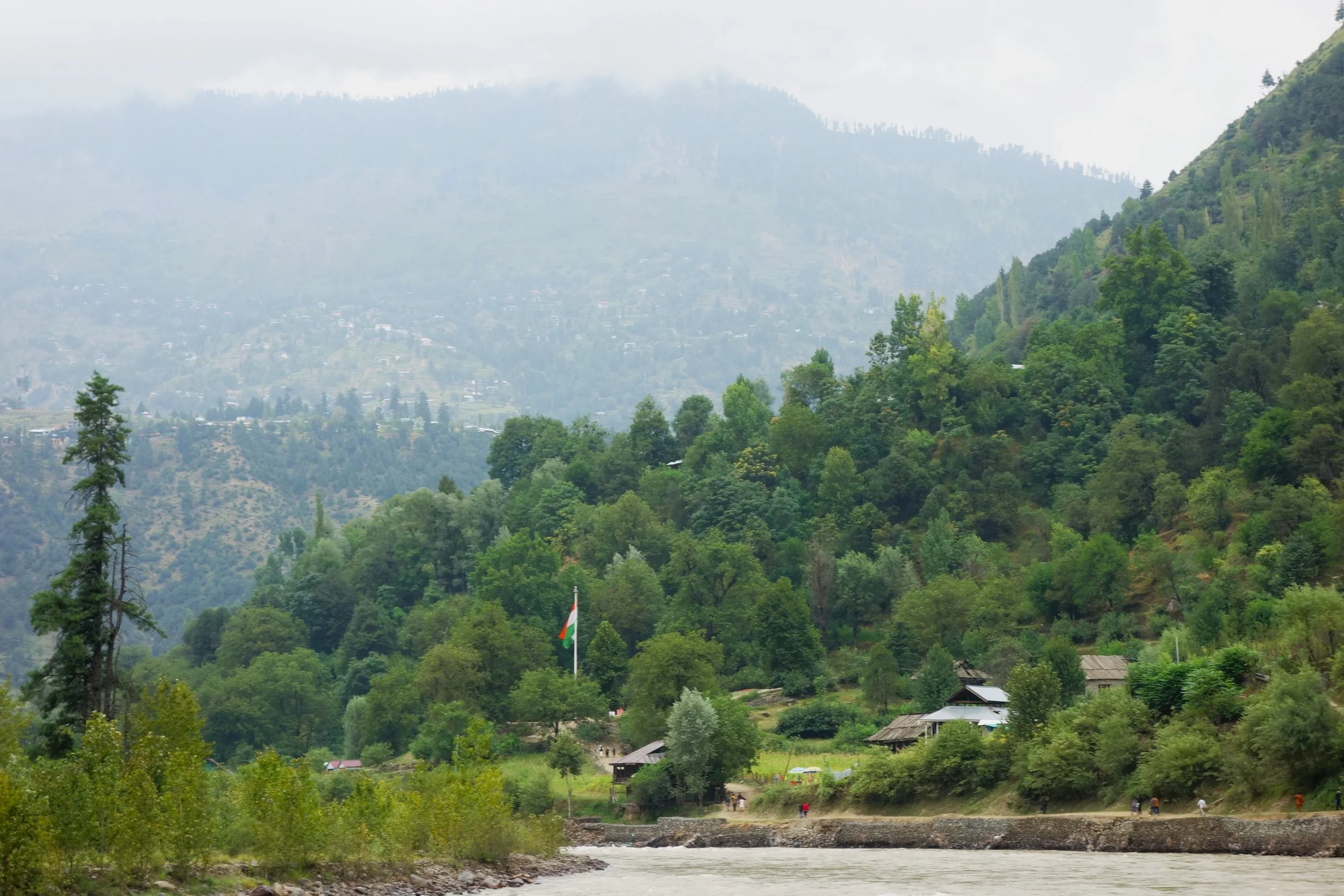
The Indian Flag flies high on the Indian side in Keran
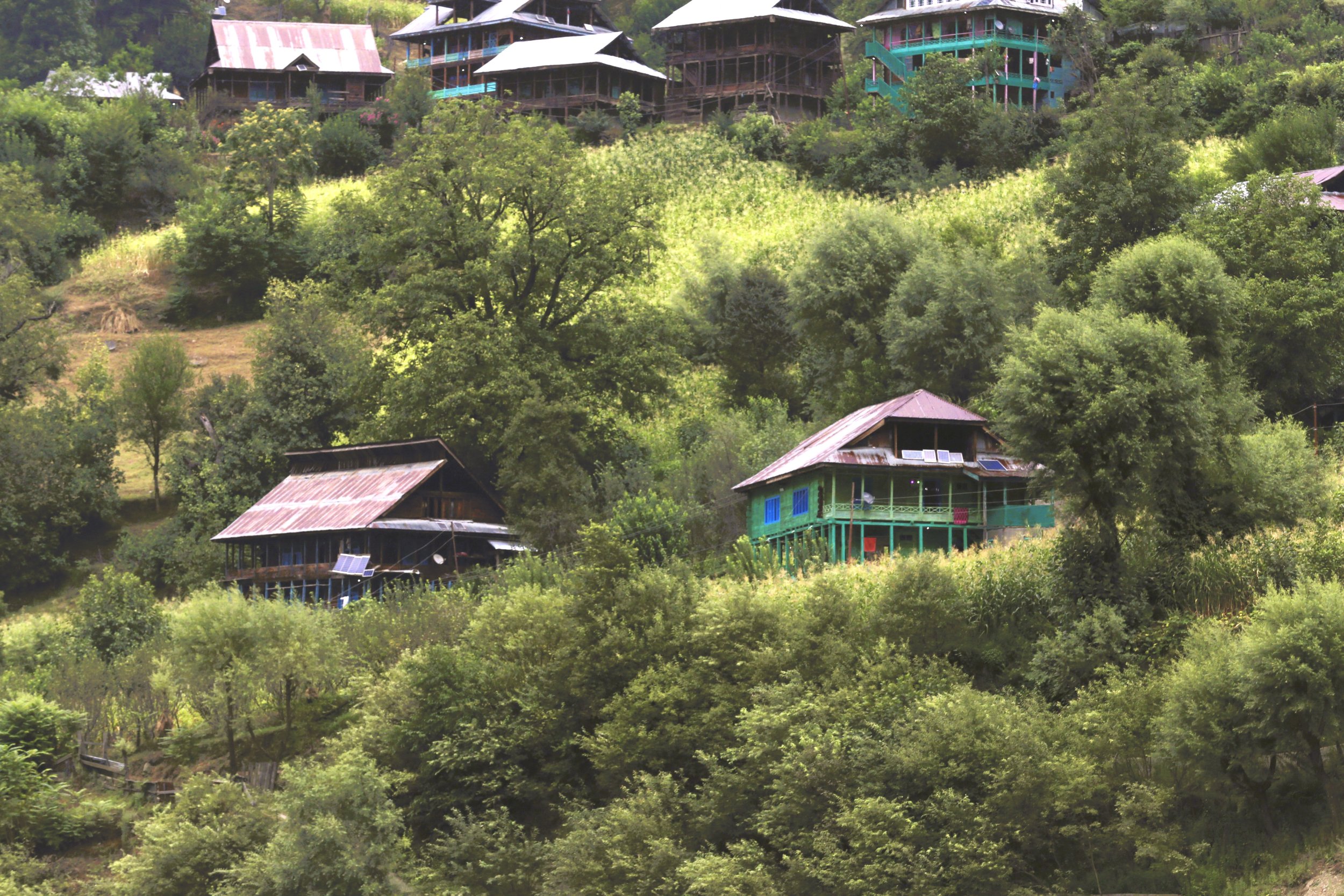
Village Houses in Keran
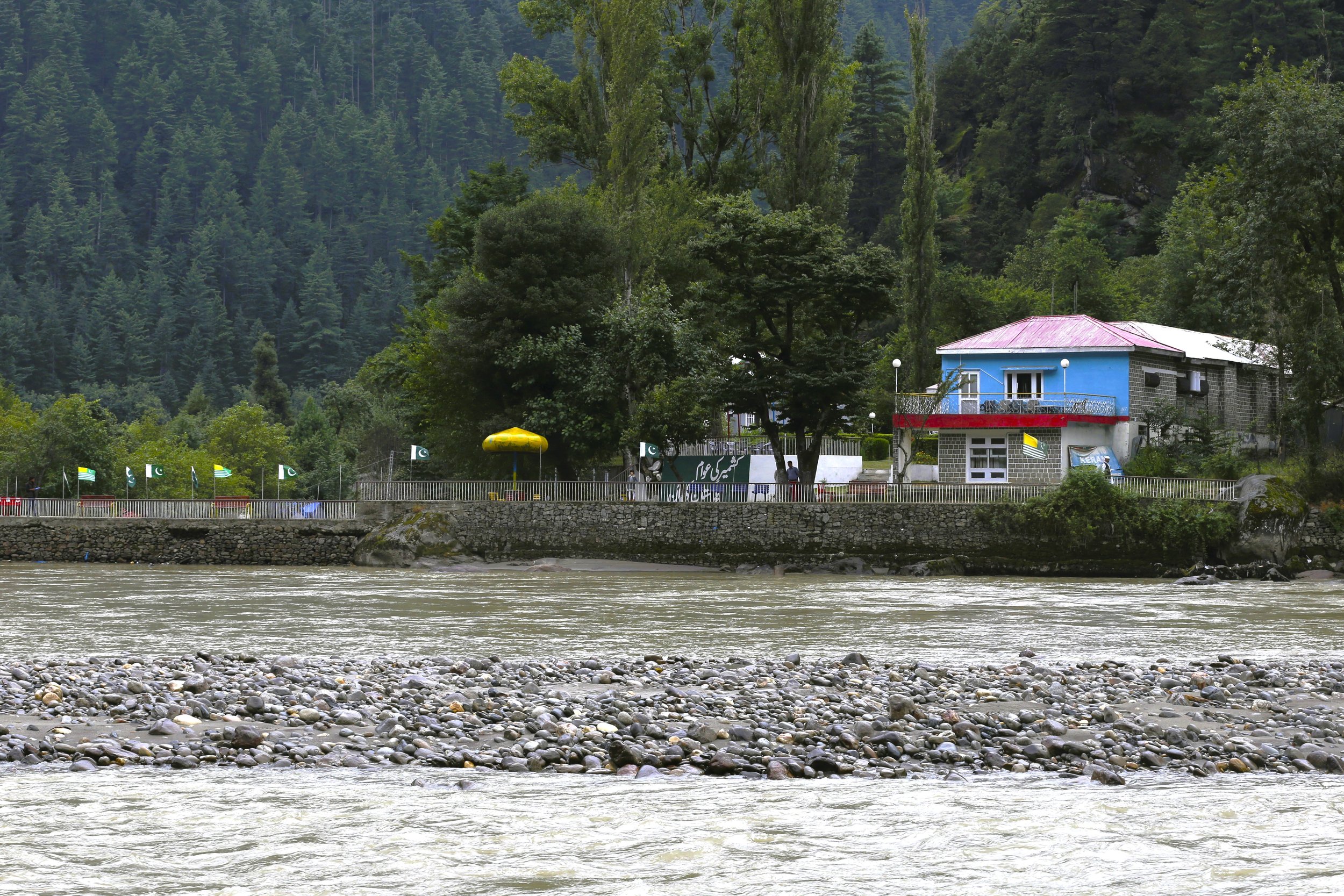


We Love Neelum signs on the other side of the Kishanganga in the so called Neelum Valley in Keran
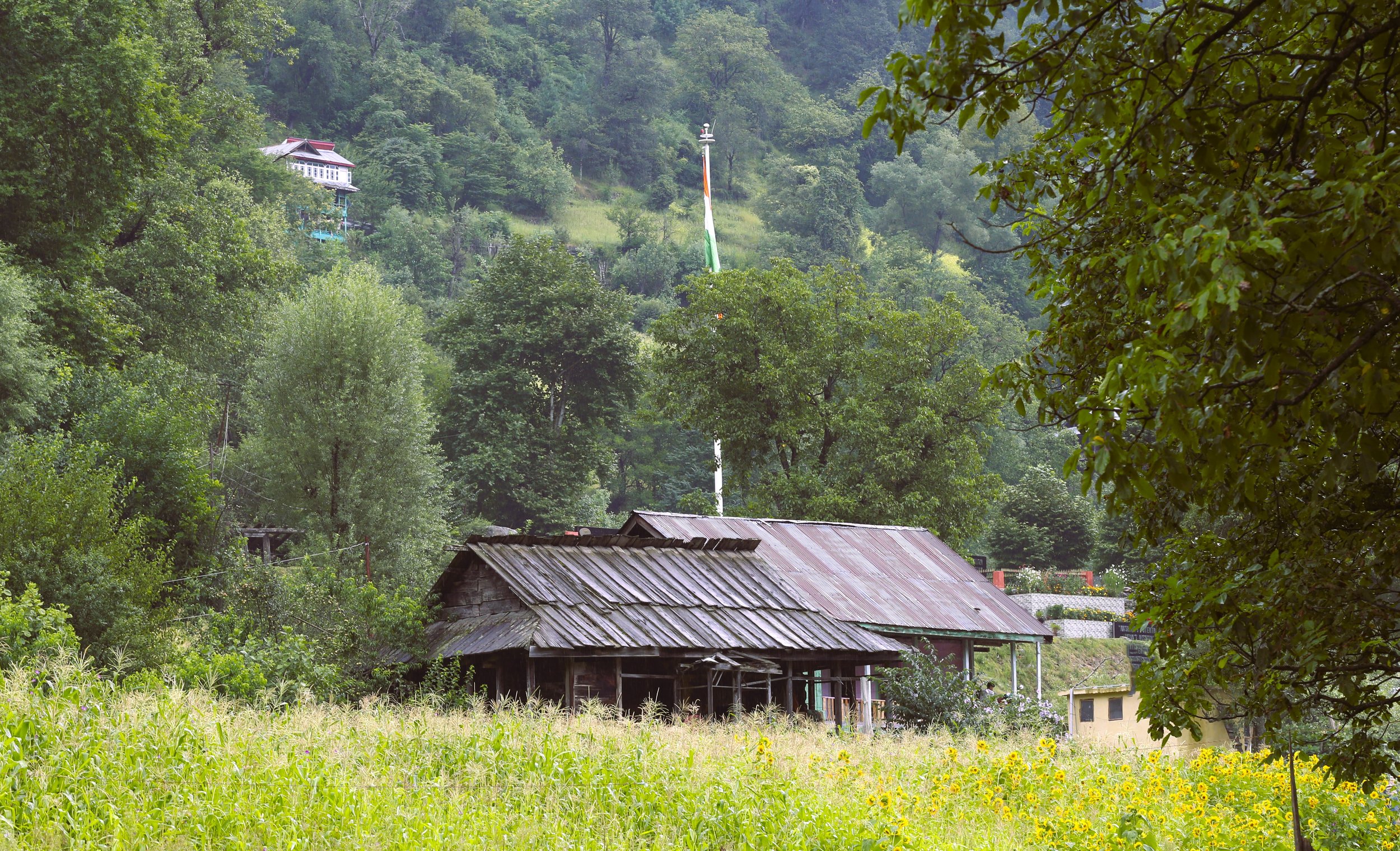
An abandoned House in the Keran Village
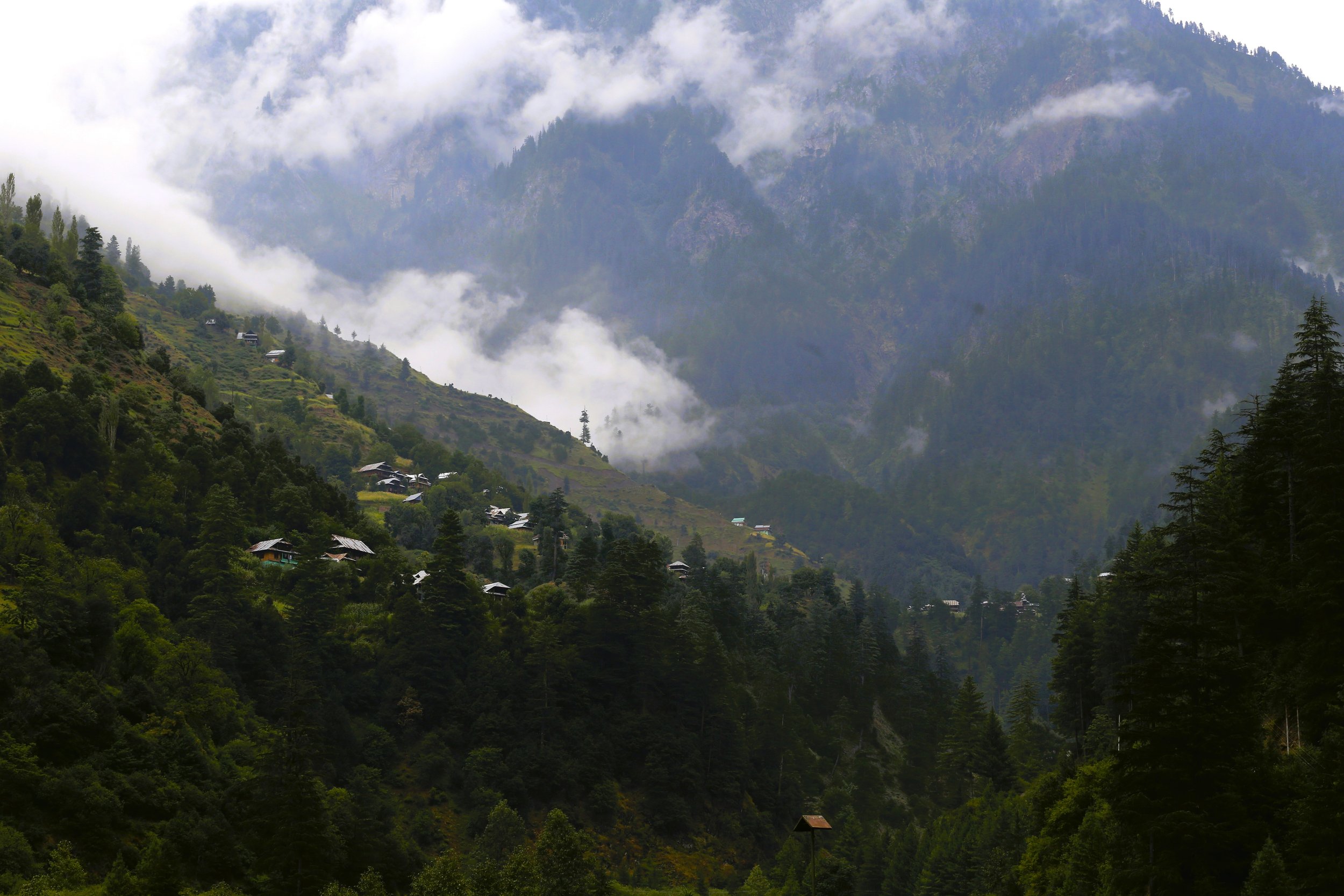
Another view of a Village in Keran

Another view of the Kishanganga aka the Neelum River in Keran

Ten Offbeat Things to Do in Ladakh
Most People while visiting Ladakh just visit the same old Places, popular Tourist places and ones popularized by Bollywood and Influencers on Social Media. As a result a few Places bear the brunt of the Tourist footfalls which has serious Environmental and Social Impact.
I have always subscribed to the Philosophy that instead of sending 100 people to 5 places send 20 people to 25 places. Ecologically viable Tourism starts by spreading the load of the Tourists. And here is a list of Ten Things that I would recommend to do in Ladakh. And please remember that Ladakh is a large Region and most of it is rather unknown for most people. Ive added a Note on the Mountain Geography of Ladakh for easier understanding. You can also read my Ladakh Travel Guide for General Information.
So I have compiled a list of Ten Things that I would do in Ladakh, keeping in view all my Visits and Readings on Ladakh. They are in no particular order and each One is a Unique experience in its own.

Most People while visiting Ladakh just visit the same old Places, popular Tourist places and ones popularized by Bollywood and Influencers on Social Media. As a result a few Places bear the brunt of the Tourist footfalls which has serious Environmental and Social Impact.
I have always subscribed to the Philosophy that instead of sending 100 people to 5 places send 20 people to 25 places. Ecologically viable Tourism starts by spreading the load of the Tourists. And here is a list of Ten Things that I would recommend to do in Ladakh. And please remember that Ladakh is a large Region and most of it is rather unknown for most people. Ive added a Note on the Mountain Geography of Ladakh for easier understanding. You can also read my Ladakh Travel Guide for General Information.
So I have compiled a list of Ten Things that I would do in Ladakh, keeping in view all my Visits and Readings on Ladakh. They are in no particular order and each One is a Unique experience in its own.
1. Explore the Basgo Monastery and Fort :
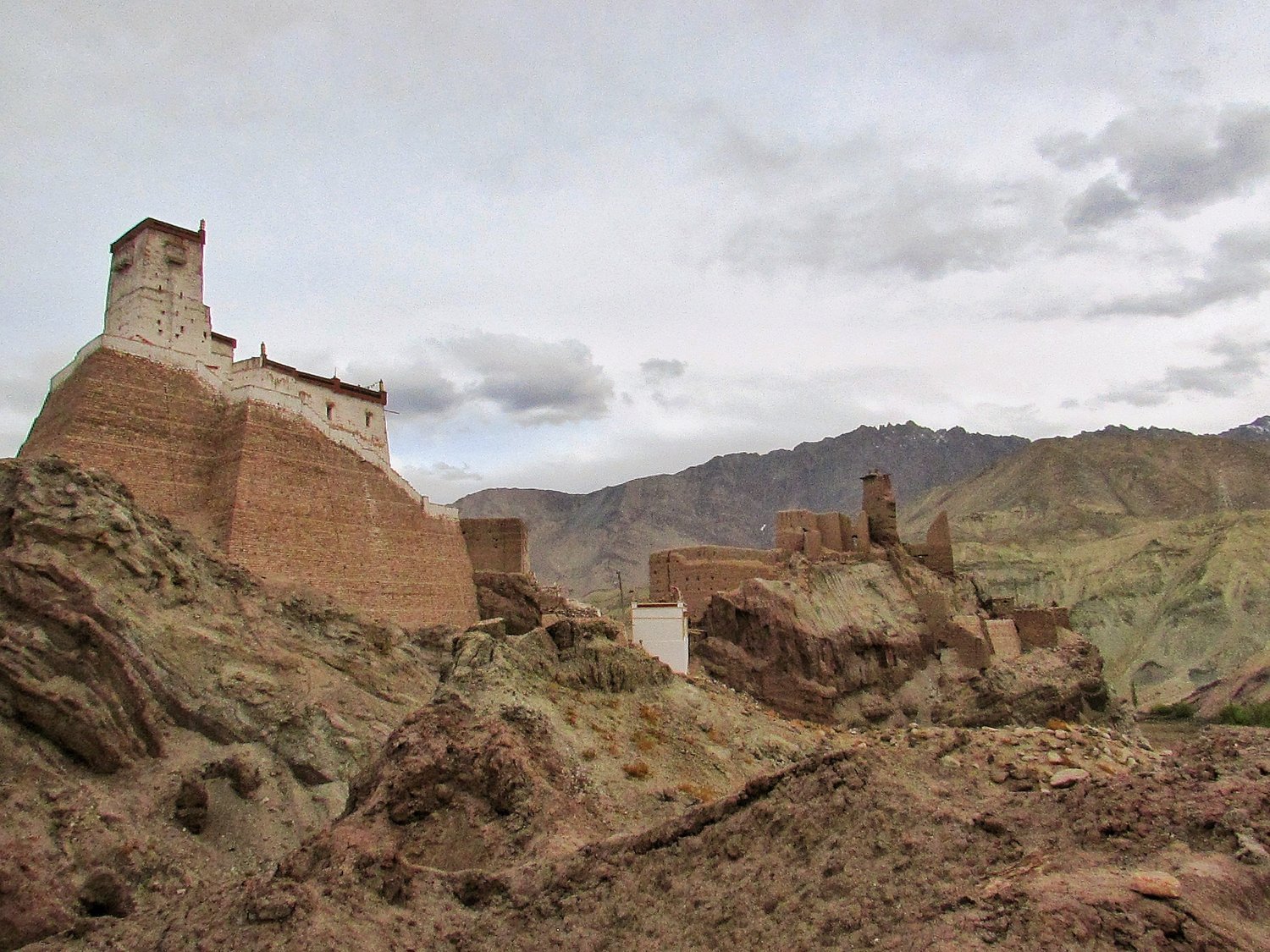
Basgo located some distance away from Leh was once the Capital of Ladakh and still the site of an impressive Monastery and a Fort. It was on the Plains outside that the Battle of Basgo was fought.
It was the Tibetans and their Mongol allies vs the Ladakhis and their Mughal allies. During the build up to the Battle the Mughal force crossed the Indus over two wooden bridges at Khalaste and marched towards Basgo. The two armies met at a plain called Jargyal between Basgo and Nimmu. This is referred to as the Battle of Basgo fought in 1679.
And the battle hardened Mughals along with their Ladakhi and Kullu allies proved too strong for the Tibeto-Mongols and their Bushahri allies. The Tibeto-Mongols were pushed back and routed all the way to Spituk where after a brief lull the fighting erupted again until they were driven beyond the Pangong Lake to a place called Tashigang.
They built themselves a Fort and shut themselves in and the Mughal Army now turned back, confident that the Tibeto-Mongols were gone for good. But of course Mongols being Mongols, they were wrong, but more of that later.
Read More about the Battle of Basgo
2. Gaze at the Stars at the Astrohub : A Great New Stargazing Experience in near Leh
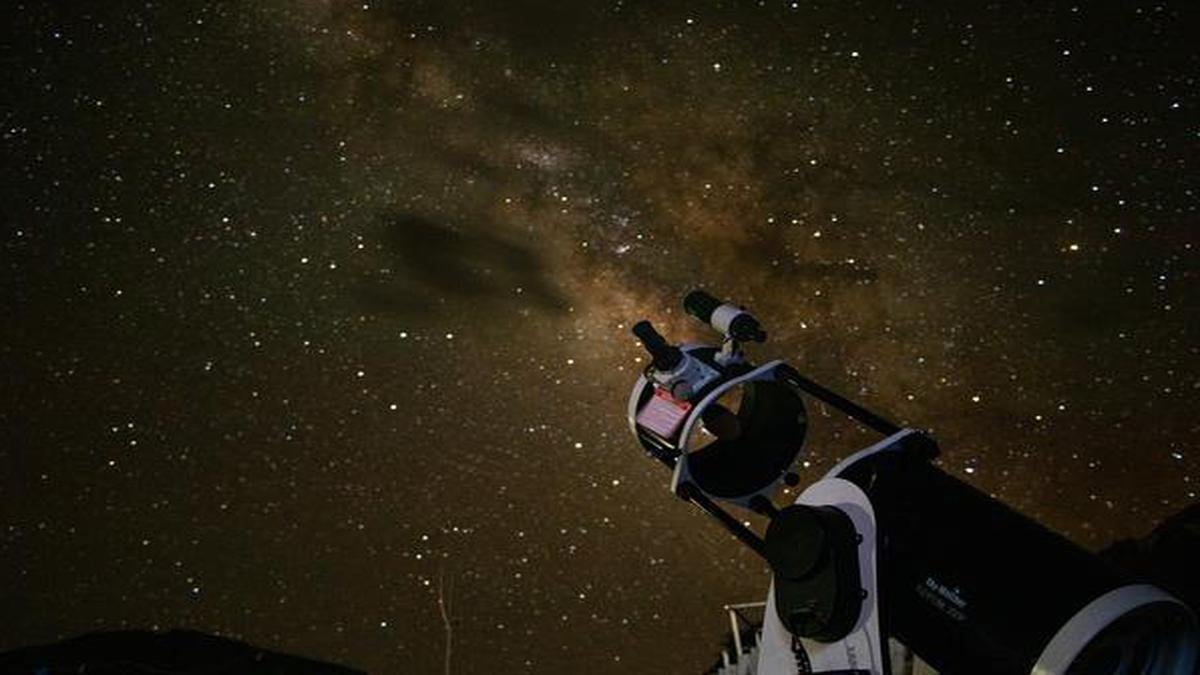
Introducing the Cosmohub in Phyang around 30 kms from Leh. An Initiative totally handled by the Local Village Ladies.
The Cosmohub has a Telescope which enables you to gaze even further into Space in the already very clear Ladakh skies.
Cosmohub- A New Stargazing experience near Leh. This women-led Astro-tourism initiative offers stargazing through a Telescope along with local folklore about skies narrated by trained local women.
You also get to Experience local Cuisine and Handicrafts prepared by a local self help group of women in addition to a guided tour of the nearby Monastery.
3. Visit the abandoned Village of Old Hundarman :
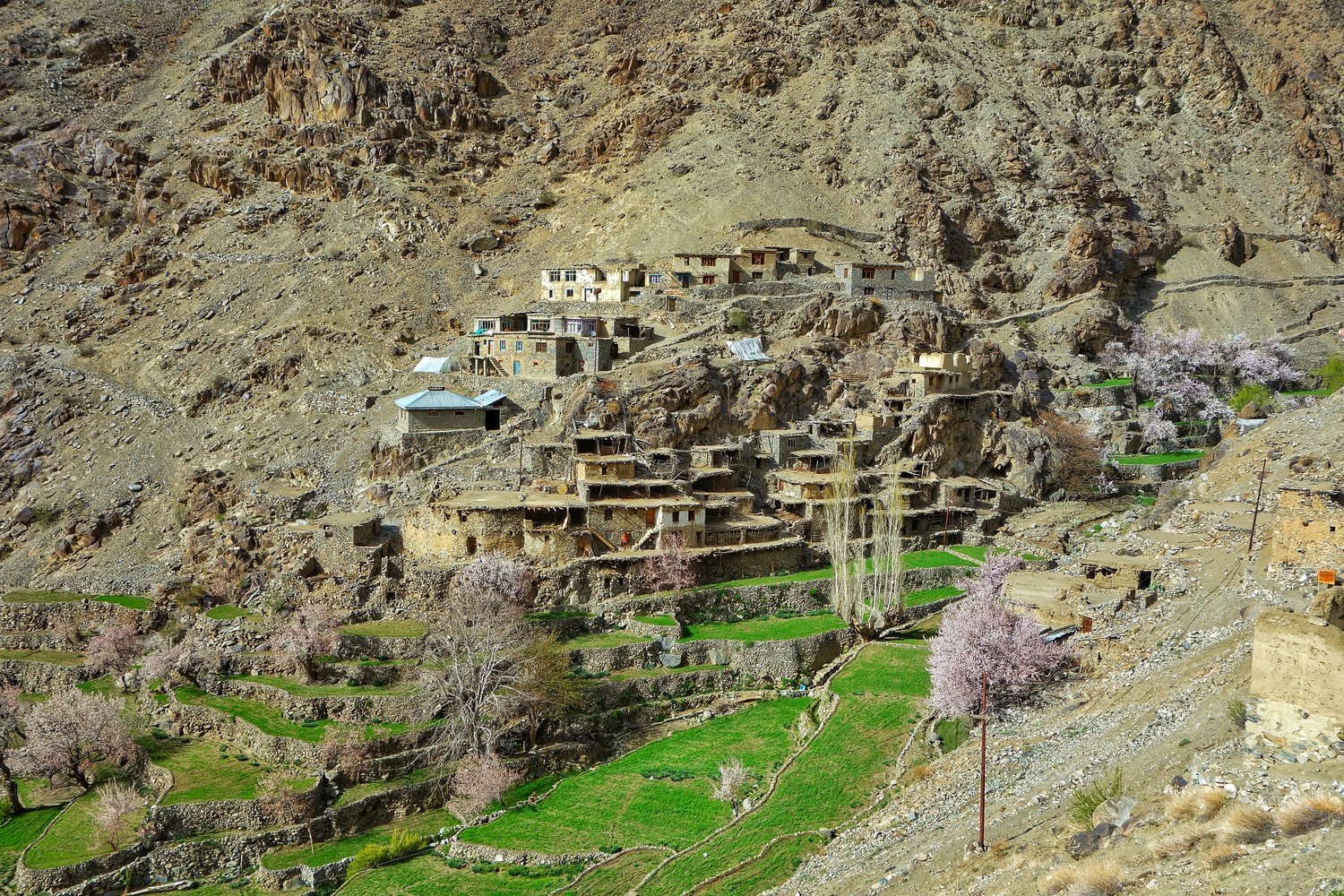
Ladakh offers many gems set in the Trans Himalayan landscape.
One such place while travelling to Ladakh is the Village called Hundarman near Kargil. Set in a sharp mountain gully 11km from Kargil, the tumbledown ghost village of Hundarman is a remarkable sight.
Rocky crags tower above, a steeply raked arc of stone-walled terraces sits below and virtually all of the low-ceilinged homes are stacked on top of one another, forming a fascinating core that has been (somewhat) preserved as a unique time capsule. And there is a neat little Museum in one of the abandoned Homes with antiquities found in these abandoned Houses.
This Village was till 1971 under Pakistani control but came under Indian Control after the 1971 War. And the fact that there are Warning Signs about Land Mines on both sides of the Road leading to Hundarman is a testament to the turmoil this Region has seen.
Yes you will hear the same Story about another place on this List.
4. Watch the Karakorams from the Khardung La :

Yes Khardung La is famous as one of the Highest Passes in the World but what most people dont know is that one gets a great view of the mighty Karakoram Range while looking North standing atop the Khardung La.
And now for some fun facts on the Karakorams in India. The Karakorams is a Mountain Range and like all Great Mountain Ranges it has a number of sub Ranges. And it has been classified into Nine Sub Ranges and out of these 3 lie fully on the Indian side and a 4th lies partly on the Indian side.
The Sasser Muztagh is the southernmost sub Range of the main Range and lies between the bend of the Shyok when it changes direction and heads in a Northern direction. The Shyok rises in the Rimo Muztagh which lies above the Sasser Muztagh.
The same trend is shown by the Nubra which also joins the Shyok and its at this point the Baltoro Sub Range starts which is partly on the Indian side. So the Sasser and the Baltoro Ranges are divided by the Nubra which rises in the Siachen Glacier. The Sasser La runs roughly between the Sasser Muztagh and the Rimo Muztagh. And in the extreme North along the Siachen Glacier runs the Siachen Muztagh.
Read More about the Karakorams in Ladakh
5. Visit the Donkey Sanctuary in Leh :

You must have seen a lot of Donkeys roaming around in the Streets of Leh. They are used as beasts of Burden in these rugged Mountains and many of them are unfortunately abandoned one they are older or are injured.
Sonam Dorje runs a Donkey Sanctuary on the outskirts of Leh where these unwanted Donkeys are taken care of. Its a Happy Place for these unwanted Donkeys where they can just do their Donkey things and get Food to eat and even basic Medical facilities.
The Donkey Sanctuary runs solely on Donations so its a good idea to visit the places, spend some time with the Donkey Bros and give whatever you can for the Welfare of these Donkeys.
Read More about the Donkey Sanctuary in Ladakh
6. Visit the Munshi Aziz Bhat Museum / Central Asian Museum :
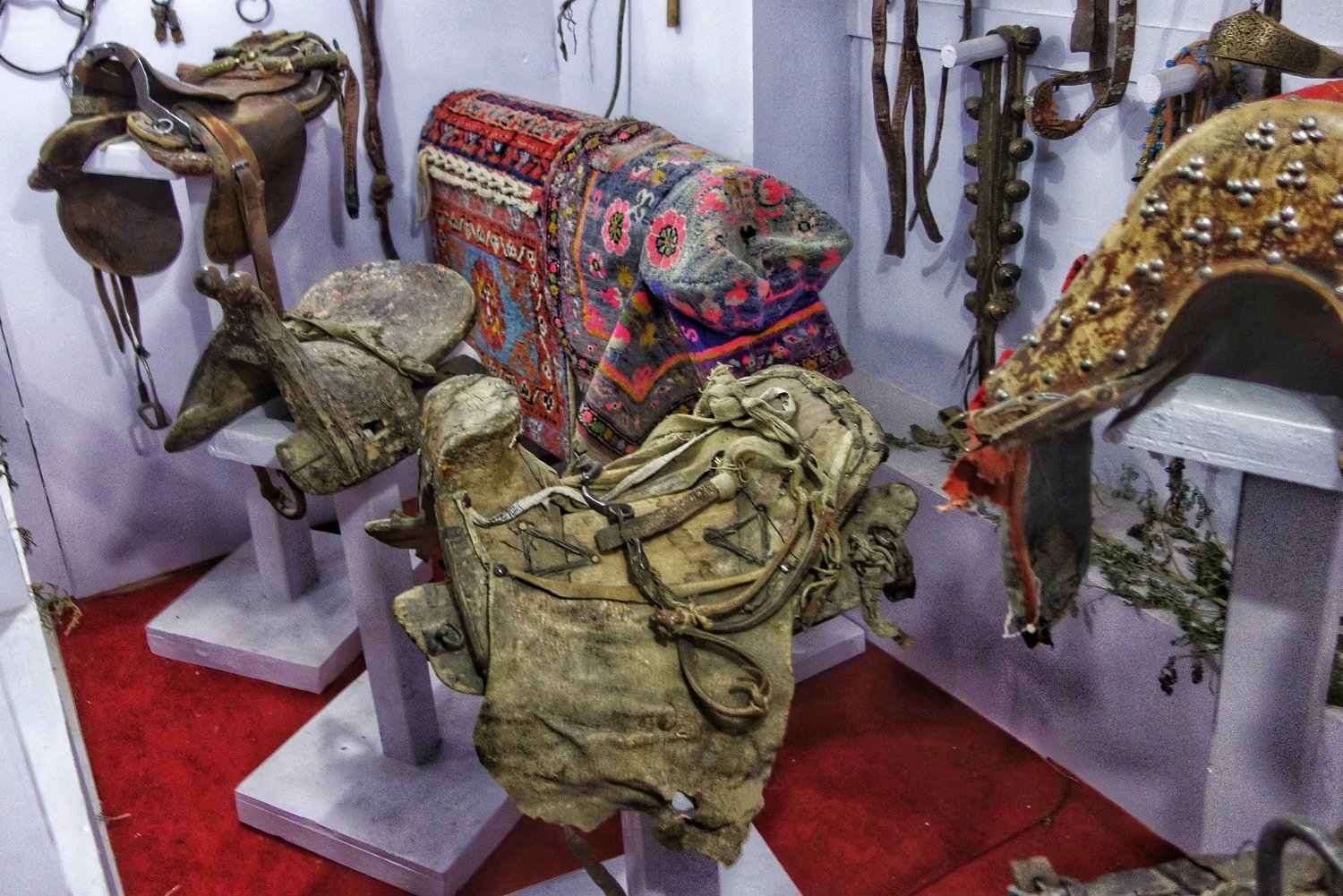
Munshi Aziz Bhat was a trader also on the Central Asian trade Route and owned a number of shops in Kargil and his trading company was called Munshi Aziz Bhat and Sons. He set up a Serai, the Kargil Serai in 1920 to offer boarding lodging and storage places to the Traders. Soon the Serai became a stopover place for all kinds of traders from all kinds of places in Kargil. The Kargil Serai also served as a kind of an unofficial Post Office which received a lot of mail especially from the Hoshiarpuri Punjabi traders. The Serai had in its front a couple of shops as well which the Traders could use to display their wares. The Serai was a busy one in the late 1800s as well as the early 1900s and it saw many traders come and go.
It was a chance discovery in the beginning of this century that some workers were sent to the place to clear some mess as parts of the structure had collapsed. The workers unearthed some very interesting items and reported these to the owners. The Owners then decided to come and check for themselves and they unearthed what can only be called a priceless treasure in the form of various items related to the Central Asian trade and items from all over Central Asia, the Indian subcontinent, Tibet and even Europe. As luck would have it a visiting historian persuaded the family to preserve this price-less collection instead of it ending up in some antique shops. And so was set up the Aziz Bhat Museum of Central Asian and Kargil Trade Artefacts to display the Collection.
The range of artefacts unearthed from the Munshi Aziz Bhat Sarai has given invaluable insights into not only the forgotten trade history but also into the cross-cultural, cosmopolitan past of Kargil. These artefacts aren’t mere antiques but they are a testimony to the fact that Kargil was a melting pot of cultures, languages, lifestyles and ideas. They are now on display in a part of the Munshi family’s house that has now been converted into the Museum.
Read More about the Munshi Aziz Bhat Museum
7. Panikhar and watch the Twin Peaks Nun and Kun :

Have you ever wondered what it feels to stand at the foot of the Greatest Mountain Range on the Planet, the Great Himalayan Range itself and stare at a 7000 Meter plus feet Mountain ?
The sheer grandeur of the Great Himalayan Range on one side and the Zanskar Range on the other side can be experienced in the Suru Valley. You can watch in awe the Twin Peaks of Nun and Kun which are a part of the Great Himalayan Range and tower above the Suru Valley and from places like Panikhar and Parkachik you get a superb view of these Giants.
Read More about the Suru Valley
8. Visit the Alchi Monastery :

Out of all the beautiful Monasteries in Ladakh the Alchi Monastery is probably the most fascinating one because of its Paintings and Murals said to have been done by Artists who came from Kashmir and they have a certain Kashmiri touch to them.
As per a leading researcher on Himalayan and Tibetan Art : “The world-famous Buddhist monastery of Alchi in Ladakh, India, is the best-preserved temple complex in the Himalayas. Proposed for inclusion in the UNESCO World Cultural Heritage list in 1998, the monastery's artworks reveal influences from India and Tibet across Central Asia and Iran, even as far back as Ancient Greece. Housing thousands of rare paintings and sculptures from the area dating back to the eleventh century, it provides fascinating insight into the spiritual and secular life of mediaeval Kashmir and Western Tibet.
9. Pay a Visit to Baltistan :

The neighbouring Region of Ladakh to the West is Baltistan Region. The people share almost the same Ethnicity as the people of Ladakh but over the centuries their Culture has changed and Religion is mostly Islam. The language of the Baltis is still quite similar to Ladakhi and is actually the closest language to the Old Tibetan language.
At the time of Partition almost the whole of Baltistan was occupied by Pakistan with its main City of Skardu. However over the Years in subsequent Conflicts the Indians managed to get back a little part of Baltistan and nowadays one of these Villages, Turtuk has become quite a Tourist destination.
Visit Turtuk to get a taste of Balti Culture and besides Turtuk there are a number of other Villages where you can see Balti People and Experience Balti Culture. You can now even visit the Northernmost Village of Thang which is located right on the Line of Control.
Read More about Ladakh and Baltistan
10. Drive from Pangong Tso to Tso Moriri over the Changthang :
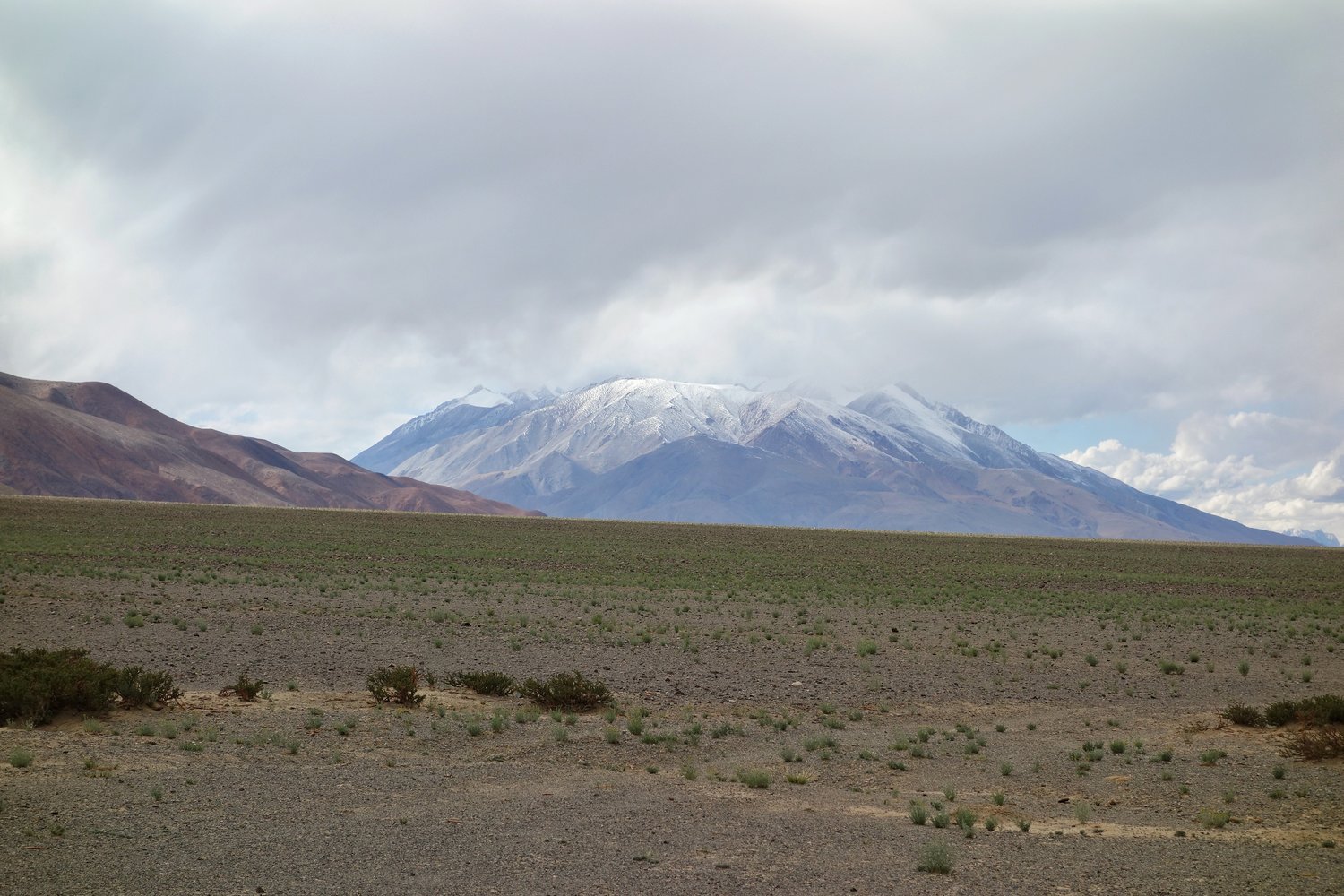
Of all the drives one can do in Ladakh the most fascinating for me is the one of going over the Changthang while driving from the Pangong Lake to the Tso Moriri Lake. The Changthang is a vast High Altitude Plateau that stretches over thousands of kms and includes parts of Tibet as well as Ladakh and goes all the way to Xinjiang.
It is an extremely inhospitable place but at the same time its beauty is quite unparalleled. Its dotted with certain Wetlands and on this stretch the Indus River enters Ladakh from the Tibetan side. The Changthang is largely uninhabited except for the hardy Changpa Nomads who raise their flocks of the famous Pashmina Goats on this Plateau.
Read More about the Changthang
Addendum : A Note on Understanding the Geography of Ladakh
The Mountain Geography of Ladakh
The Elusive Kaobal Gali
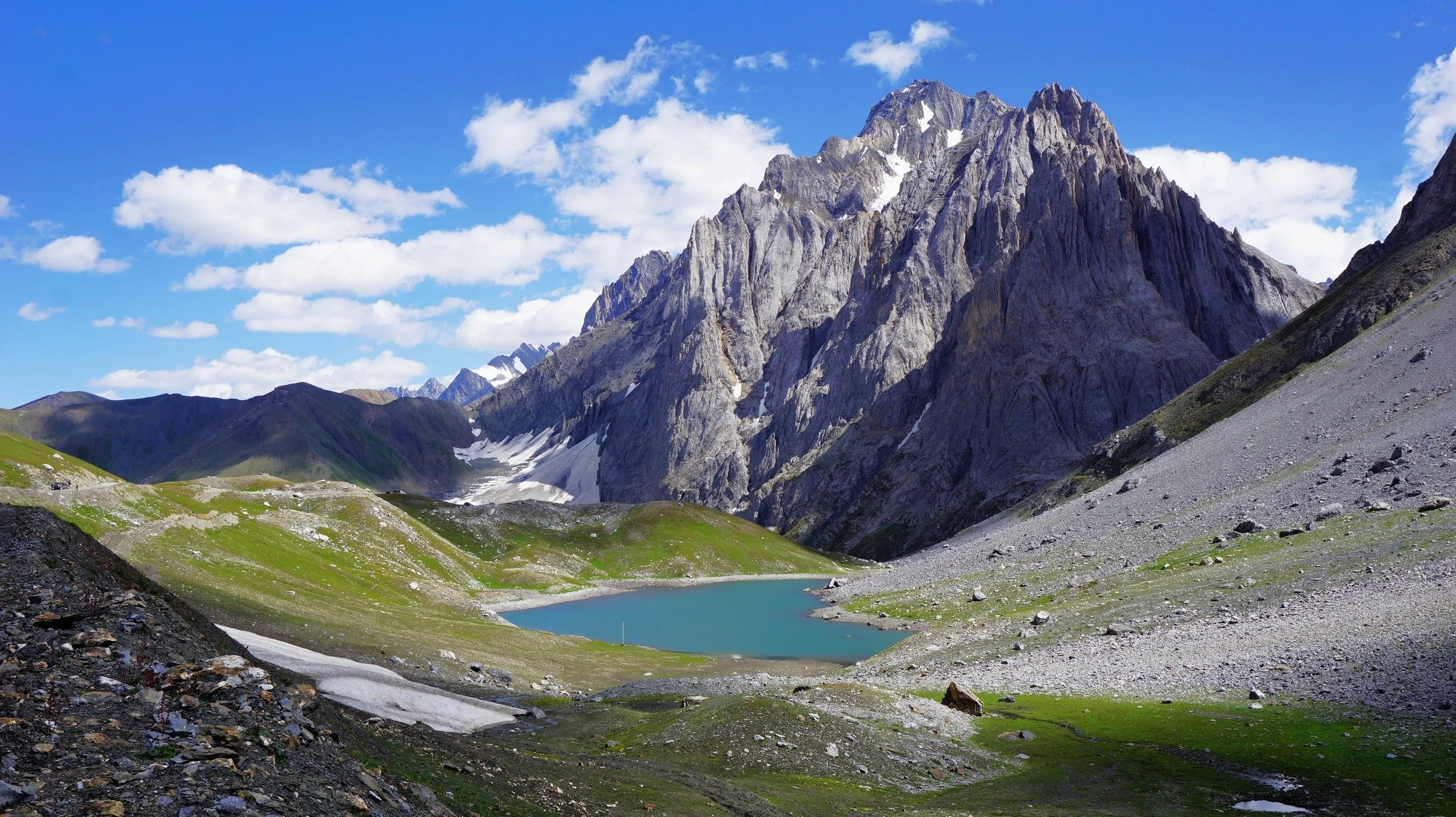
The Kaobal Gali stands at an Elevation of 4167 metres (app 13600 ft) on the main Great Himalayan Range has traditionally connected the Tulail and Gurez Valleys with the Mushkoh Valley in the Drass Region. Interestingly people on both sides of the Pass are Shina and speak Shina language just like their fellow Dardic Shina people in Gilgit. This is a peculiarity as usually when you cross a Pass on the Great Himalayan Range the Culture Language and People change.
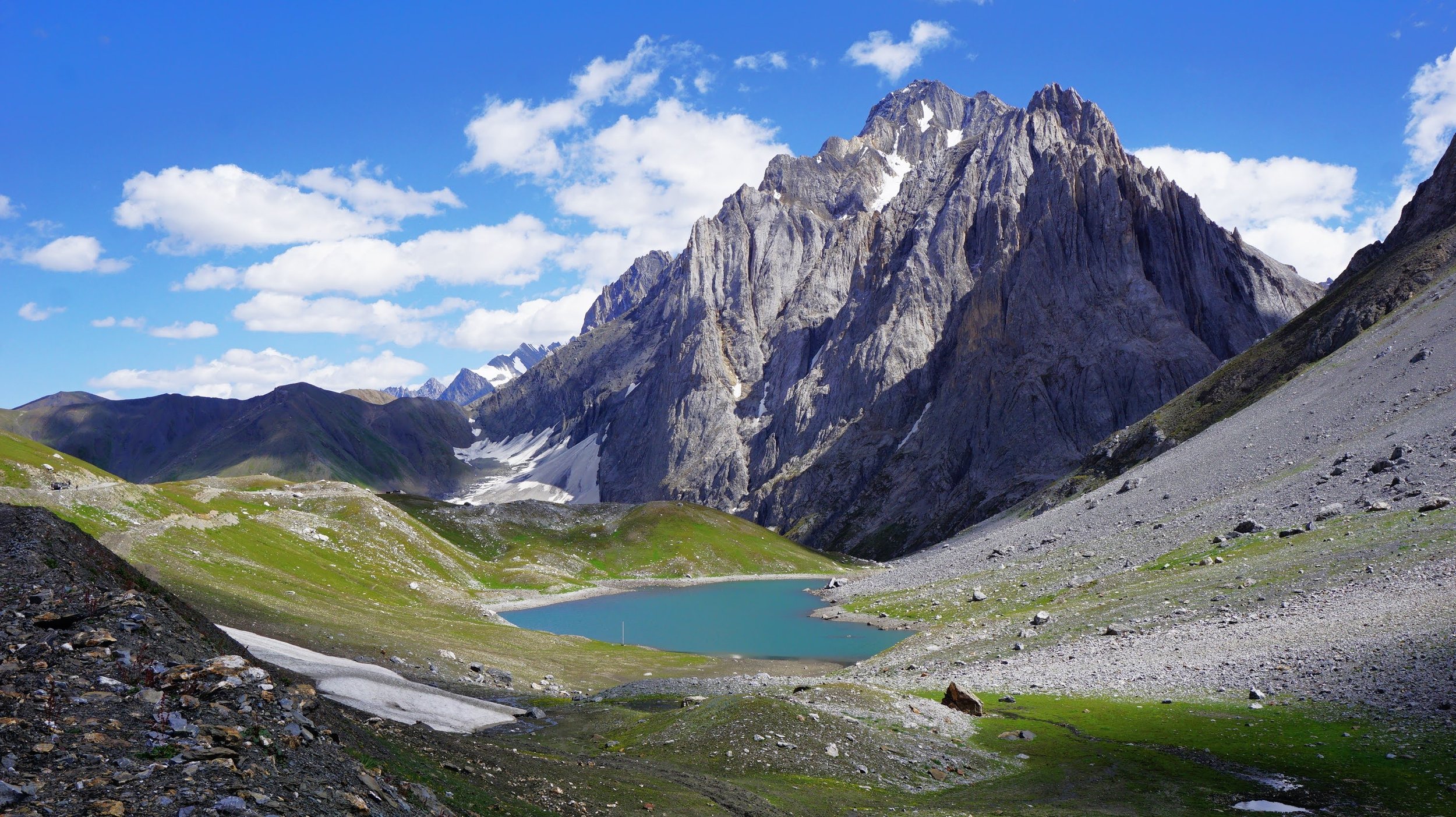
The Kaobal Gali with the Kaobal Sar or Draupadi Kund at its foot
The Great Himalayan Range is a formidable barrier with its monumental Mountains but Humans for centuries have endured to cross this Range to go beyond this Range into Ladakh and Tibet and beyond into Central Asia.
In the Western Himalayas there were a series of Passes which were used the cross this Great Mountain barrier with the main ones starting from the East were the Parang La which connected Ladakh with Spiti, the Baralacha La which connected Lahaul with Ladakh, the Sinku La which connected Lahaul with Zanskar in Ladakh, and then a series of difficult Passes which connected Padar in Kishtwar with Zanskar in Ladakh like the Umas La, Poat La and Hagshu La.
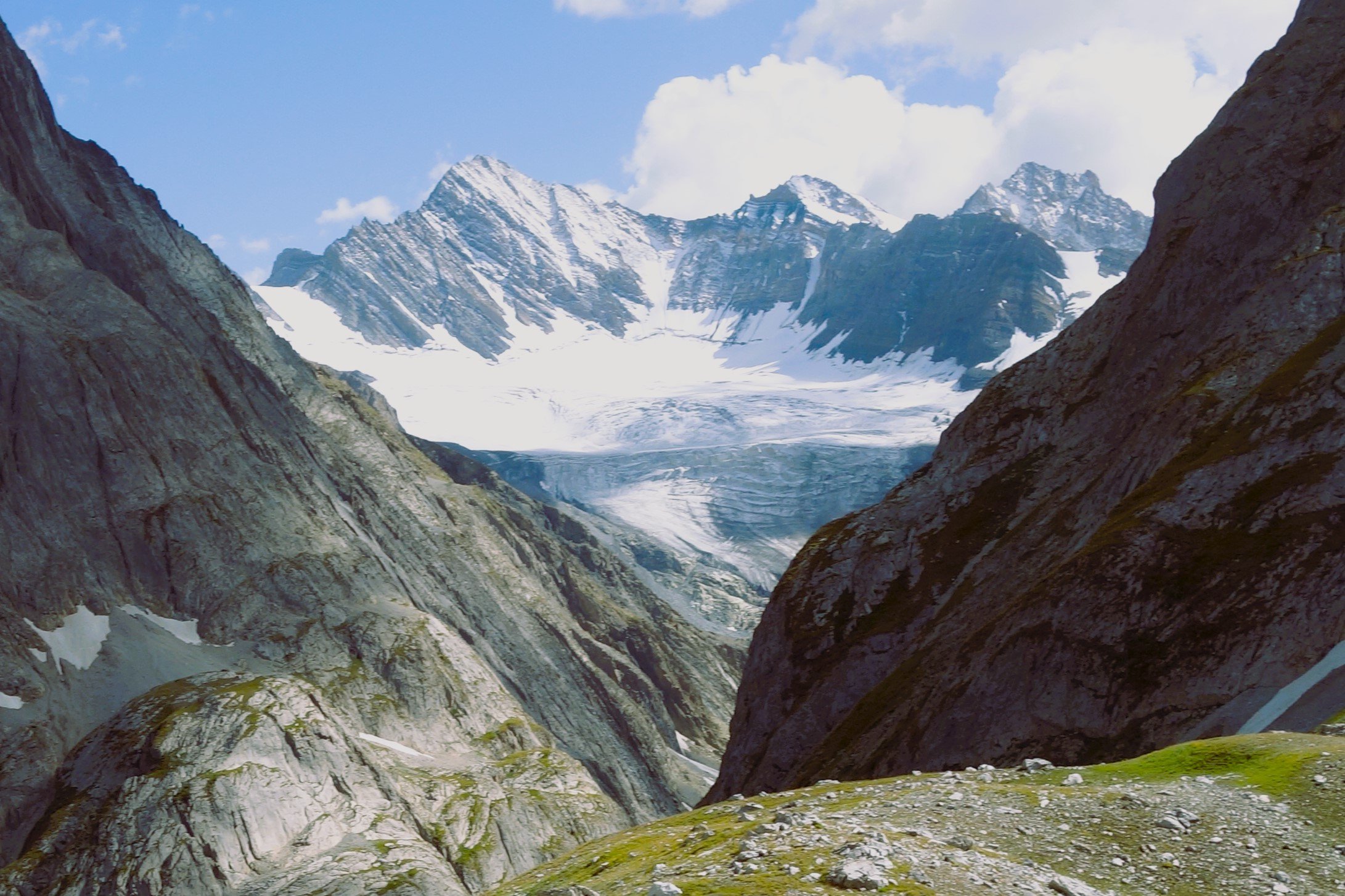
The Kaobal Glacier
Moving further West we again had a series of Passes which connected Warwan in like the Bhotkol Pass / Lonvilad Gali. And then we had the one of the lowest but one of the most notorious Passes over the Great Himalayan Range, the Zoji La. And then the last one is mostly unknown Kaobal Gali which connected the Tulail Valley in Gurez with the Mushkoh Valley in Drass in Ladakh.
The Pass stands at an Elevation of 4167 metres (app 13600 ft) on the main Great Himalayan Range has traditionally connected the Tulail and Gurez Valleys with the Mushkoh Valley in the Drass Region. Interestingly people on both sides of the Pass are Shina and speak Shina language just like their fellow Dardic Shina people in Gilgit. This is a peculiarity as usually when you cross a Pass on the Great Himalayan Range the Culture Language and People change.

Closer View of the Kaobal Sar also known as the Draupadi Kund
Another factor which makes this Pass different in todays context is that it lies at a very sensitive position along the Line of Control and on one side is the Mushkoh Valley which had seen a lot of Military action during the Kargil War. As a result of this Pass is strictly off limits to all Civilians and till date very few Civilians have been allowed to visit this Pass and recently we were among the lucky few who have got access to the Pass.
The Pass itself is set in a spectacular location. The Kaobal Peak and the Kaobal Glacier loom over the Pass and there is a beautiful Alpine Lake at the foot of the Pass called the Kaobal Sar but also more commonly referred to as the Draupadi Kund. The setting of the Lake is so beautiful that you cant help but give it a celestial connection. On one side are the Greens of Tulail and on the other side are the Trans Himalayan browns of Mushkoh in Drass. The Contrast is quite stunning.

The Tulail Gurez side of the Pass
The Pass also marks the Border between the Union Territory of Jammu and Kashmir and Ladakh. At the time we were there we had gone from the Tulail side and had initially planned to descend the other side of the Pass into Drass but that was not to be as there was a Landslide on the other side and the Road was shut for all kinds of traffic. Also the Road onwards from Chakwali Village which is the last Village on the Jammu and Kashmir side is extremely Rough and can only be attempted in clear Weather with proper 4x4 Vehicle.
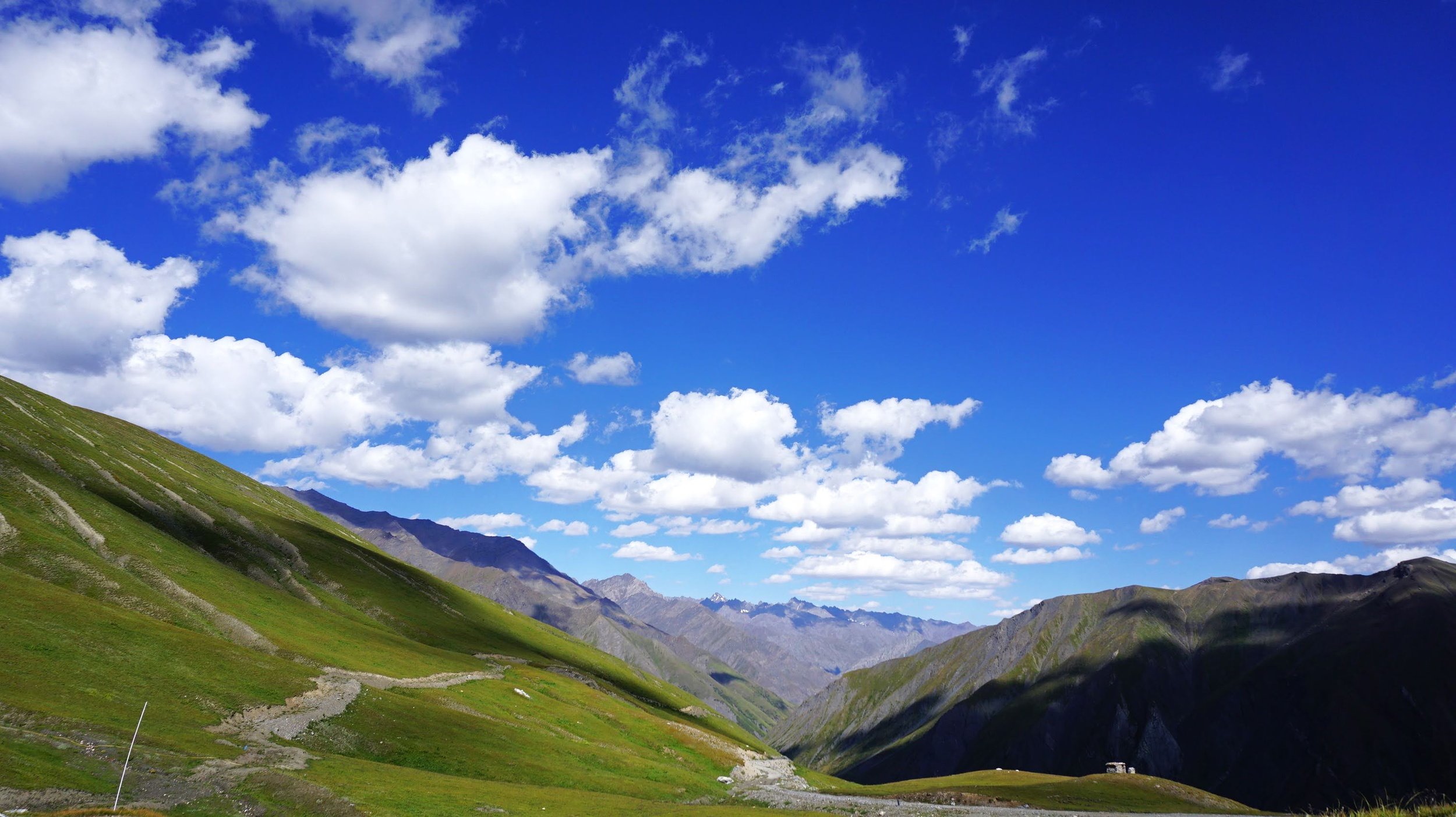
The Drass side of the Pass
There was a recent Report that the Government is planning to open the Road from Gurez to Drass via Kaobal Gali to Tourists at some point in future. So hopefully one day a controlled number of Tourists will get access to this absolute Gem of the Himalayas.
Kiki’s Ten Things to Do in Ladakh
Most People while visiting Ladakh just visit the same old Places, popular Tourist places and ones popularized by Bollywood and Influencers on Social Media. As a result a few Places bear the brunt of the Tourist footfalls which has serious Environmental and Social Impact.
I have always subscribed to the Philosophy that instead of sending 100 people to 5 places send 20 people to 25 places. Ecologically viable Tourism starts by spreading the load of the Tourists. And here is a list of Ten Things that I would recommend to do in Ladakh. And please remember that Ladakh is a large Region and most of it is rather unknown for most people. Ive added a Note on the Mountain Geography of Ladakh for easier understanding. You can also read my Ladakh Travel Guide for General Information.
So I have compiled a list of Ten Things that I would do in Ladakh, keeping in view all my Visits and Readings on Ladakh. They are in no particular order and each One is a Unique experience in its own.
Most People while visiting Ladakh just visit the same old Places, popular Tourist places and ones popularized by Bollywood and Influencers on Social Media. As a result a few Places bear the brunt of the Tourist footfalls which has serious Environmental and Social Impact.
I have always subscribed to the Philosophy that instead of sending 100 people to 5 places send 20 people to 25 places. Ecologically viable Tourism starts by spreading the load of the Tourists. And here is a list of Ten Things that I would recommend to do in Ladakh. And please remember that Ladakh is a large Region and most of it is rather unknown for most people. Ive added a Note on the Mountain Geography of Ladakh for easier understanding. You can also read my Ladakh Travel Guide for General Information.
So I have compiled a list of Ten Things that I would do in Ladakh, keeping in view all my Visits and Readings on Ladakh. They are in no particular order and each One is a Unique experience in its own.
1. Explore the Basgo Monastery and Fort :
Basgo located some distance away from Leh was once the Capital of Ladakh and still the site of an impressive Monastery and a Fort. It was on the Plains outside that the Battle of Basgo was fought.
It was the Tibetans and their Mongol allies vs the Ladakhis and their Mughal allies. During the build up to the Battle the Mughal force crossed the Indus over two wooden bridges at Khalaste and marched towards Basgo. The two armies met at a plain called Jargyal between Basgo and Nimmu. This is referred to as the Battle of Basgo fought in 1679.
And the battle hardened Mughals along with their Ladakhi and Kullu allies proved too strong for the Tibeto-Mongols and their Bushahri allies. The Tibeto-Mongols were pushed back and routed all the way to Spituk where after a brief lull the fighting erupted again until they were driven beyond the Pangong Lake to a place called Tashigang.
They built themselves a Fort and shut themselves in and the Mughal Army now turned back, confident that the Tibeto-Mongols were gone for good. But of course Mongols being Mongols, they were wrong, but more of that later.
Read More about the Battle of Basgo
2. Gaze at the Stars at the Astrohub : A Great New Stargazing Experience in near Leh
Introducing the Cosmohub in Phyang around 30 kms from Leh. An Initiative totally handled by the Local Village Ladies.
The Cosmohub has a Telescope which enables you to gaze even further into Space in the already very clear Ladakh skies.
Cosmohub- A New Stargazing experience near Leh. This women-led Astro-tourism initiative offers stargazing through a Telescope along with local folklore about skies narrated by trained local women.
You also get to Experience local Cuisine and Handicrafts prepared by a local self help group of women in addition to a guided tour of the nearby Monastery.
3. Visit the abandoned Village of Old Hundarman :
Ladakh offers many gems set in the Trans Himalayan landscape.
One such place while travelling to Ladakh is the Village called Hundarman near Kargil. Set in a sharp mountain gully 11km from Kargil, the tumbledown ghost village of Hundarman is a remarkable sight.
Rocky crags tower above, a steeply raked arc of stone-walled terraces sits below and virtually all of the low-ceilinged homes are stacked on top of one another, forming a fascinating core that has been (somewhat) preserved as a unique time capsule. And there is a neat little Museum in one of the abandoned Homes with antiquities found in these abandoned Houses.
This Village was till 1971 under Pakistani control but came under Indian Control after the 1971 War. And the fact that there are Warning Signs about Land Mines on both sides of the Road leading to Hundarman is a testament to the turmoil this Region has seen.
Yes you will hear the same Story about another place on this List.
4. Watch the Karakorams from the Khardung La :
Yes Khardung La is famous as one of the Highest Passes in the World but what most people dont know is that one gets a great view of the mighty Karakoram Range while looking North standing atop the Khardung La.
And now for some fun facts on the Karakorams in India. The Karakorams is a Mountain Range and like all Great Mountain Ranges it has a number of sub Ranges. And it has been classified into Nine Sub Ranges and out of these 3 lie fully on the Indian side and a 4th lies partly on the Indian side.
The Sasser Muztagh is the southernmost sub Range of the main Range and lies between the bend of the Shyok when it changes direction and heads in a Northern direction. The Shyok rises in the Rimo Muztagh which lies above the Sasser Muztagh.
The same trend is shown by the Nubra which also joins the Shyok and its at this point the Baltoro Sub Range starts which is partly on the Indian side. So the Sasser and the Baltoro Ranges are divided by the Nubra which rises in the Siachen Glacier. The Sasser La runs roughly between the Sasser Muztagh and the Rimo Muztagh. And in the extreme North along the Siachen Glacier runs the Siachen Muztagh.
Read More about the Karakorams in Ladakh
5. Visit the Donkey Sanctuary in Leh :
You must have seen a lot of Donkeys roaming around in the Streets of Leh. They are used as beasts of Burden in these rugged Mountains and many of them are unfortunately abandoned one they are older or are injured.
Sonam Dorje runs a Donkey Sanctuary on the outskirts of Leh where these unwanted Donkeys are taken care of. Its a Happy Place for these unwanted Donkeys where they can just do their Donkey things and get Food to eat and even basic Medical facilities.
The Donkey Sanctuary runs solely on Donations so its a good idea to visit the places, spend some time with the Donkey Bros and give whatever you can for the Welfare of these Donkeys.
Read More about the Donkey Sanctuary in Ladakh
6. Visit the Munshi Aziz Bhat Museum / Central Asian Museum :
Munshi Aziz Bhat was a trader also on the Central Asian trade Route and owned a number of shops in Kargil and his trading company was called Munshi Aziz Bhat and Sons. He set up a Serai, the Kargil Serai in 1920 to offer boarding lodging and storage places to the Traders. Soon the Serai became a stopover place for all kinds of traders from all kinds of places in Kargil. The Kargil Serai also served as a kind of an unofficial Post Office which received a lot of mail especially from the Hoshiarpuri Punjabi traders. The Serai had in its front a couple of shops as well which the Traders could use to display their wares. The Serai was a busy one in the late 1800s as well as the early 1900s and it saw many traders come and go.
It was a chance discovery in the beginning of this century that some workers were sent to the place to clear some mess as parts of the structure had collapsed. The workers unearthed some very interesting items and reported these to the owners. The Owners then decided to come and check for themselves and they unearthed what can only be called a priceless treasure in the form of various items related to the Central Asian trade and items from all over Central Asia, the Indian subcontinent, Tibet and even Europe. As luck would have it a visiting historian persuaded the family to preserve this price-less collection instead of it ending up in some antique shops. And so was set up the Aziz Bhat Museum of Central Asian and Kargil Trade Artefacts to display the Collection.
The range of artefacts unearthed from the Munshi Aziz Bhat Sarai has given invaluable insights into not only the forgotten trade history but also into the cross-cultural, cosmopolitan past of Kargil. These artefacts aren’t mere antiques but they are a testimony to the fact that Kargil was a melting pot of cultures, languages, lifestyles and ideas. They are now on display in a part of the Munshi family’s house that has now been converted into the Museum.
Read More about the Munshi Aziz Bhat Museum
7. Panikhar and watch the Twin Peaks Nun and Kun :
Have you ever wondered what it feels to stand at the foot of the Greatest Mountain Range on the Planet, the Great Himalayan Range itself and stare at a 7000 Meter plus feet Mountain ?
The sheer grandeur of the Great Himalayan Range on one side and the Zanskar Range on the other side can be experienced in the Suru Valley. You can watch in awe the Twin Peaks of Nun and Kun which are a part of the Great Himalayan Range and tower above the Suru Valley and from places like Panikhar and Parkachik you get a superb view of these Giants.
Read More about the Suru Valley
8. Visit the Alchi Monastery :
Out of all the beautiful Monasteries in Ladakh the Alchi Monastery is probably the most fascinating one because of its Paintings and Murals said to have been done by Artists who came from Kashmir and they have a certain Kashmiri touch to them.
As per a leading researcher on Himalayan and Tibetan Art : “The world-famous Buddhist monastery of Alchi in Ladakh, India, is the best-preserved temple complex in the Himalayas. Proposed for inclusion in the UNESCO World Cultural Heritage list in 1998, the monastery's artworks reveal influences from India and Tibet across Central Asia and Iran, even as far back as Ancient Greece. Housing thousands of rare paintings and sculptures from the area dating back to the eleventh century, it provides fascinating insight into the spiritual and secular life of mediaeval Kashmir and Western Tibet.
9. Pay a Visit to Baltistan :
The neighbouring Region of Ladakh to the West is Baltistan Region. The people share almost the same Ethnicity as the people of Ladakh but over the centuries their Culture has changed and Religion is mostly Islam. The language of the Baltis is still quite similar to Ladakhi and is actually the closest language to the Old Tibetan language.
At the time of Partition almost the whole of Baltistan was occupied by Pakistan with its main City of Skardu. However over the Years in subsequent Conflicts the Indians managed to get back a little part of Baltistan and nowadays one of these Villages, Turtuk has become quite a Tourist destination.
Visit Turtuk to get a taste of Balti Culture and besides Turtuk there are a number of other Villages where you can see Balti People and Experience Balti Culture. You can now even visit the Northernmost Village of Thang which is located right on the Line of Control.
Read More about Ladakh and Baltistan
10. Drive from Pangong Tso to Tso Moriri over the Changthang :
Of all the drives one can do in Ladakh the most fascinating for me is the one of going over the Changthang while driving from the Pangong Lake to the Tso Moriri Lake. The Changthang is a vast High Altitude Plateau that stretches over thousands of kms and includes parts of Tibet as well as Ladakh and goes all the way to Xinjiang.
It is an extremely inhospitable place but at the same time its beauty is quite unparalleled. Its dotted with certain Wetlands and on this stretch the Indus River enters Ladakh from the Tibetan side. The Changthang is largely uninhabited except for the hardy Changpa Nomads who raise their flocks of the famous Pashmina Goats on this Plateau.
Read More about the Changthang
Addendum : A Note on Understanding the Geography of Ladakh
The Mountain Geography of Ladakh

Understanding the LoC in Kashmir
Most people are eternally confused about the location of the LoC in Kashmir. And Tourists are shown the LoC from almost everywhere. Even the Pahalgam side.
Anyways this is a simple Map which explains the LoC in Kashmir.
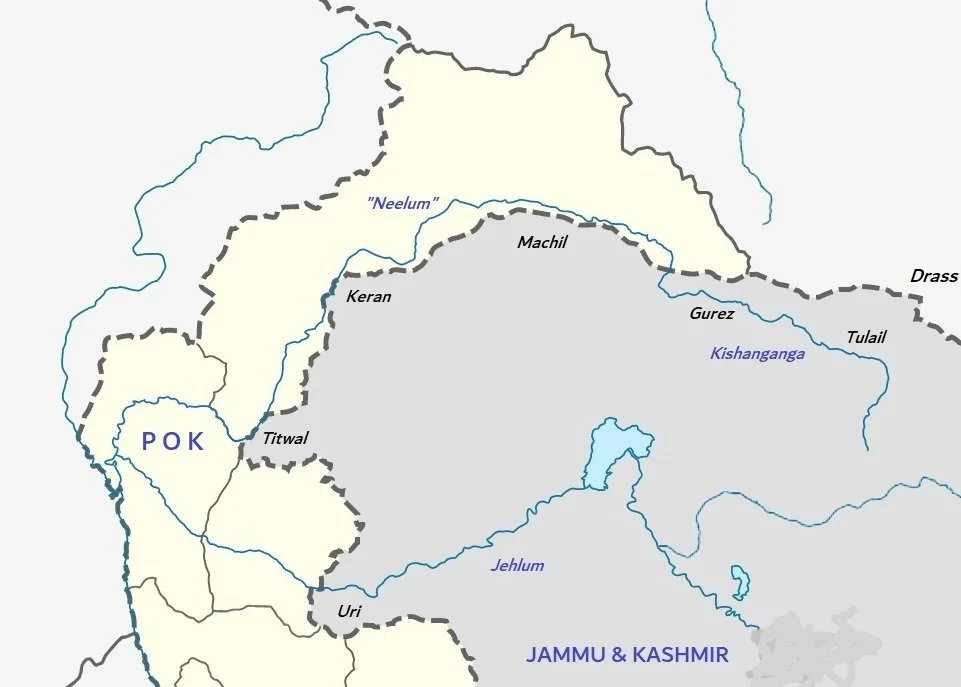
The Line of Control in Kashmir
Most people are eternally confused about the location of the LoC in Kashmir. And Tourists are shown the LoC from almost everywhere. Even the Pahalgam side.
Anyways this is a simple Map which explains the LoC in Kashmir. The LoC kind of plays around the Kishanganga aka Neelam. The Kishanganga originates in the "Great Lakes" Region of Kashmir specifically from the Kishansar Lake and comes down into the Tulail Valley and then onwards to Gurez and at Bagtore in Gurez is where it enters PoK or the LoC and becomes the Neelam. From there on both banks of the River run through PoK and has places like Taobat and Kel and of course the very beautiful Village of Arang Kel (Google Arang Kel). The Indian side pushes very close to the Neelam in Machil sector.
And then again India manages to take one side of the bank in Keran. And again the Kishanganga emerges. Further on again both sides are in PoK and it becomes the Neelam.
But again at Teethwal in the Karnah Valley the Indians managed to take one bank of the River. The Battle of Tithwal was an epic Battle and it was in this Battle that Piru Singh and Karam Singh won Param Vir Chakras.
But again after Teethwal the Kishanganga forever becomes th Neelam till it meets the Jehlum at Domail.
The Loc below this area lies around the Uri sector on what used to be the Jehlum Cart Road. Uri itself used to be connected to Poonch via the Haij Pir Pass but that was taken by the other side.
So this August we are doing an LoC drive where we will start from Uri and the road to Haji Pir and then onto Tithwal. Then Keran. The Machil. Then we would enter Gurez and go till Bagtore and then in the other direction all the way to Tulail and hopefully across the Kaobal Gali into Drass and then return to Srinagar.

Srinagar to Kashgar by Road : The First Motorised Crossing of the Greatest Mountain Ranges
Once the Expedition commenced there arose new Challenges. Though the Afghanistan Civil War had ended, the situation in North Afghanistan and Routes into the Pamirs were far from being safe for the Expedition. So another detour was decided. It was decided that the Expedition would now crossover into India from Afghanistan and then they would take the Mountain track that connected Srinagar in Kashmir with Yarkand / Tashkurgan in Chinese Turkestan or what is now Xinjiang

The Complete Beirut to Beijing Route
Citroen is an iconic French Automobile brand which has been making Motor Cars for well over 125 years. In the 1920s and the 30s they embarked upon a number of Journeys through the wildest impenetrable parts of the World to prove the reliability of the ruggedness of the Citroen. The idea of putting these Expeditions together came from Andre Citreon who was the founder of the Company.

They first made Two Expeditions into the wilds of Africa as the French had a bunch of Colonies in Africa and they completed the Expeditions with a reasonable amount of success. The First of these being the crossing of the Sahara Desert by Motorcar in 1924. And then they made a Journey across the length of Africa from Bechar in Algeria in North Africa all the way down to Cape Town in South Africa becoming the first people to do so. Both these were accomplished using Half Track Citroen Vehicles and these were led by the Explorers Georges-Marie Haardt and Louis Audouin Dubreuil.

Being received by a British detachment at Landi Kotal near the Khyber Pass in June, 1931
And then in 1930 they came up with their most ambitious Expedition. One that involved retracing the steps of Marco Polo by crossing Central Asia and going all the way to China. This Route was the famous Silk Route as it was called and for centuries traders from all over the adjoining Regions used this Road for not only Trade but the exchange of ideas as well. As with their other Expeditions this was also supposed to be a first, the First Motorised Expedition to retrace the fabled Silk Route.

The Expedition had its own set of unique challenges. And these were not only Geographical and Logistical. It was Political as well. It involved getting the requisite Permissions from the Communists in Russia as well as the powers to be in China which was in the throes of a Civil War between the Kuomintang and the Communists. And so the Expedition applied for permission was applied to the Russians for passage through Western or Russian Turkestan as that part of Central Asia was called.

But with just a few Months before the Expedition was to commence the Russians withdrew the permission and they now had to chalk out an Alternative Route. Which they did and now after crossing Persia instead of going into Western Turkestan they decided to take the Route through Afghanistan and up North crossing the Hindu Kush and the Pamirs and reaching Tashkurgan.

Once the Expedition commenced there arose new Challenges. Though the Afghanistan Civil War had ended, the situation in North Afghanistan and Routes into the Pamirs were far from being safe for the Expedition. So another detour was decided. It was decided that the Expedition would now crossover into India from Afghanistan and then they would take the Mountain track that connected Srinagar in Kashmir with Yarkand / Tashkurgan in Chinese Turkestan or what is now Xinjiang

So now a new Geographical challenge arose. That of crossing the Himalaya as well as the Karakorams besides all the other Regions. These were two of the Highest Mountain Ranges on the Planet but still they reckoned that they would be able to achieve the same. They decided to run the gauntlet.

So from Iran they entered Afghanistan via Herat and crossed the Country at great Speed and entered British India at where else but the Khyber Pass and now they were in relative safety and they proceeded towards Srinagar via Rawalpindi through the Jhelum Cart Road. In Srinagar they were personal Guests of the Maharaja and it was through the Maharaja’s territory they would travel all the way North across the Great Himalayan Range and the Karakoram Range.

The Pandethran Temple in Srinagar, Kashmir
They took the Silk Road from Srinagar which connected Srinagar with Gilgit as well as Skardu. So they drove from Srinagar towards the Wular Lake, crossed over the Rajdhan or Rajdhanigan or Tragbal Pass (around 11600+ feet) as it was called and entered the Gurez Valley which bordered the Kashmir Valley on the North. This was the first Motorised crossing of the Razdan Pass as well. From Gurez onwards the tough part started as they now had to cross the Snow Laden Burzil Pass on the Great Himalayan Range. And the Photographs attached show the condition of the Pass.

Infact to get to the Pass itself they had to disassemble the Vehicles and they were carried on foot by the Porters and then re-assembled when it was possible to drive these tough Half Tracks. They were tough but nothing compared to the Mountains. And rather than the Machines it was the hardy Mountain men who carried these Automobiles over the Mountains. They also set a World Record for the highest altitude that a Vehicle drove on at over 13500 on the Burzil Pass.
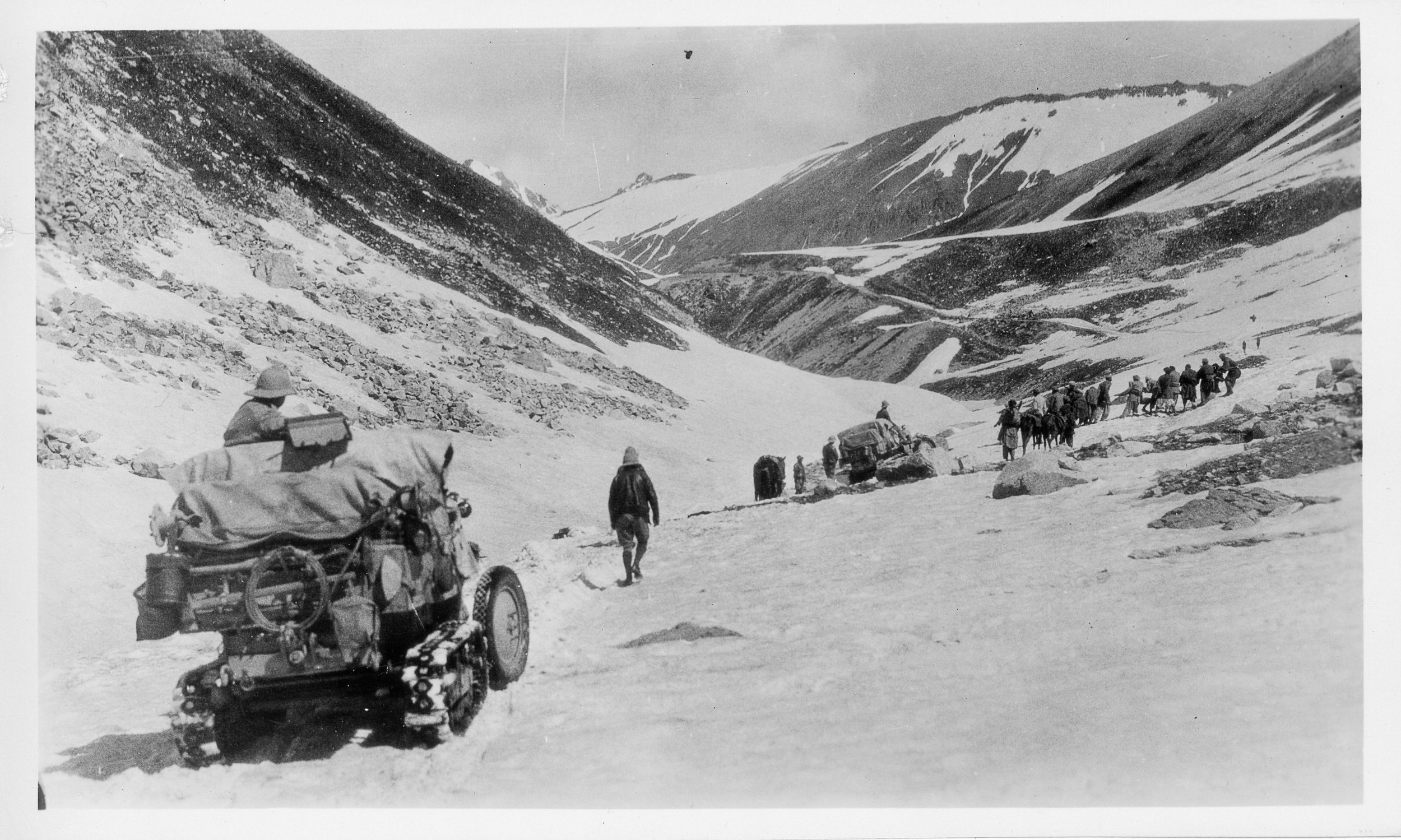
On the way down as well they had to face almost impossible situations and again they had no option but to disassemble the Vehicles and have them carried by the Porters. And they managed to make their way to Astore and then to Gilgit. From Gilgit they made their way to Gojal and to get over the Karakorams they chose the Kilik Pass which was parallel to the Mantaka Pass which was more frequently used but the Kilik Pass was relatively free of Snow and they carried the Vehicles over the Kilik Pass and descended into the Pamirs and were now across the Border of British India and firmly in Chinese Turkestan where they planned to meet up with the other Group which had started from Peking towards Central Asia. Of course the Group which came from Peking faced a lot of Political obstacles rather than the Geographical obstacles faced by what was called the Pamir Group. But that then is another Story.

All said and done it was the Citroen Haardt Expedition which showed that it was possible for Automobiles (with a lot of Human help) to cross this almost unassailable Mountain barrier.

Nowadays however due to the Political situation the Old Silk Route from Srinagar to Gilgit lies abandoned though you can cross the Razdan Pass and get into Gurez. And on the other side of the LoC a Motorable Road now gets you over the Karakorams via the Khunjerab Pass. The Kilik Pass being long forgotten.

Photo Credit : All Photos from the Internet / Citroen Haardt Expedition / Nationa Geographic/ Getty Images.
Lolab and Bangus
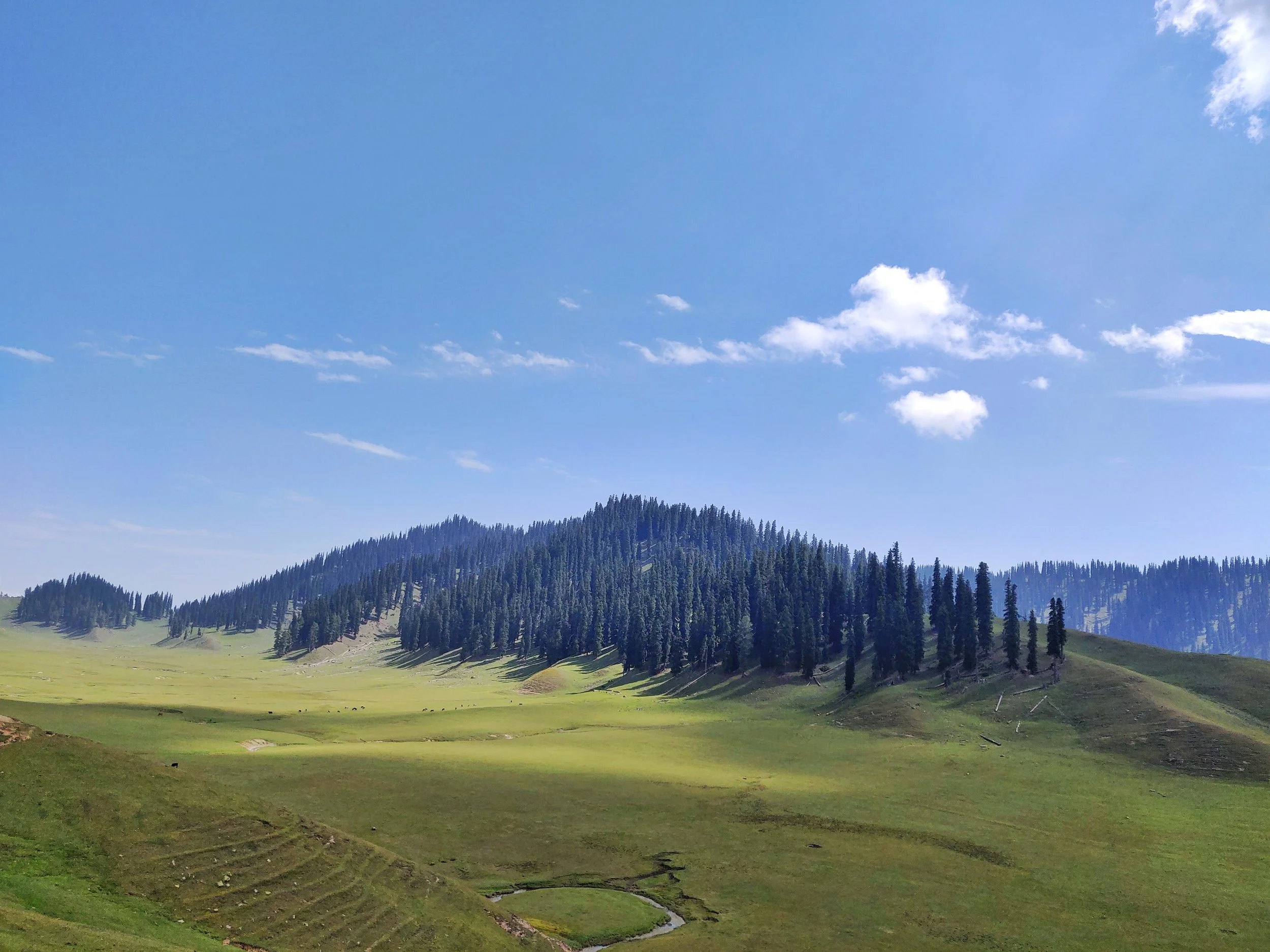
One of the relatively unknown areas of Kashmir with vast tourism potential is the Valley of Bangus. Lying within the Trans Himalayan Area, Bangus is a unique combination of ecological area, compromising Mountain Biome, which includes Grassland Biome with flora at lower altitudes, and Taiga or Coniferous forest.

Kashmir Offbeat : Lolab and Bangus
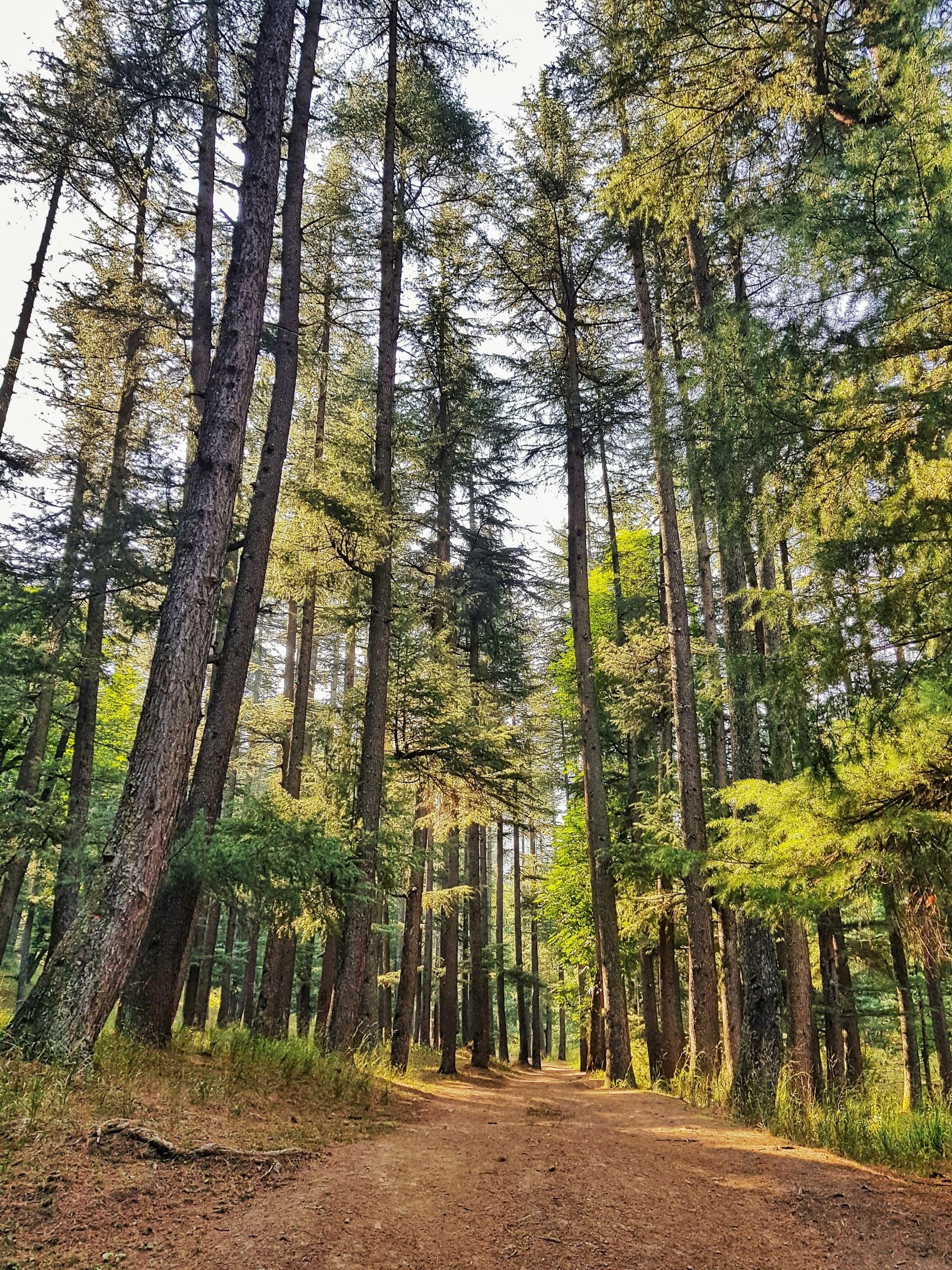
Lolab Valley : The Lolab Valley is named after the Maharaja Lolo is a very beautiful Valley known for its lush Green Trees and Pastures, stretches about 25 kms from the North West and South West varying in breadth from a few yards to almost 5 kms wide. It is traversed by a considerable Stream known as the Lalkul (Lahwal). The Water to the Lalkul is contributed by a number of tributaries flowing from the surrounding Hills which are clothed by dense Forests of Deodar. There are Eleven Ponds in the Valley with an average depth of 7 to 15 feet and are unique in themselves. Varnow Village in the Lolab Valley is of historical importance because of being the birthplace of Allama Anwar Shah Kashmiri. Lolab Valley today has a well developed infrastructure and good connectivity with the rest of the Region. Some of the other renowned places with tremendous potential are Chandigam, Dooruswani, Khurhama, Krusan, Khomrial, Nagsari and Cherkoot.

As per the Gazetteer Lolab - A pargana comprising a beautiful and very fertile valley, situated on the north-east side of Kashmir ; the tahsil station is at Lalpur. Tlle valley is oval in shape, and its surface is elevated and undulating; it stretcher about 15 miles north-west and south-east, varying in breadth from .few hundred yards to about 3 miles. It is traversed by a considerable stream called the Lahwal, and is intersected in all directions by its numerous tributaries, which flow down from the surrounding Hills, which are clothed by dense forests of deodar. North of the Sharibal mountain the valley is thickly covered with jungle and has little Cultivation. On the north side the wudar or the table-land is very strongly marked, and in two places it extends across the valley, the road passing through a narrow defile. This Table-Land is covered with thick pine forest, and a few Gujar families are the only Inhabitants. There are extensive tracts of pasture In the Valley under the Hills and along the sides of the Spurs, and large number of ponies are grazed in the district. The Lolab valley contains about thirty villages, which are mostly situated in the midst of groves of chunar, apple, cherry, alu'cho, and peach trees.
There are eleven small lakes in the district, having an average depth of 3 or 34 feet. They are covered with weeds, and afford great shelter to waterfowl.
Vigne, in his description of the Lolab valley, observes that there is in the middle a large flat and circular space, a valley within the valley, the snuggest and most retired-looking region imaginable. This part of Lolab is about 5 1/2 miles in diameter, and a morass, that appears to have been formerly a lake, occupies the center; the sides are verdant, and more or less covered with jungle.
The Valley is also known for the Sat Baran (Seven Doors) and Caves in the jungles of Madmadav. The famous Lovnag is located in the Anderbaugh Village.
Lolab Valley also provides Road connectivity to Machil which is known for the Waterfall Rangil. Lolab Valley has not only been the area of attraction for the Bollywood fraternity but has been appreciated by Saints, Poets and Philosophers from Centuries together.

Seemab Valley : About 4 kms from the Tourist reception Center in Kupwara is located the Seemab Valley, on the entrance of the Lolab Valley. The Valley is home to a picturesque all year round water body called the Daal Kul. The Seemab Valley is surrounded by lush Green forests and therefore provides ample scope for day picnics. The Valley also holds a great potential for Adventure activities like Rock Climbing, Hiking and Trekking.
Sattabarran Kalaroos : A unique place where the Past meets the present of ancient architecture situated on the outskirts of Madmadav Village in Kalaroos area. About 19 kms from TRC Kupwara Sattabarran can be reached by Road upto Kalaroos and then 1.5 kms on foot. On the backside of the Sattabarran is a Cave which is believed to be the way to Central Asian States. While visiting Sattabarran the picturesque view of the Lolab Valley can also be enjoyed.
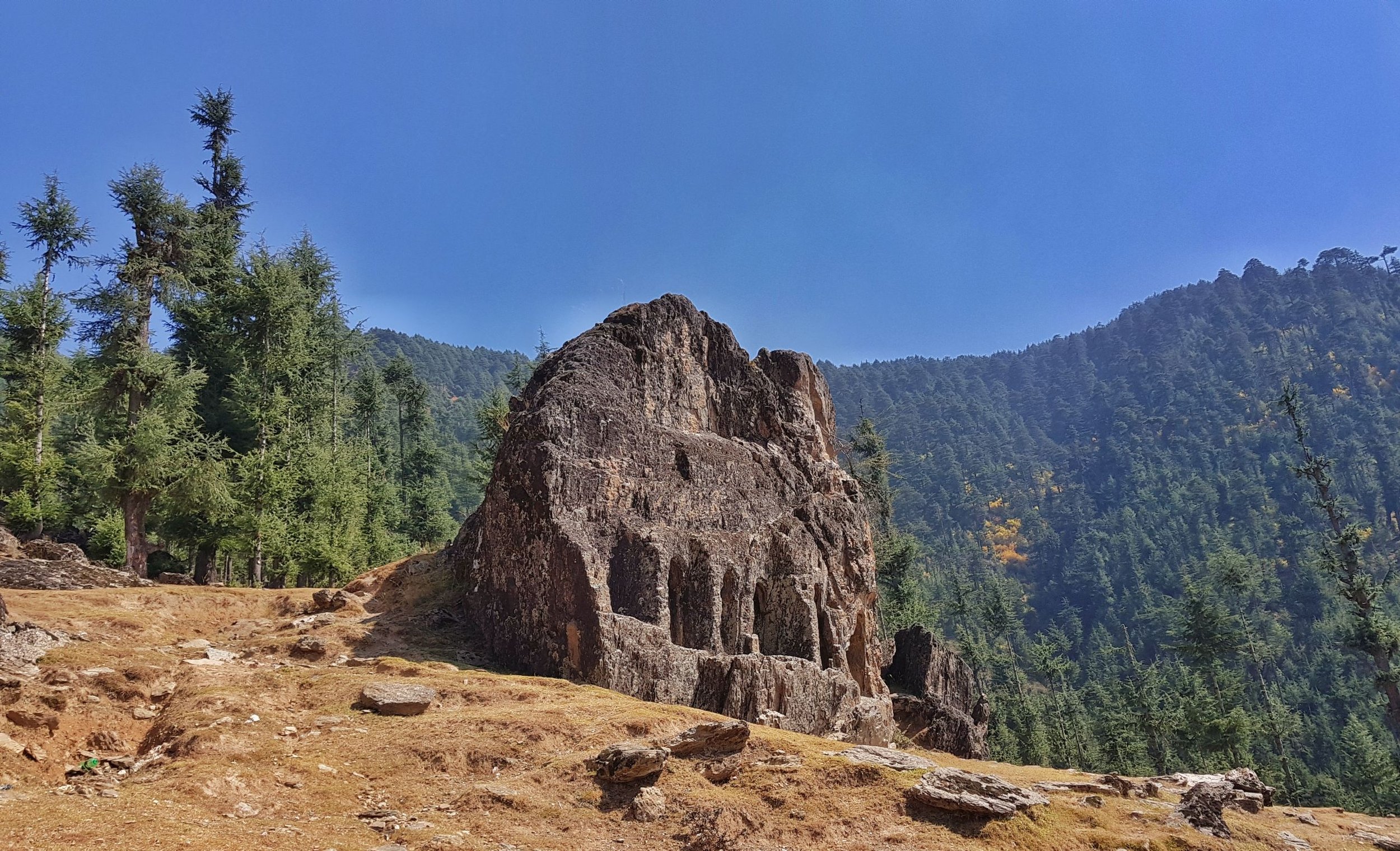
Chandigam : About 25 kms from TRC Kupwara is one of the best Tourist spots in the Lolab Valley. Having a macadamized Road network it is also utilised as a Camping site. The lush Green Jungles surrounding the Chandigam area provide ample scope for the Adventurous people for Trekking and Mountain Biking. 05 kms from Chandigam lies another beautiful Tourist spot by the name of Dooruswami. On the way to Dooruswami the traditional constructions such as thatched Houses can also be seen.
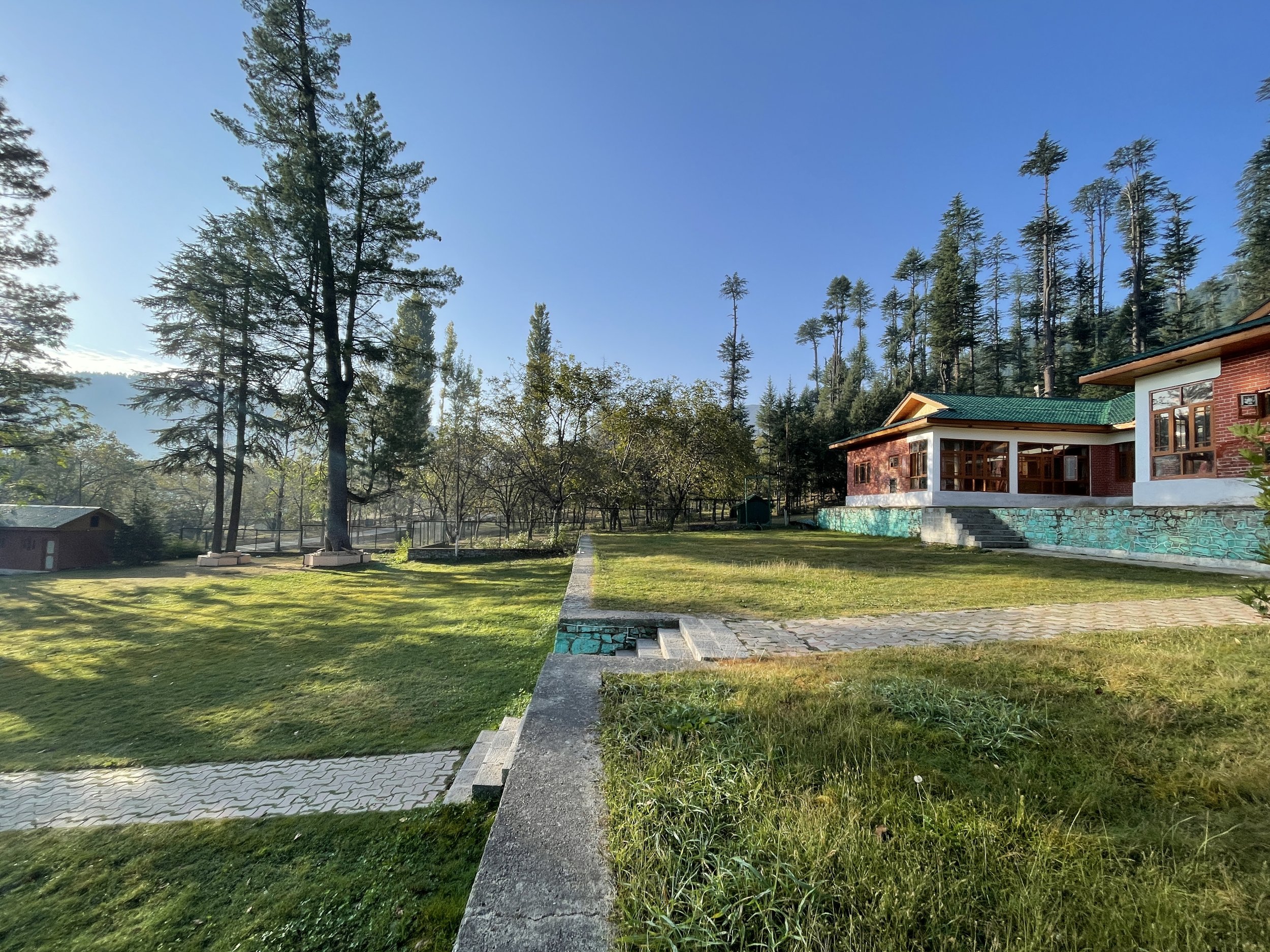
Rangwar Lalpora : About 26 kms from the TRC Kupwara Rangwar Lalpora is known for the pastures and lush green forests, wild flowers, and a stream flowing on its outskirts. On the way to Rangwar a Village by the name of the Krousen can also be reached where a Tourist hutment is available. Rangwar has big pastures which are used by the locals for Cattle grazing.
Bangus Valley : One of the relatively unknown areas of Kashmir with vast tourism potential is the Valley of Bangus. Lying within the Trans Himalayan Area, Bangus is a unique combination of ecological area, compromising Mountain Biome, which includes Grassland Biome with flora at lower altitudes, and Taiga or Coniferous forest.

As per the Gazetteer “Bangas -Lat 34' 22'. Long. 74' 5'. - A Valley in the mountains south-west of Shalurah, in which the Bangas stream, one of the headwaters of the Kamil River, rises. On the Bangas maidan there is an abundance of excellent grass in summer, and it is much frequented by Gujars.”
The Valley which lies at an altitude of around 10,000 ft above sea level, is in the northern part of district Kupwara within the Handwara sub-district. Occupying an area of 300 sq kms (20 x 15) the principal Valley locally known as Bod Bangus (Big Bangus) consists of a linear elliptical bowl aligned along the East West axis.
The Valley is surrounded by Rajwar and Mawar in the East, Shamsbari and Dajlungun Mountains in the West, Chowkibal and Karnah Gali in the North. A smaller side Valley known as Lokut Bangus (Small Bangus) lies on the north-eastern side of the Main Valley. Both the Valleys comprise level green meadows surrounded by low lying Mountains covered with dense Coniferous forests (Budloo) with a stream flowing through.

These Meadows are divided into two types - Plain Meadows and Plateaus. The Meadows and slopes of the side Plateaus are covered with a Range of Flowers and Medicinal plants. The Meadows support a rich variety of Grassland flora which had Medicinal value as well. A large part of the Plain within the Valley of Bangus is water locked, during the rainy Season. The Valley is traversed by a number of small streams whose number sources stand at 14. These include the Roshan Kul, Tillwan Kul and Douda Kul. The Valley is also fed by the Waters of the Qazinag and Satkulnag springs. The Water of the various streams in the Valley form one of the headwaters of the Kamil River which in turn joins the Lolab stream, thus forming the Pohru River.

Plain Meadows include the open Plains of Chota Bangus, Bod Bangus, Masjid Aagan, Nichan Reyan and Kiyind Patter. Tableland Meadows constitute about 60% of the Meadows. These include Bidran, Lashar, Dodhe, Gumre, Cheekta, Deeyar, Satkoul and Zanzer.
Credits : The text comes from JK Tourism Catalog and the Gazetteer of Kashmir and Ladakh 1890. Phot Credits to THPC, Black Top and Beyond and Escape Photography.

Gurez and Tulail : Then and Now
Gurez is a Valley in the north of Kashmir. It stretches from a short way above Gurais Fort to below Sirdari. The main road, leading from Kashmir into the Valley, crosses the Rajdihgan Pass ; the distance from Bandipura, at the head of the Wular lake, to Kanzalwan, on the left bank of the Kishanganga, being about 25 miles, which is usually divided into three stages. The entrance to the valley is exceedingly picturesque, as the river comes dashing along through a rich meadow, partly covered with lindens, walnut, mud willow trees, while the mountains on either side present nothing but a succession of most abrupt precipices, end alpine ledges, covered with fir trees. It is nowhere above a mile in width, and is surrounded on every side by lofty peaks, chiefly of mountain limestone, rising far above the limit of forest which covers their lower slopes.

The Habba Khatoon Peak with the Kishanganga River in the foreground
Gurais / Gurez
Notes from the Gazetteer of Kashmir and Ladakh of 1890 on Gurez (which was also referred to as Gurais or Gurys) and Tulail (referred to as Tilail or Tlyl ). The Gazetteer was a treasure of vital information on all parts of Kashmir and Ladakh and it also carried detailed Route Maps and Details in the Mountains. Presenting the Notes on both Gurez and Tulail and some Explanatory addendums.
Gurez is a Valley in the north of Kashmir. It stretches from a short way above Gurais Fort to below Sirdari. The main road, leading from Kashmir into the Valley, crosses the Rajdihgan Pass ; the distance from Bandipura, at the head of the Wular lake, to Kanzalwan, on the left bank of the Kishanganga, being about 25 miles, which is usually divided into three stages. The entrance to the valley is exceedingly picturesque, as the river comes dashing along through a rich meadow, partly covered with lindens, walnut, mud willow trees, while the mountains on either side present nothing but a succession of most abrupt precipices, end alpine ledges, covered with fir trees. It is nowhere above a mile in width, and is surrounded on every side by lofty peaks, chiefly of mountain limestone, rising far above the limit of forest which covers their lower slopes.
As the Note states Gurez is located North of the main Kashmir Valley across the Razdan Pass and the Journey now from Srinagar to Dawar which is the main Village in Gurez takes around 6 to 7 Hours. There are a number of Check Posts that you need to Pass while going into Gurez and the details of all Visitors are duly Noted as its a Militarily sensitive Region as the present Line of Control between India and Pakistan runs the Region. The Gurez Valley also now stands divided between the two Countries.

The View of the Mountains North from the Razdan Pass
The south-east end of the valley ie occupied by a superb peak of mountain limestone, rising nearly 5,000 feet above it, and dividing the Tilail valley from that of Gurais; to the north of this mountain is an immense mass of alluvium, which must once have up the entrance to the north-east end of the valley, and through which the Burzil stream .appears to have worn its way. This part of the valley, which lies north-east and south-west, is very narrow at its lower end. It is bounded by precipitous mountains, which are somewhat scantily fringed with forest, the greater lying on the left bank of the stream.
The Peak being referred to in the above Note is the iconic Habba Khatoon Peak which stands over the Village of Dawar in an almost perfect Pyramidical form. The Peak is named after the famous Poetess Habba Khatoon who was from the area and who’s Lovestory with the Chak Sultan of Kashmir is the stuff legends are made of. The Peak lies at the Junction of the Kishenganga with the Burzil stream. Also the extent of Gurez Valley is till the Peak and after the Peak moving along the Kishenganga the Tulail Valley starts.

The Kishanganga Reservoir
The South portion of the valley about the Fort is wide and level, offers a beautiful prospect, the mountains on the South side being clothed with forest, while to the north they rise in precipitous masses of Grey rock with here and there a few pine trees. The scenery in the west portion of the valley between Kanzalwan and Sirdari is likewise very pleasing,the river winding amid dense forests of pine and cedar.
The elevation is between 7,000 and 8,200 feet.
Taking a leftern Route from Kanzalwan takes one towards the Southern part of the Gurez valley which traditionally extended till the Village of Sirdari which now lies on the other side of the Line of Control. Now the last Village on the Indian side is Bagtore and after that the Kishanganga crosses over the Line of Control.

The Village of Dawar, the main Village of the Gurez Valley
The road from Srinagar crosses the Kishanganga at Kanzalwan by a single span bridge about 6 feet wide. The river-bed here is about 70 yards broad. The road lies uniformly along the right bank of the River. It is repaired annually by the Maharajas troop, preparatory to the dispatch of commissariat stores for the frontier garrisons, and is consequently a good and, for the most part, level road, quite practicable for laden animals and mountain artillery.
A regular postal establishment is maintained on this road, but the intervals at which the mails are dispatched are uncertain; during the summer months the dak-runners are stationed in pairs, at 2 kos apart, but in winter, parties of eight or ten men are located in stages of 5 kos; the line is worked as high up as the village of Dudgay by Gurais men, and beyond that point by Tilailis. These men are said to be paid at the rate of R6 (Kashmir currency) per mensem. The path from Gurais to Tilail crosses the Burzil stream by a bridge at, or above, the village of Tsenial and ascends the mountain, the distance from the fort to the Tilail valley being about 13 miles. From Kanzalwan, in a westerly direction, the path lies at first on the left bank of the Kishan' Ganga, crossing the river by the bridge between Bakthaor and Thaobut ; it then lies along the right bank as far as Sirdari, after passing which village it becomes impracticable,
Now the Road is well Motorable all the way to the extreme end of Tulail on the other side. In the earlier days begore the era of Motorcars there was a System of Dak Runners who used to deliver letters up and down between Gurais and the main Kashmir Valley. These Dak Runners were placed at regular intervals and their Job was just that, Run to the next Dak Runner station and deliver the Messages.

The Kishanganga River flowing through the Gorge which separates Gurez from Tulail
The inhabitants dress differently to the Kashmiris ; they invariably wear very loose puttu pajamas coming down as low as the calf, and a kamarband outside the choga or coat. They also wear the Dard cap in place of a pagri. In the village of Gurais itself there is a mixture of Dards and Kashmiris.
The inhabitants of Gurez are mostly Shina people and speak primarily the Shina language though many of them due to the linkage with Kashmir are fluent in Kashmiri as well. Nowadays their dressing is no different than in Kashmir.
Their houses are built of unhewn timber, dovetailed at the corner, the interstices being plastered with mud ; they are built as close as possible to each other for the sake of warmth and communication, and are usually disposed in squares facing inwards, a small aperture serving the triple purpose of door, window, and chimney. In some of the villages in the western portion of the valley, they are beginning to build houses of a more commodious pattern, copied from those in Kashmir. There is a great want of trees and shade about the villages, which is explained by the statement that the heavy load of snow by which they are weighed down in winter destroys them. The villages in the Gurais valley are Walpur (twenty-five houses), Khandial (thirty houses), Murkot (forty houses) and Digar (twenty eight Houses)
There are still many Houses made in the traditional way out of timber though slowly and steadily these are being replaced with Concrete and Brick structures with Tin Roofing as is prevalent in most of the Kashmir Valley.

The First Views of the Gurez Valley after descending from the Razdan Pass
The climate of the Gurais Valley ia very rigorous, and the harvest scanty and uncertain; seasons of dearth, caused either by want of sun or rain are not infrequent, but flocks and herds abound, and from their profits the inhabitants are enabled to import grain in seasons of scarcity. '
Gurez has a Cold Climate and experiences heavy Snowfall in the Winters as a result of which it remains cut-off for 4 to 5 Months every year from the main Kashmir Valley. Also many of the local Gurezis now have Property in Bandipura and other parts of the Kashmir Valley and they prefer spending the Winters in these places instead of being stuck in Gurez. It needs to be Noted that Gurez has no regular Electricity supply though they get some Supply in the Evenings through Army run Gensets.
The only crops are millet, buckwheat, and peas; and of these there is but one harvest in the year. Besides willows, a few crab-apples and pears are met with, and in the south and west portions of the valley walnut trees of scant dimensions are found, but the fruit is said to be hard and small; in the west also strawberries are usually plentiful, and raspberries and mild currants are not uncommon. The aromatic plant called burrish is found in great quantities on the slopes of the mountains on the north side of the valley. It is of a whitish-green colour, very similar in appearance to the tetwan or wormwood, but rather larger; its roots, ,which are large and fibrous, are extensively used as fuel at elevations where wood is not procurable. Rice will not ripen. Very good ponies can be obtained at Gurais. The valley affords splendid pasturage.

The Burzil River which joins the Kishanganga at the foot of the Habba Khatoon Peak
Gurais was originally governed by a Nawab, tributary to the Gaor Aman Rajas of Gilgit ; the present Nawab, by name Malik Wafadar, is the eighth or ninth of his family, who has borne the title in regular succession. His father, Malik Dilawar, having been invited to Srinagar by Shaikh Ghulam Maihidhin, the Governor under the Sikh rule, was treacherously thrown into prison, from which be managed to effect his escape after a captivity of three years; he retired to the mountains north of the Kishanganga river, where he collected his followers, but the Sikh force opposed to him being vastly superior in numbers, he thought it prudent when the flood subsided, rendering the passage of the river feasible, to withdraw to Gilgit, where he was eventually treacherously murdered. His son the present Nawab, was, at the time the events occurred, a hostage in the hands of Colonel Mia Singh, who had succeeded to the governorship of Kashmir. On attaining man's estate he took service under the Maharaja, and is now Thanadar of the Valley his forefathers ruled. Malik Wafadar is an intelligent man of pleasing address; he has a son, Baktawar, a child of about five years of age.

Gurais is, most probably, the Urasa of the Raja Taringini.
During the winter months the road from Kanzalwan to Gurais is extremely difficult and dangerous for the first 4 miles, as the sides of the mountain along the face of which the road is made are extremely steep, and the Snow lying at the slope of the ground makes the difficulty of cutting a track through it very.great.
(Vigne-Drew-Barrow-Manifold.)
Tilail / Tulail

TILAIL-Lat. 34' 30' and 34' 35'. Long. 75' and 7S0 %Of. Elev. The name of a long and narrow valley lying to the north-east of Kashmir, which is traversed by the incipient Kishan Ganga.
It in nowhere more than a mile in width, and is encompassed by lofty mountains which exhibit a like peculiarity to those in Kashmir, inasmuch as the elopes having a southern aspect, are uniformly bare of forest, and are here clothed with grass or masses of prangos, while on the south side there is no want of timber, except towards the west end of the valley between the villages of Purana Tilail and Zergay, where the mountains are too precipitous to give footing to any vegetation, excepting here and there a few pine trees which cling to the bare face of the rock.
The general appearance of the valley presenta a great contrast to Kashmir, as the sylvan beauty of the earthly paradise is entirely wanting, and the mountains that enclose it are not bold enough in outline to compensate by the wild grandeur of their scenery.

In the upper portion of the valley the fall is considerable, and the Kishan Ganga flows a turbid and impetuous torrent, which finds an exit at the western extremity through a narrow gorge which only gives passage to the river; and the main path traversing the valley, which has hitherto followed the right bank of the stream, crosses the range of mountains to the north-west into Gurais.
This path forms the high road between Gurais and Dras, and is that by which the Tilail valley is usually entered. It may, however, be reached more directly from Kashmir by a path which ascends from Wangat to Gangarbal ; there are also two roads from Sonamarg in the Sind valley ; the one known as the Nikka Nai road lies by the Krishun Sar and Vishun Sar lakes, the other, called Bara Nai, follows the course of the Raman stream. From the Tilail valley, the Shingo river and Deosai plains, and Skardu, may, it is said, be reached at certain seasons of the year by a path which ascends the Grati Nar.

Traditional Wooden Structures in Gurez and Tulail
The inhabitants of this valley differ somewhat in appearance from those of Kashmir, their features approaching the Mongolian type. Their dress is much the same, except that the women wear an exaggerated copy of the common red head-dress. The Dard language is universally spoken.
The Valley is sparsely populated; the houses are all huddled together in the village or ranged in a square enclosing a courtyard, in which the cattle are herded ; this disposition is adopted for the sake of warmth and communication during the long and rigorous winter. The dwellings, which are frequently double-storied, are constructed of unhewn timbers dovetailed at the corners, and having the interstices plastered with mud. They have no chimneys, and are all very dirty. The villages, with scarcely an exception, are entirely bare of trees, and have but little vegetation of any description about them ; barley, peas, trumba, and pinga are the only products of theValley ; rice is of course unknown at this elevation.

The harvests are not abundant, and are scarcely in excess of the requirements of the inhabitants.
It is the custom to bury the grain in caches ; this appears to be a remnant of the precautions which were taken during the old marauding days, but the habit is still adhered to, owing to the want of proper vessels to contain the grain, and of space in the homes. in which to store it, The holes are usually constructed in some dry spot near the village ; they are called dis in the Dard language and sus in Kashmiri. The grain is carefully fully wrapped in birch bark before being consigned to these receptacles; the hole is then filled in with stones, above which a layer of earth is spread. When well dried and securely packed, the grain is said to keep good for six months, but it is not usually preserved so long.

The inhabitants of Tilail seem to be extremely fond of fruit, of which the only indigenous varieties are the strawberry and a few wild para, but a great deal is imported from Skardu, principally dried mulberries of a very inferior description, and a small apricot called but but sair by the Kashmiris; for these luxuries the people barter the woollen stuffs they have manufactured during the winter. Ths mild flowers and grasses common to the British Isles are found throughout the valley, and roses in Tilail are scarcely less abundant than those of Kashmir, exhibiting, if anything, more beautiful tints.
Though extremely poor, the Tilailis pay 60 rupees (chilki) at their marriages ; this sum is paid by the bridegroom to the bride's family either before or on the day of marriage. Flocks of sheep constitute their most valuable possession ; the Kashrniri butchers buy much of their meat in this valley, paying for the animals at the rate of 14 or 15 rupee (chilki) a kharwa taken at an estimation.

The government tax is calculated at half the produce of the lands and is paid either in money or in kind. Vigne states that when Tillail was subject to Abmad Shah, the Gyalpo or Raja of Skardu, he, instead taking a tribute of money, contented himself with receiving annually a present of a sheep and a coil of rope from each house.
The government likewise levies a duty of an anna in the rupee on all articles exported from Tilail to Kashmir.

The administration of justice is provided for in the following manner: Small cases are decided by the village mokaddams ; more important matters are referred to the thanadar, who resides in Badgam, from whom appeal lies to the governor of Kashmir.
It is said that on all suits having a pecuniary value the Government levies a duty equal to one-fourth of the value in dispute.
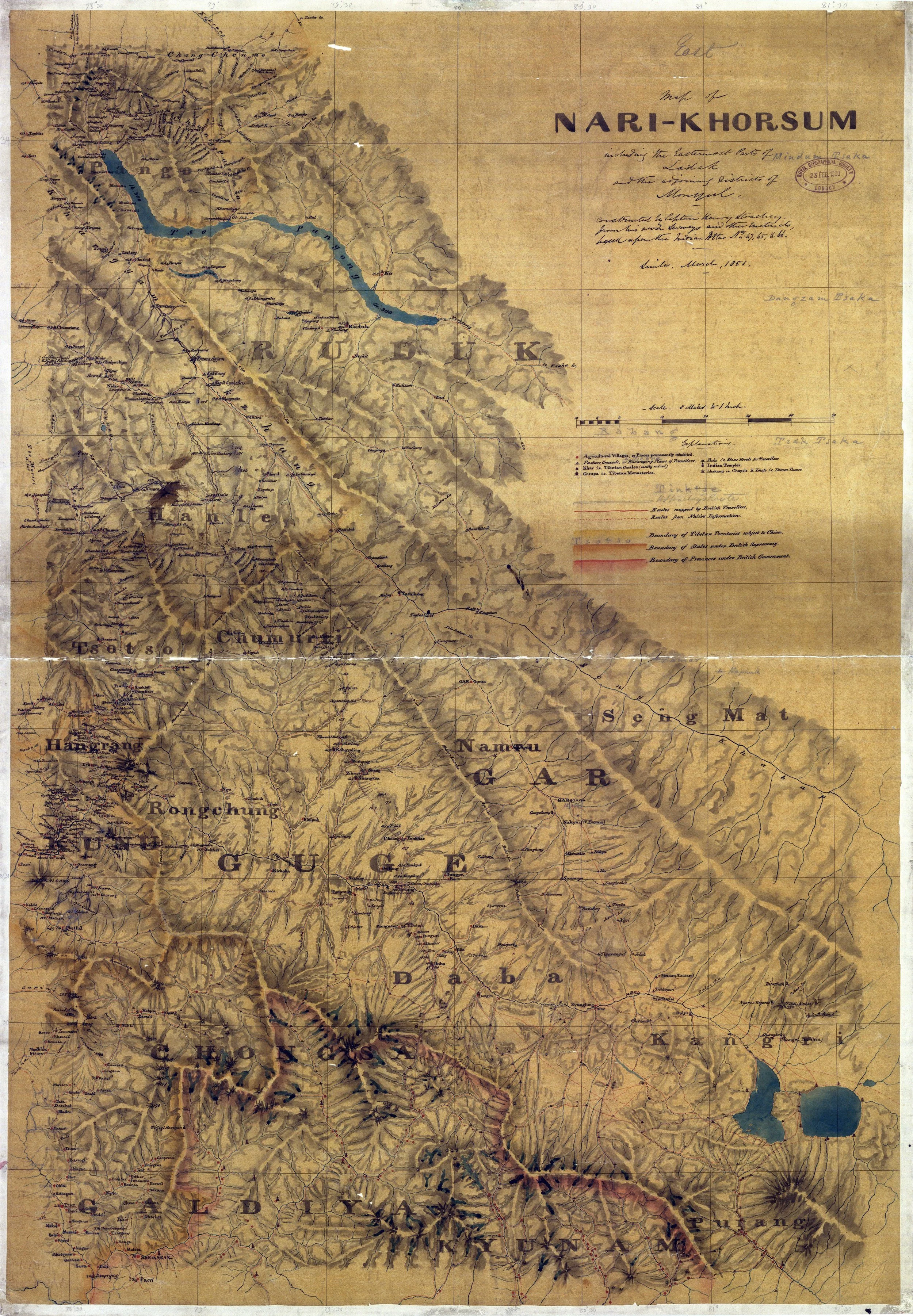
Starchey's Ladakh 1851
Col Starchey was an Officer in the British Army and was involved in the Surveying and Mapping the unmapped Regions to the North of the Great Himalayan Range as well as around Tibet. He made various Journey’s to the Region and came up with some Great Maps of the area and one of the most prominent being the Maps of Ladakh (Western Tibet as it was called) and the Regions around it.


Col Starchey was an Officer in the British Army and was involved in the Surveying and Mapping the unmapped Regions to the North of the Great Himalayan Range as well as around Tibet. He made various Journey’s to the Region and came up with some Great Maps of the area and one of the most prominent being the Maps of Ladakh (Western Tibet as it was called) and the Regions around it.
In this Note we will go through his legendary Ladakh map which came out in Two Parts, the first being Ladakh West with Parts of Balti and Monyul 1851 (labelled as the Ladak Map) and the second one being Ladakh East with Parts of Balti and Monyul 1851 (labelled as the Nari-Khorsum Map)
One of the interesting things is that the names of all the neighbouring Regions are as per what the Tibetans / Ladakhis referred to these Regions as for eg Kacheyul instead of Kashmir.
Also what the Map does is show the names of the Regions in Capital and it reflects on how prominent a certain name was for a Region and how prominent was that Region in itself. This was one of the first Maps of the Region and it came just three years after the first European stood on top of the Karakoram Pass which is the watershed between the Himalayas and Turkestan of old.
The Regions listed in bold in both the Maps are as such :
In the West Ladakh Map
Ladak (Ladakh) : Balti (Baltistan) : Zangskar (Zanskar) : Kacheyul (Kashmir) : Chamba : Kunu (Kinnaur)
In the East Ladakh Map (besides the ones already mentioned)
Ruduk : Gar : Guge : Chongsa : Galdiya : Kyunam
In his account called “ Physical Geography of Western Tibet” written for the Journal of the Royal Geographic Society writes as such ;
The Indian Provinces next adjoining to Tibet are Ashong i e Acham or Assam. Monyul the whole of the Indian Himalaya especially the Sub Himalaya inhabited by Mon i e Hill Indians. Lhopato, Lho dukor Lho mon, the Bhotant of Bengal or Bootan of the English. Its capital b Krashismchhosdzong or pronounceably Tashichuzong i e the August City of Religion improved by the English to Tassisudon and the like Demojongs i e the Goodly Region, the Shikim Shikimpati or Sikkim of Indians and English the British cantonment in its lower part is r Dorjegling or Dorjeling corrupted to Darjeeling and the like a name equivalent to Vajrapura or in plain Saxon Thunderbolton otherwise the Place of the Heavenly Sceptre or of the Precious Stone or Diamond Kangschan hJing i e the Icy Mass is the great snowy mountain on the N border of this province famous as the highest measured peak on the globe
Palbo is Naipal (Nepal), Kyunam is Kumaon, Galdiya is Garhwul, Chongsa is Himalayan Garhwal. Kunu is the District of Knor Kanor Kanoring Kanaur Kunawar (Kinnaur), c Nyungti is Kullu, Garzha is Lahaul, Panga of Himalayan Chamba, Paldar and Maru Wardwan of Himalayan Kishtwar are called by their native names Kacheyul vulgo Kachul is Kashmir
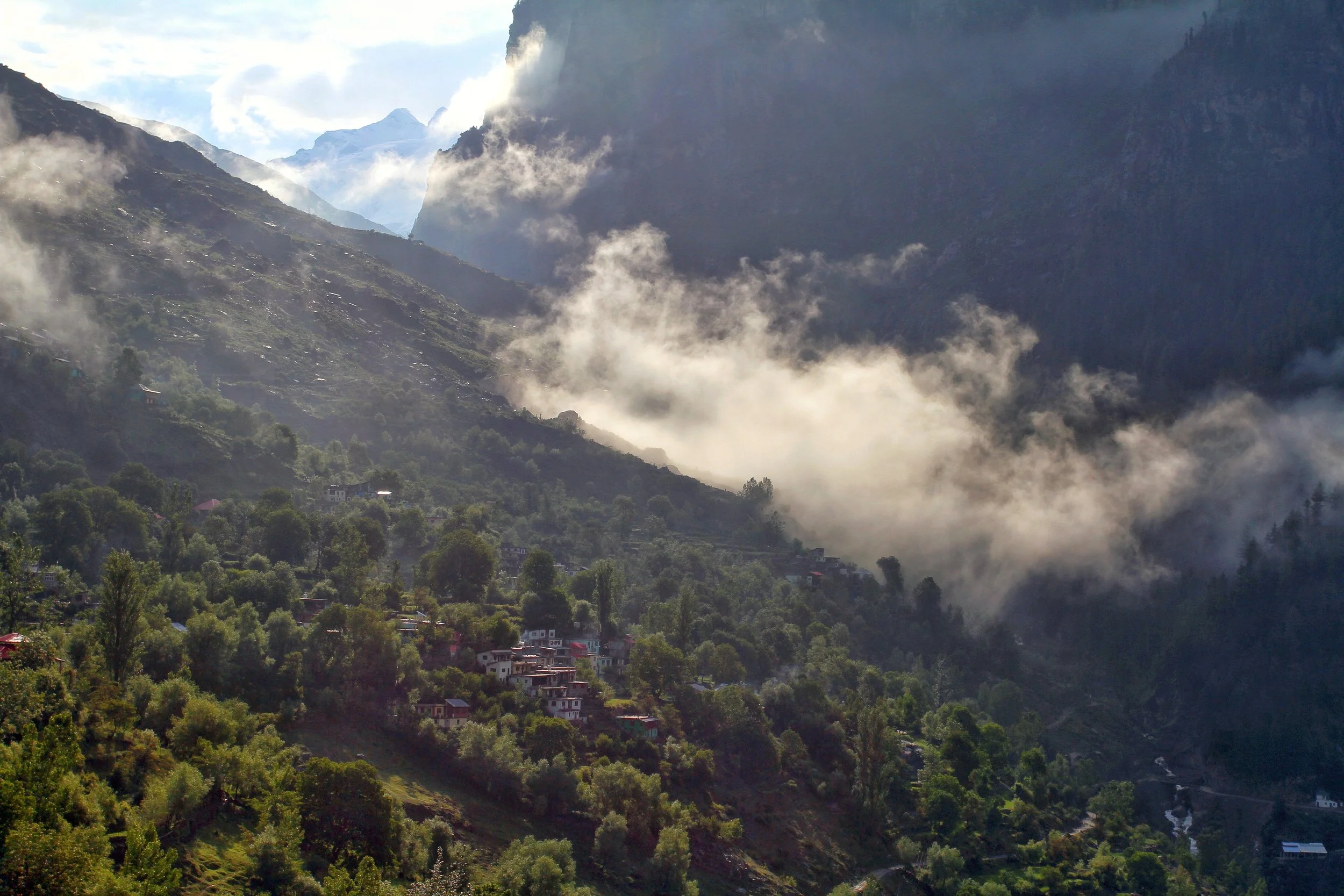
Rainfall in the Himalayas
But as the Weather Readings below will testify the Monsoon is not consistent over the Himalayas. Different areas in the Himalayas get different amounts of Rainfall during the Monsoons. And the Monsoons are not the only Rainy Season in the Western Himalayas. There is another Rainy Season which arrives in December and it comes in the form of what we call Western Disturbances which are Rain bearing Clouds rising above the Mediterranean and making its way to the Western Himalayas.

Rainfall in the Himalayas
It's Monsoon season again and many people Plan visiting the Mountains during the Rainy Season. It might not be the ideal Season to go to the Mountains due to all the Landslides and Floods but Rains in the Mountains have their own charm.
But as the Weather Readings below will testify the Monsoon is not consistent over the Himalayas. Different areas in the Himalayas get different amounts of Rainfall during the Monsoons. And the Monsoons are not the only Rainy Season in the Western Himalayas. There is another Rainy Season which arrives in December and it comes in the form of what we call Western Disturbances which are Rain bearing Clouds rising above the Mediterranean and making its way to the Western Himalayas.
Of course the Eastern parts of the Himalayas get a great amount of Rainfall once the Monsoon arrives. This Rainfall comes from the Bay of Bengal branch of the Monsoons and the Rains travel upcountry along the Great Himalayan Range and move into the Central and Western part of the Himalayas. At the same Rain also arrives from the Arabian Sea branch of the Monsoons and this also makes its way up towards the Western and Central Himalayas. Most of you must be aware that most of the Monsoon Clouds don't make it over the Himalayas hence the Trans Himalayas is a Desert Region.
As a result of the Rains and the Mountains meeting, the interplay causes some interesting Weather conditions in different parts of the Himalayas. Ladakh being in the Trans Himalayan zone hardly gets any Rain. The Kashmir Valley also gets moderate Rainfall as the Pir Panjals stop the Monsoon Clouds from going over. Infact the Kashmir Valley gets more Rainfall from the Western Disturbances than during the Monsoon. The wettest Months in the Kashmir Valley are March, April and May. And though it does Rain during the Monsoons its nowhere near the amount of Rain that falls on the other side of the Pir Panjals facing the Northern Plains. Kashmir and Ladakh both are good choices if you want to travel to the Mountains in the Monsoons.
Then we have places like Dalhousie which lie close to the Himachal border with J&K. Dalhousie gets a lot a Rainfall (at 2311 mm) as it stands right above the Plains but the Wettest place in the Western Himalayas would be Dharamshala in the Kangra Valley. It gets a huge amount of Rain during the Monsoons and at the same time it gets Rain from the Western Disturbances (at 2755 mm) . Putting this into perspective Dharamshala on an Average gets more Rainfall in July (at 765 mm) than Srinagar, Kashmir gets throughout the Year (at 721 mm). Interestingly both are at similar Altitudes. Dharamshala infact gets more Rainfall than Darjeeling which is located in the Eastern side of the Himalayas.. Shimla also gets good Rainfall but the Rains are not that Heavy comparatively in Manali and the Kulu Valley.
Moving Eastwards both Mussoorie and Nainital get a lot of Rainfall. Infact Nainital is also one of the Wettest places in the Himalayas and it is the Wettest in the State of Uttarakhand. Of course it goes without saying that the surrounding areas also get a lot of Rainfall. Nainital and Mussoorie also get Rainfall due to the Western Disturbance though not as much as Dalhousie or Dharamshala. And moving even Eastwards we move to Darjeeling which again gets a lot of Rain but thats a feature in the Eastern Himalayas as North East India gets some of the heaviest Rainfall on the Planet. But again the Western disturbance has no effect on Darjeeling and the same is reflected in the Rainfall figures for the Winter Months.
So when you plan a Holiday to the Mountains in the Rainy Season be aware of the variations in the Rainfall patterns across the Himalayas and Plan accordingly.
And here is a comparison of the the Temperatures that prevail in these different Himalayan locations for the sake of comparison. Of course Drass is the most Coldest inhabited Town in India. And Leh is also quite Cold. These are Trans Himalayan Regions and due to the High Elevation and proximity to Glaciers in the case of Drass make it so cold.
After the Trans Himalayan Regions the Coldest places are in Kashmir with Gulmarg being the Coldest and famous as a Ski Resort as it gets a large Amount of its precipitation as Rainfall.
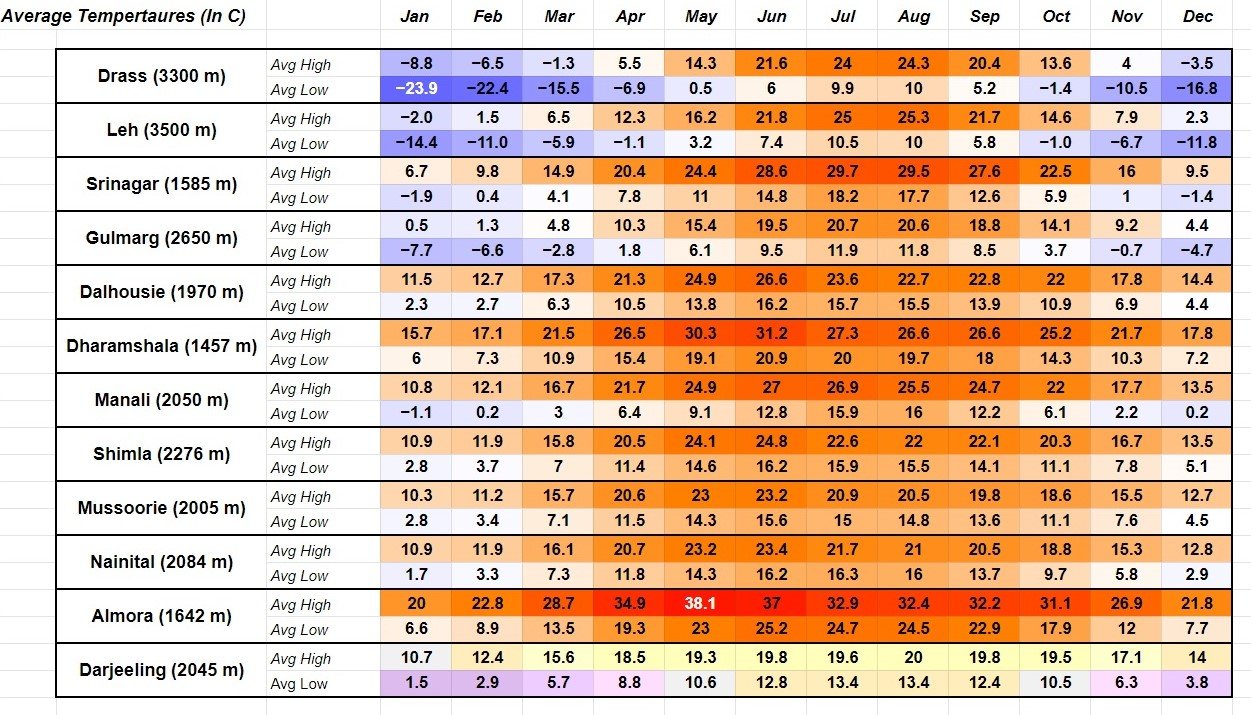
Leh which is the main Town / HQ of the UT of Ladakh has a Cold Climate with severely Cold Winters, a Warmish Summer and due to to paucity of Rains in this Trans Himalayan its classified as a Cold Desert with precipitation per Annum just over a 100 mm. The Wettest Months are July and August when a few Clouds manage to cross the Great Himalayan Range into this Arid Highland. But in these Months also it just experiences around 15 mm of Rain. Do go through our Ladakh Travel Guide if planning a Trip to Ladakh.

Drass is the Coldest place in India. Well the Coldest inhabited Town at least. It located just beyond the Great Himalayan Range and in proximity of a large number of permanently Glaciated areas amongst other factors. Temperatures dip to close to almost minus 50 Degree C in the Winters. Drass again gets some Rain in August as well as in the Winters thanks to the Western disturbances. And Drass gets 4 times the precipitation as Leh. Drass is probably the Wettest place in Ladakh. Do go through our Ladakh Travel Guide if planning a Trip to Ladakh.

Srinagar
Srinagar is the Capital of the UT of Jammu and Kashmir. It has a Continental Type Climate with Warm to nowadays almost Hot Summers and Cold Winters with the Temperature falling below Zero on most Nights in Winter. As a unique characteristic of the Kashmir Valley the majority of the Precipitation in Kashmir comes due to the Western Disturbance and March / April are the Wettest Months. Kashmir also experiences a Mild Monsoon as some Clouds do make it over the Pir Panjals but it isnt nowhere as heavy as in the other locations in the Himalayas mentioned in this Article. Do go through our Kashmir Travel Guide if planning a Trip to Kashmir.

Gulmarg
And then there is Gulmarg. The world famous Ski Resort in Kashmir. Its located at a certain edge of the Pir Panjals and this is the area that the Western Disturbance usually hits at first and as a result of that Gulmarg gets a lot of Snowfall in Winters. And plus the altitude of above 8000 ft creates the perfect condition for Snow related activities.

Dalhousie

Dharamshala

Manali

Shimla
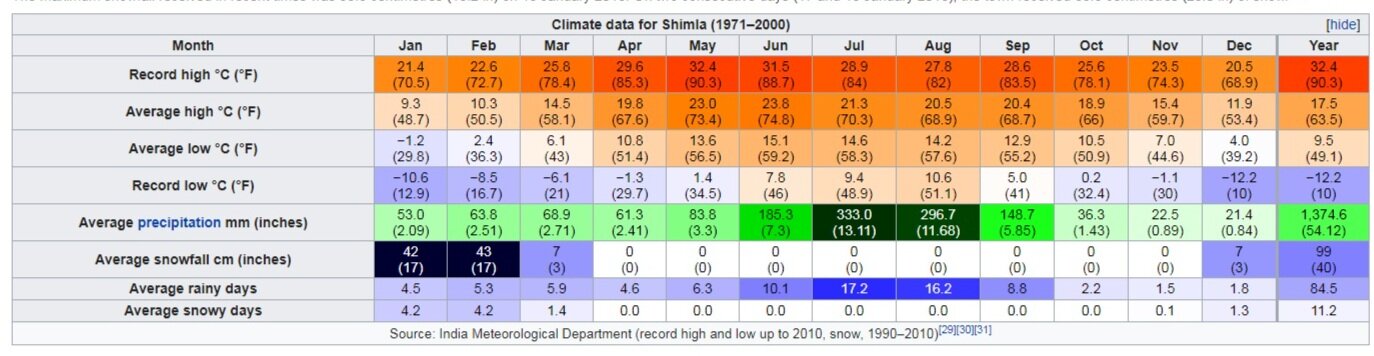
Mussoorie

Nainital

Almora

Darjeeling


Kiki's Guide to Kashmir
A Rough Guide for People planning to visit the Kashmir Valley. And notes on the History, Culture and most importantly the Geography of the Region. And taking you beyond the normal Tourist Hotspots into more Offbeat and even unheard of places in Kashmir.
A truly fascinating place which gives people the visions of beauty and is referred to as the “Paradise on Earth”. The name is enough to conjure up images of snow covered mountain peaks, valleys with a shroud of flowers, enchanting Mountain streams and beautiful lakes. Well the geography and the de facto political boundaries of the state are a bit more complicated. Here I try to explain the complexities of what used to be the Riyasat-e-Jammu and Kashmir in 1947. I will use that as the reference point and as a geographical unit will refer to it as RJ&K.

Moving beyond the territorial claims that individual countries have on RJK and avoiding the political baggage that comes with the veracity of each claim I will just mention the geography and the political status as it exists as on date. Based upon the actual territory that is being held by the various countries which have a claim on RJK. That being said, I would like to emphasise that the purpose of this article is to educate travellers and mountain lovers about where they can go and where they cannot, which is governed basically by their nationality and the relationships which exist between individual countries.
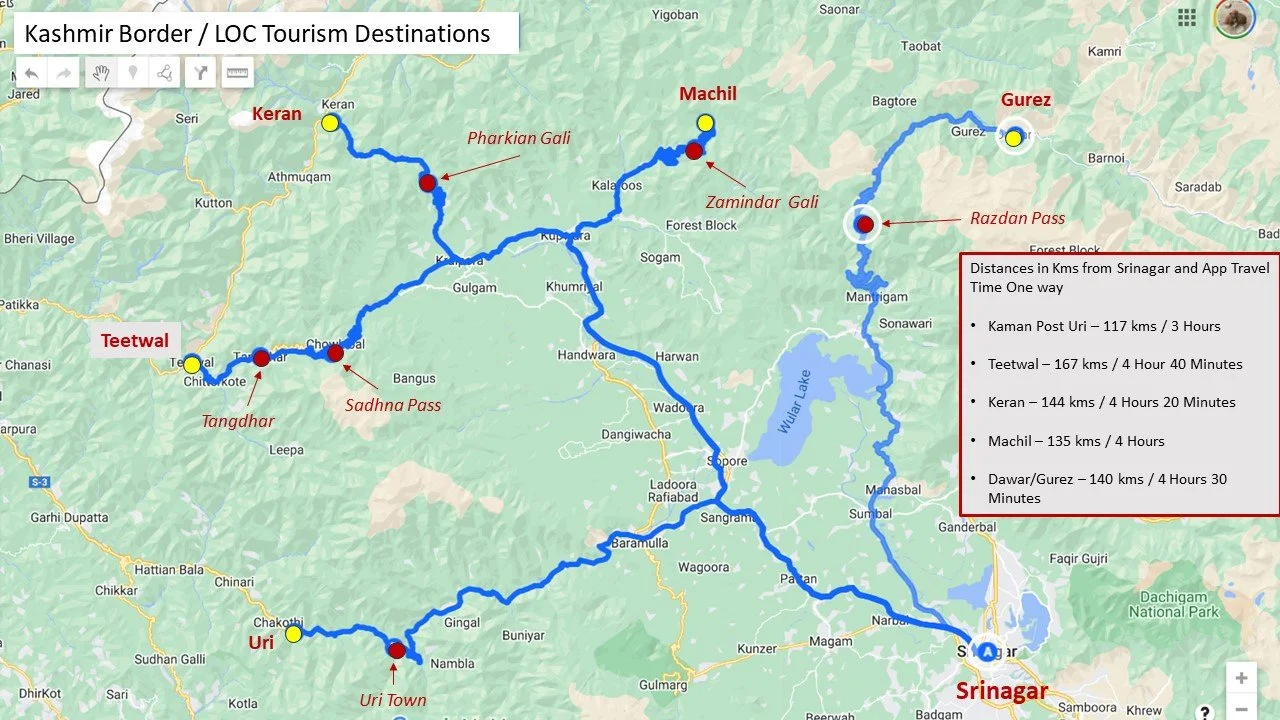
Offbeat / LOC Locations in Kashmir
RJK consisted basically of the regions Jammu, Kashmir, Ladakh, Baltistan, Gilgit and the uninhabited Aksai Chin. I would first comment on the areas of RJ&K that are under de facto Indian control which I will call J&K. J&K broadly consists of the regions of Jammu, Kashmir and it used to include Ladakh. Until they were divided into two separate Union Territories, one J&K and one Ladakh. However there are little parts of the former Baltistan that exist in J&K like the Kargil district and even Gilgit like Gurez. Jammu consists of the Jammu district as well areas along the border like Poonch, Rajouri, Udhampur and Doda. The beautiful Valleys of Bhadarwah and Kishtwar are also a part of the Jammu region. Jammu has its share of mountains especially the rugged region of Kishtwar but they are largely unknown and away from the glare of the outside world. I will cover the Jammu region in detail in a later post but for now we move on to Kashmir.
From Jammu we move onto the fabled “Vale of Cashmere” as it was called. Technically the Valley starts once you cross the Banihal Pass/ Banihal Tunnel (Pir Panjals) on the highway or when you cross the Pir Ki Gali Pass (Pir Panjals) on the Mughal Road when coming from the South. The original road to the Valley via Muzuffarabad is no longer in use due to political reasons. Also you can alternately cross the Sinthan or the Margan Pass to go to Kishtwar or Warvan. Up North the Zoji La marks the exit from the Valley while to the North West the Razdhan Pass would also entail technically leaving Kashmir Valley but those areas of Gurez are still considered a part of the Kashmir region.
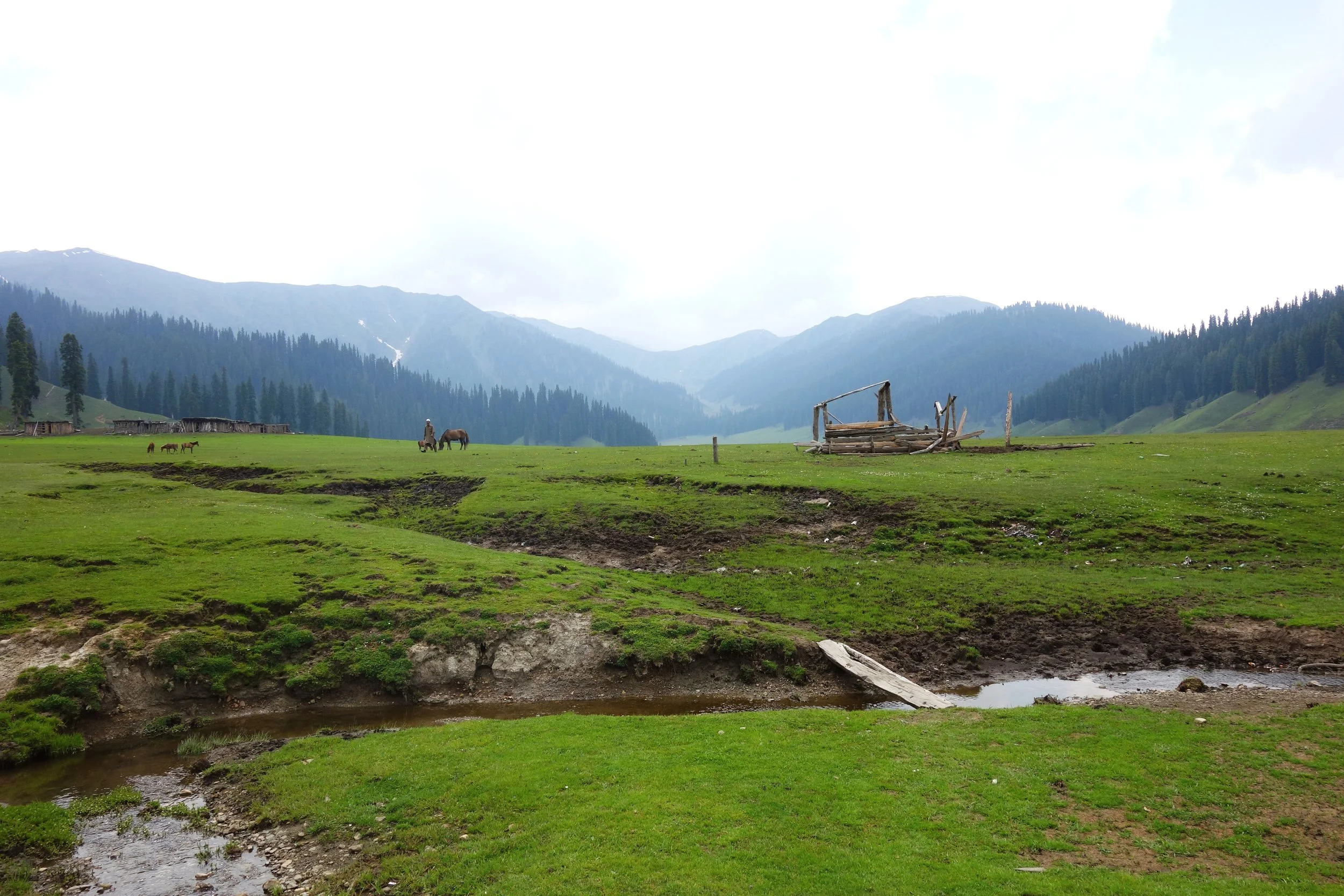
In the geological past the Valley was once a lake called the Satsar Lake which drained eventually due to various factors. However there is still a large diversity of of Lakes from the largest Wular Lake to the most famous Dal Lake to thousands of high altitude lakes nestled within the mountains which are an attractive trekking destination. The Kashmir Valley is bound on the South and South West by the Pir Panjals. And on the North and North East by the Great Himalaya and the Zanskar Range. It is by far the largest Valley in the complex Greater Himalaya Mountain system and certainly the most celebrated one.
Kashmir Valley is actually the Jehlum Valley and the Jehlum is the main drainage system for the Valley. The traditional source of the the Jehlum is considered to be the springs at Verinag. However many attribute the source to the Konsarnag Lake and even the Sheshnag Lake. The Lidder and Sindh are two main well known tributaries of the Jehlum. The Lidder has two main sources the Kolahoi Glacier for the West Lidder and the Sheshnag Lake for the East Lidder. The Sindh River rises from the Machoi Glacier near the Amarnath Caves.

A Faith Map of Jammu and Kashmir by Drew in 1875
Srinagar is the capital city of J&K and lies on the banks of the Jehlum River and it also includes the famous Dal Lake and the Nigeen Lake. The city is well know for the various Gardens laid out by the Mughals as well as the new fangled Tulip Garden which is a hit with the tourists. The Srinagar city has its own range of mountains called the Zabarwan Mountains which is a sub range of the Zanskar Range. The home of the endangered Hangul, the Dachigam National Park also lies on the edge of the City.
There are various other places of tourist interest in the Valley including Gulmarg, Pahalgam, Sonamarg, Yusmarg, Kokernag, Verinag, Achabal, Daksum, Parang and lately places like Doodpathri etc. My personal favorite has always been Gulmarg probably because I have sent a lot time here while growing up. However recently it is is over crowded and over priced. Gulmarg is a great Winter destination due to the humongous amount of Snows it gets.

The Wadwan Marwah River
The lesser know place which has fascinated me the most has been the Warwan Valley which could only be reached by trekking in the good old days. I happened to spend 5 nights in this enchanting Lost World. Being born in Kashmir and having familial connections in Himachal I have seen a lot of mountains but Warwan was special. Nowadays there is a road which goes over the Margan Pass and takes you to Inshin, the main village in Warwan. As of now I am not aware of how further this road goes. Technically though Warwan is a part of Kishtwar and hence a part of the Jammu Region.
A special note on Warwan Valley : The people of this region are by some accounts the closest that come to the ancient Kashmiris. Their language is the purest form of Kashmiri. The Warwan River runs through this enchanting Valley. This Valley runs parallel to the Lidder Valley and is around 3 to 4 km wide and 30 km long at an average elevation of 8000 to 9000 ft. At a place called Sukhnis the Valley transforms into a Gorge and on reaching Rangmarg you have two options.Taking a left leads you to the Gulol Pass crossing which you can descend into Sheshnag. Going straight takes you to the Botkol Pass going over which you come down to Panikher in the Suru Valley (Zanskar). This is the same route taken by the indomitable General Zorawar Singh when he launched his expeditions into Ladakh. Interestingly there was a Government proposal to make a road from Pahalgam to Panikhar which would technically be 45 kms but would provide unparalleled beauty as for almost half that route would under be the shadow of the fabled Nun Kun Massif. A point of special note is that Warwan as such is not in proximity of the Line of Control as compared with Gurez or Lolab.
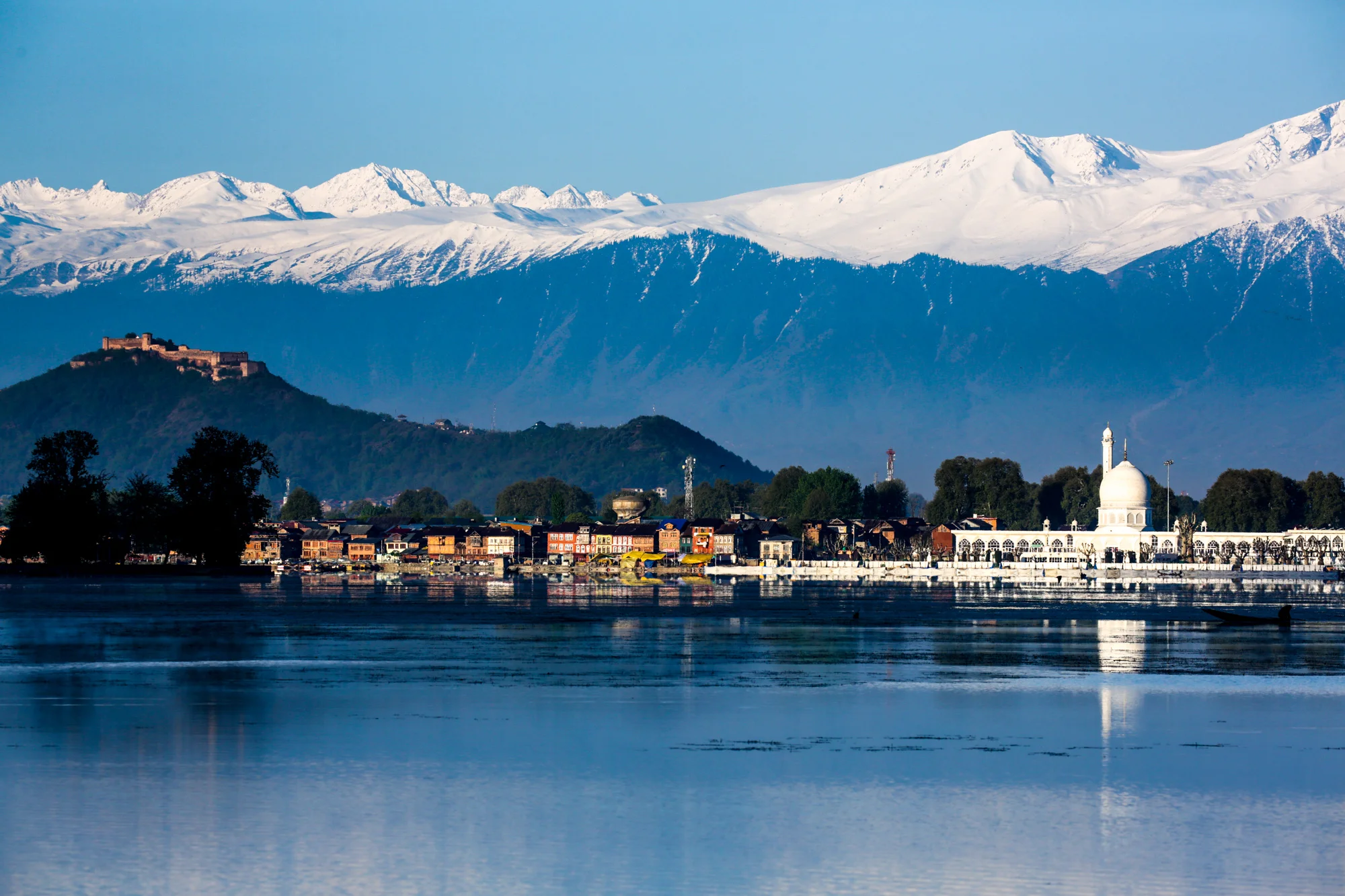
The Hazratbal Shrine by the Dal Lake and the Pir Panjals in the back ground
On the same axis lies the Sinthan Pass which connects Kashmir with Kishtwar proper. This scenic Pass is now becoming a destination as more and more Tourists go there to experience Snow which lasts well into June usually on the Sinthan Pass. One can also cross the Pass and go into Kishtwar and there are many interesting places there as well. Totally Offbeat.
Another region which sees a lot of tourist interest in the Gurez area. Gurez is actually a part of the Gilgit region but is counted in the Kashmir Valley. The people in Gurez speak Shina and were always more aligned with fellow Shina speakers in Gilgit rather than with Kashmir. The road to Gurez leads one over the Razdhan Pass and then you enter the enchanting land called Gurez. There is a road which goes from Gurez towards Kargil but as of now it is a military road but earlier that used to be one of the main Roads into Gurez. The fact that it is a part of Baltistan is borne out by the fact that the locals speak the Shina language, which is quite prevalent in Baltistan instead of Kashmiri.
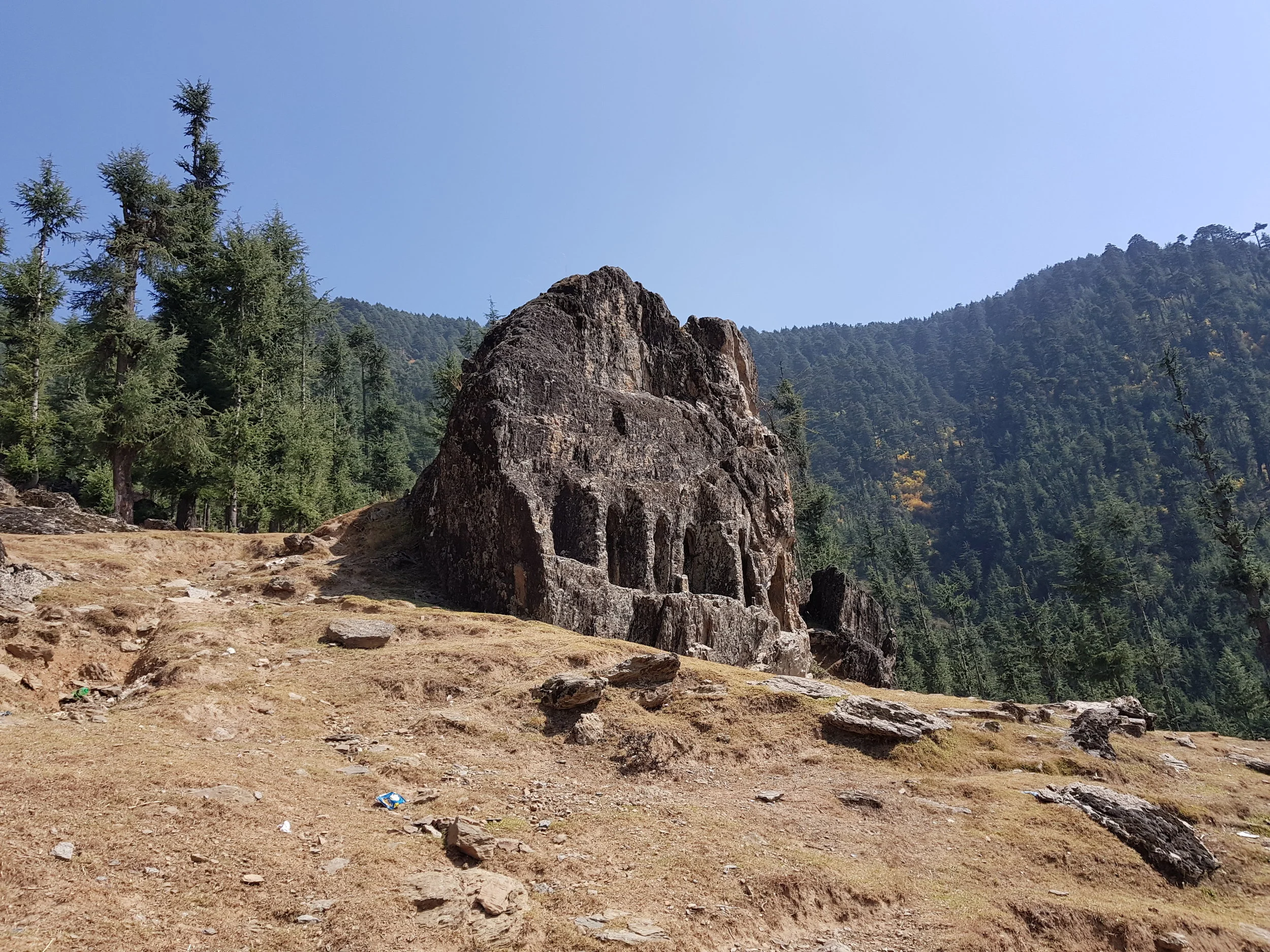
The Kalaroos Cave in Loalb Valley
And then there is the Lolab Valley and the Bangus Valley (both the Bod Bangus and the Lokut Bangus) in North Kashmir district of Kupwara. These are again very scenic areas but the movement of civilians especially tourists was severely restricted due to the proximity to the Line of Control. However now the restrictions have eased up and many Tourists now visit Bangus. Bangus is the largest Alpine meadow in Kashmir and covers a large area. The other famous Meadows in Kashmir like Gulmarg, Doodhpathri, Yusmarg and Tosa Maidan lie in the Pir Panjals and South and Western Kashmir but Bangus abuts the Great Himalayan Range itself. A Motorable Road has already been built to Bangus itself and Vehicles with 4x4 and Good Ground Clearance can already get t Bangus and even normal Passenger Cars would be able to get there once the Road is black topped.
And now for the first time the Government is trying to promote Tourism to the areas which lie right on the LOC along the Kishenganga. This includes places such as Machil, Keran, Tangdhar and Titwal. Ours is the first Travel Company which has started limited Tours to these places for Adventurous clients.
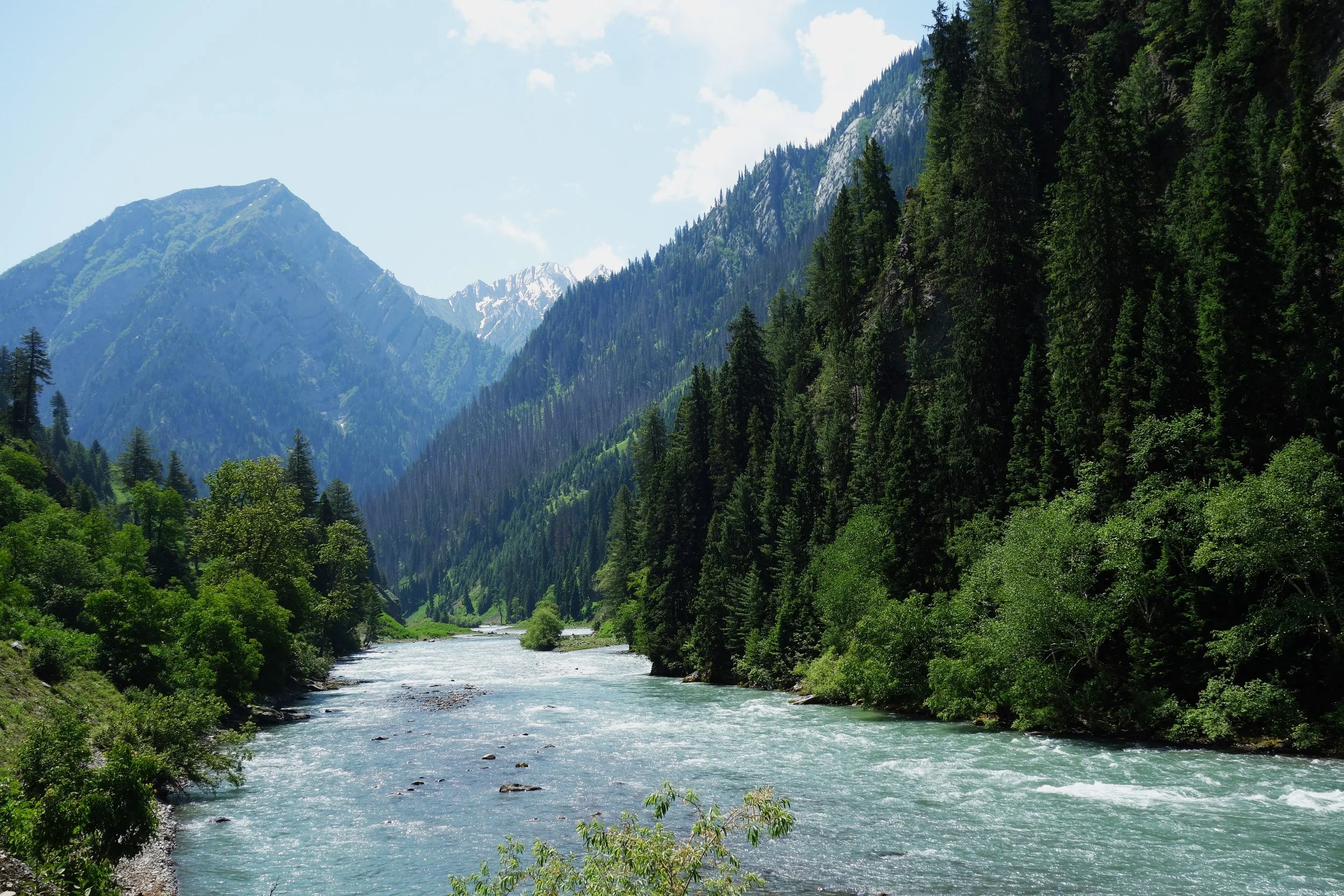
The Kishanganga River flowing through the Gurez Valley.
Weather
Kashmir has a Continental Weather with a proper 4 Seasons. In the Winters it can get quite Cold and all areas of the Valley get Snow in the Winters. Places like Gulmarg get a huge amount of Snow and that's why it's everyone’s favourite Winter Destination. Spring is probably the best Season in Kashmir with pleasant Days and Chilly Evenings. The Summer starts around mid June and July and in recent years it has started to get really Hot in Summers. Autumn again the Days become pleasant and the Nights Chilly.
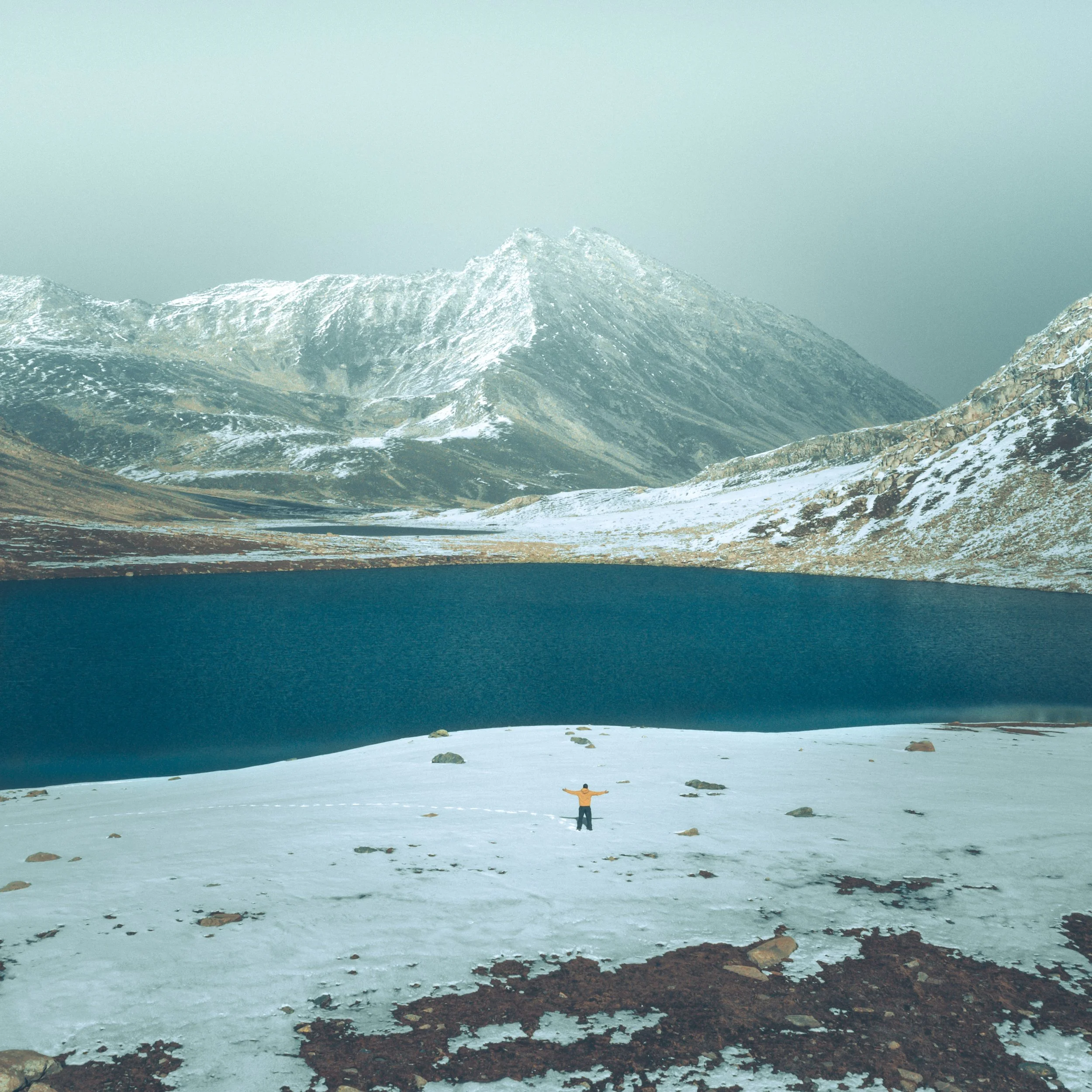
Transport
The biggest advantage in Kashmir is the International Airport in Srinagar and its connected directly / indirectly with all Major cities. The Flight from Delhi to Srinagar is just One and Half Hours. Of course there is the Highway as well its on the verge of being connected by Rail in a couple of years.
Places to Stay
Kashmir offers a large Range of Accommodations especially in the areas more popular with the Tourists. From Budget Hostels to Five Star plus accommodations. Plus there are Homestays which offer a unique Cultural Experience as well. You can also take a look at Our Kashmir Boutique Stays in Srinagar and Pahalgam. And soon we will be in Gulmarg as well.
Tours
Here are some of the Signature Tours we run in Kashmir for people interested an authentic Kashmir Experience. People coming for the first / second Time can opt for our Kashmir Boutique Experience. People who have been to Kashmir before but now want to Experience the Offbeat side of Kashmir can go for our Kashmir Offbeat : Gurez, Lolab and Bangus Tour. And for People who want edge of the Seat Adventures we can recommend our Kashmir Edge Border Tour.
We can Customize as well and Organize Trips to all these Places. Connect with us on Whats App Messenger on 98712 92288 for a Great Kashmir Experience.

Warwan Marwah Dacchan : The Last Inner Himalayan Wilderness
Kishtwar itself is remote and always under the shadow of Kashmir but this part of Kishtwar which lies next to Kashmir on one side and the Suru Valley of Ladakh on the other side is probably one of the last great wildernesses in the Inner Himalayas. This is the Warwan- Marwah - Dachchan belt lies along the Maru Wadwan River or as its also known Warwan / Marwah (Marev) / Marsu Dhar River along different parts of its course, which is a major tributary of the Chenab.

In the Inner Himalayas lies a beautiful Region so remote that most people haven't even heard of it forget about going there. Kishtwar itself is remote and always under the shadow of Kashmir but this part of Kishtwar which lies next to Kashmir on one side and the Suru Valley of Ladakh on the other side is probably one of the last great wildernesses in the Inner Himalayas. This is the Warwan- Marwah - Dachchan belt lies along the Maru Wadwan River or as its also known Warwan / Marwah (Marev) / Marsu Dhar River along different parts of its course, which is a major tributary of the Chenab. These three sub parts of this Region all lie along the same River and offer a rare insight into how people lived maybe many years ago. Sandwiched between the Pir Panjals and the Great Himalayan Range this is a Region few outsiders have set foot.
My romance with this area began in 1989 when I was a student in Class 9 in the Burn Hall School, Srinagar. We were supposed to Trek from Daksum in Kashmir to Kishtwar via the Sinthan Pass. But at the last moment the original Trek was changed. Now we were to go from Daksum to Pahalgam via the Warwan Valley. None of us had even heard of Warwan Valley before but of course we had little choice in such matters. So off we went and on the second day we climbed up the Margan Pass and started to descend into Warwan Valley towards Inshan.
It was like walking into a lost World. The Houses were still made all of wood and the people still held that innocence. Of course the whole Village was excited as we were around 30 people. Technically though Warwan is in Kishtwar the people here speak the purest and the oldest form of Kashmiri. We happened to Trek for a few days in the Valley headed North and after reaching the head of the Valley we turned right and went over the Gulol Pass and descended onto the Sheshnag Lake to join the Amarnath trail. And of course we didnt take any pics at that time. But the memories were still there. And even today pics of these areas are very hard to come by.

The Gazetteer of Kashmir puts it as such :
MARU WARDWAN (They considered the Wardwan and Marwah as one long Valley which is also kinda like the case)
The name of a long and narrow valley lying to the South-East of Kashmir, from which it is separated by a lofty range of mountains; its direction is nearly north and south, its length being about 40 miles, and its average breadth not more than a quarter of s mile; that part lying between Maru and Wardwan being merely a narrow defile, whose sides are very steep and covered with a jungle, chiefly of fir trees. It is bounded by high and rugged mountains , which almost entirely exclude the sun from its lower portions.

The river which intersects it is a considerable stream which swells to a mighty torrent during the melting of the Snow. It rises at the northern extremity of the valley, on the borders of Suru, and flows south until it joins the Chandrabhaga just above Kishtwar, receiving in its course several tributaries from the numerous minor valleys which open on each side of it.
The upper portion of the valley is called Wardwan, and the lower Maru, The Village of Inshin, in the middle of the valley, is distant about 84 miles north of Kishtwar; and thence to Suru, by the Bhot Kol Pass, is about 76 miles, or five marches. There are various paths communicating between the Maru Wardwan Valley and Kashmir ; the principal are those lying over the Margan and Hoksar passes ; by the former Islamabid is distant 67 miles from Inshin, and by the latter 51 miles from Maru or Petgam.
'The Maru Wardwan valley contains several thinly-populated villages; the houses, which are double-storied, are roughly built of timber, and have pent roofs. It forms a portion of the Udhampur district.

Very little difference is observable in the dress and appearance of the inhabitants of this valley and of those of Kashmir, but they seem to share some of the prejudices of the Tibetans, as Vigne relates that he was told that after a death among the inhabitants of the Maru Wardwan valley, none of the deceased's relatives will touch milk until the arrival of a particular day. All the natives of the valley are, mith scarcely an exception, Muhammadans.
The climate ie very rigorous, and rain or snow falls throughout the greater part of the year; the stony fields produce but one harvest in the twelve months, and that is limited to a scanty crop of Trumba and Grihmah, and for five months of the year the inhabitants are absolute prisoners to their houses, the snow lying 10 and 15 feet deep, entirely blocking up the lower stories of the habitations. Pollard trees, Which elsewhere furnish abundant supplies of fodder for the cattle during the winter months, are very scarce, and such trees, as do grow, are small and stunted. Despite these disadvantages a considerable number of ponies are bred in the Valley, and taken to Suru, where they find ready sale or barter.

A good pony, between three and five years old, fetches, it is said, about Rs.20 (British currency). The vendor prefer to be paid in cash, but has frequently to be contented with tea ; in this case be receives a damu (a weight equal to three seers) of tea, which is valued at Rs.17 ; on this he is required to pay an import duty of Rs.2 at the custom post at Sukhnis, at the north end of the valley. If fortunate, he disposes of his tea to an itinerant merchant in the Valley, otherwise he must continue his journey to Islamabad or Srinagar before he can sell it for the Rs20 it is supposed to be worth in Kashmir ; in either case, when the labour and risk are considered, it is apparent that the transaction brings little or no profit.
The geological formation of the Maru Wardwan valley is gneiss, mica alate, and a silicious grit. The Maru Wardwan Valley is mentioned by Abul Ful in the Ayin-Akhbari ss the Murwar Dhun.

DACCHAN
The name applied to the mountains on both sides of the defile to the South of the Maru Wardwan Valley, through which the river flows on its course towards Kishtwar. The path which lies up this valley is extremely difficult, and not practicable for ponies. (Pigne.)
Now there are a few interesting Tales and Stories of this Region outlined by a few visitors who came to this place including the most eminent Archaeologist of Kashmir, Ram Chandra Kak who went onto become the Prime Minister of the Riyasat under Maharaja Hari Singh. RC Kak had visited the Valleys in the 1920s and were published in the publication called the Antiquities of Marev Wadwan.

The Valleys of Wadwan and Marwah are completely Muslim barring a few in Marwah and in Dachan they are mostly Hindu. But historically it was the inhabitants of Marwah who were more warlike who dominated all the 3 Valleys. The hereditary Zamindars carried the surname Malik but were originally Rainas pointing out that they came from outside. As per their local tradition their ancestors came from Bengal but the actual history is obscured in the fog of time. The most amazing part was that R C Kak was shown actual firmaans issued in the name of the Maliks by the Governors of Kashmir from the time of Jahangir and all the way to the time of Shah Shuja. These Marwah Maliks even provided Marrivs (as the local residents are called) to General Zorawar Singh for his campaigns in Ladakh and apparently they gave a good account of themselves. It said even from his last Campaign a few Marivs were among the few who survived.
Moving towards the South we come to the Region called Dachchan which is mostly Hindu and quite a mysterious one at that. RC Kak noted that the condition of the Men in Dachchan was unusually wretched which was because apparently almost every Woman there was proficient in the Black Arts and Witchcraft. The Men it seemed were constantly under their spell. He also noted that Marriage was quite a casual affair where a Man who found himself in an affair with a Married woman could simply pay her husband off and get her as his Wife. RC Kak noted that the whole Society was deeply ensconced in Sorcery and deviousness of all kinds. And then there were another set of people who would actually help you combat the evil spells and curses cast upon you. Curiously the Sorcery did not work on the Maharaja’s officials as it was said that during the rule of Maharaja Gulab Singh the Witches promised that they wouldn't cast their magic on his Officials. And I guess the Witches stuck to their promise.

Of course times have changed now but still due to the absence of proper Roads the area remains pretty cut-off. And as a result Backward but as the photographs would testify as far and Natural beauty is concerned this Area is second to none and hopefully now that the State has become a Union Territory some Tourism would be promoted in this Region and in Kishtwar as a whole. Nowhere else in the Himalayas due you get such a mix of Culture, Language and Religion as you do in Kishtwar.
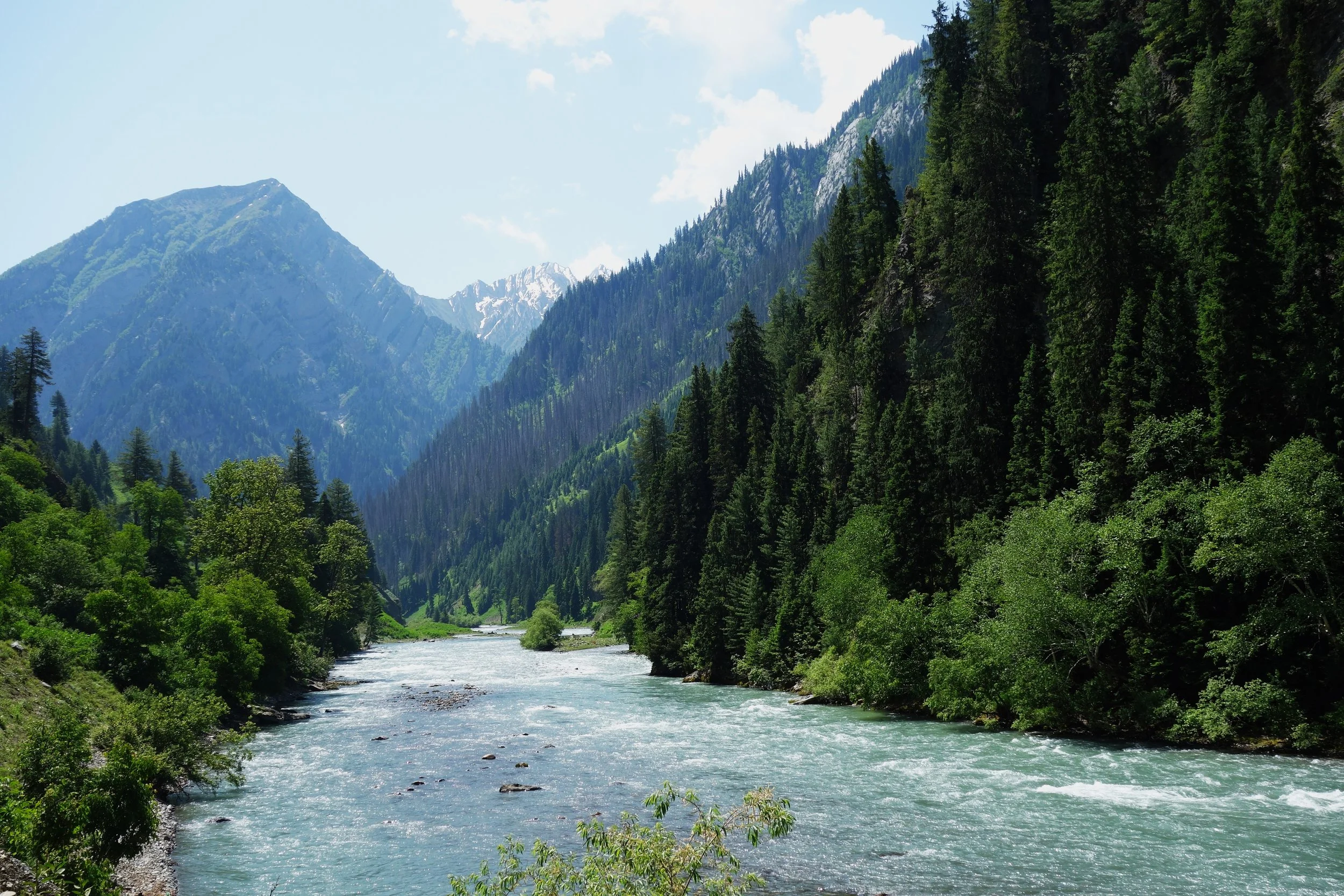
The Border River : Kishanganga aka Neelam
The Kishanganga is the main River flowing through the enchanting Gurez Valley rising in the Kishansar Lake (which is a part of the Group of Lakes commonly referred to as the Great Lakes) and flowing through some great Mountain scenery until its confluence with the Jhelum around Muzaffarabad in Pakistani held Kashmir. The River was renamed as the Neelam in Pakistan in the 1950s. Old Maps and Books still refer to it as the Kishanganga.

The Kishanganga is the main River flowing through the enchanting Gurez Valley rising in the Kishansar Lake (which is a part of the Group of Lakes commonly referred to as the Great Lakes) and flowing through some great Mountain scenery until its confluence with the Jhelum around Muzaffarabad in Pakistani held Kashmir. The River was renamed as the Neelam in Pakistan in the 1950s. Old Maps and Books still refer to it as the Kishanganga.
The River as mentioned originates at the Kishansar Lake which lies in the Mountains above Sonamarg and is joined by the Raman Sind and then it flows in a Western direction and enters Gurez where its joined by the Burzil Nallah which comes down from the direction of the Burzil Pass which was the Pass on the Trade Route which connected Kashmir with Astore and Gilgit. Of course now the Route is not used anymore and Burzil Pass is on the Pakistani side.

The Gazzetteer describes the tributaries as such : The principal tributaries of the KishanGanga are the Raman Sind has been mentioned as joining it from the south side of the Tilai Valley; the Burzil stream, which flows through the north~east portion of the Gurais Valley ; the Matsil a considerable stream which drains the mountainous tract to the North of the Kashmir valley ; the Kel dara, which drains a similar district on the right bank of the Kishanganga, South of Chilas and Astor, and flows in nearly opposite the Matsil. The natives describe the Kel river as running into KishanGanga at right angles, with such force and volume as to arrest its course, causing a large whirlpool just above the junction. At. the north end of the' Drawar district, the Kishanganga is joined on the right bank, nearly opposite to Sharidi, by the Kankatori or Samgan, and in the middle of the same district, also on the right bank, by the Jagran river, receiving the united waters of the Shamahabari and Kazi Nag streams, the drainage of the Karnao valley, by its left bank at the village of Tetwal. Besides the tributaries above enumerated, the Kishanganga receives contributions from innumerable streams and torrents.
Sadly today the beautiful Geography stands defeated by the vagaries of Politics. Of its app 250 kms length, app 50 kms lies on the Indian side while the rest is either the border or on the other side. The Valleys on both sides of the River are incredibly beautiful but in most places you can see across the River but never can go across. It is the border River but in Geographic terms as well the Kishanganga River marked the limit of the Kashmir Valley in a broader sense. Its point of origin is not very far from the point Kashmir ends and Ladakh starts. And the point where it merges with the Jehlum around Muzzafarabad is the edge of Kashmir where traditionally Kashmir meets the Potohar Plateau and the Plains of the Punjab.

Historically as well the Kishanganga has made its mark. The area drained by the Kishanganga was referred to as the Shardadesh which is in reference to ancient Sharda University or the Sharda Peeth which was a great centre of Learning and one of the most revered places for the Kashmiris. It was referred to as one of the most revered Holy Places in India by Al Beruni as well.
Also it was along the Kishanganga ran the Trade Route which connected Kashmir with Astore and Gilgit. One had to cross the Rajdhanigan Pass or the Tragbal Pass to enter Gurez. Then you went upstream the Kishanganga to the Tulail Valley where you followed the Burzil Nallah up the Burzil Pass and where there on descend into Astore and further into Gilgit. There would have been few Trade Routes which could have rivalled this one in beauty. Of course many like to give it the fancy moniker of “Silk Route” but then any Route which crossed the Himalayas and connected with Central Asia and in turn with China was called the Silk Route. But after the events of 1947 Trade along this Route stopped and the Route lost its relevance.

From the Indian side you can of course see the River in its glory in Gurez and in the areas along the LoC like Karnah, Titwal and Machil. These areas have recently been opened for Tourists starting with Gurez where a few Tourists are going nowadays though the Government is now promoting Tourism in other areas as well along this River.
And the Indian Government is building a Dam on the Kishanganga and work is already underway and it has created a large Reservoir near the Village of Dawar and the waters would be diverted via a Tunnel towards Bandipora and into the Wular Lake. Of course the Volume of water now after the Dam will become lesser and the difference between the River before the Dawar and after the Dam is apparent.
The Border River now controversially stands tamed.
Kiki’s Blog
Stories from the Himalayas
Five years ago the Galwan Valley was in the News for the wrong reasons after a deadly clash between the Indian and Chinese Armies in the Valley located in Ladakh lead to many deaths on the contentious Border between the two countries in wake of continued Chinese intrusions into Indian territory.
This area along the Shyok River, of which the Galwan Nallah or the Galwan River which forms the Galwan Valley has been off limits to Civilians since long but now the Indian Government has decided to open up the area for Civilians and we were amongst the First Civilians to venture into this beautifully desolate part of the Eastern Karakorams in Ladakh. Earlier Civilians could only venture upto the Village of Shyok from where the Shyok River takes a U turn and flows in a Northerly direction.