

Ten Offbeat Things to Do in Ladakh
Most People while visiting Ladakh just visit the same old Places, popular Tourist places and ones popularized by Bollywood and Influencers on Social Media. As a result a few Places bear the brunt of the Tourist footfalls which has serious Environmental and Social Impact.
I have always subscribed to the Philosophy that instead of sending 100 people to 5 places send 20 people to 25 places. Ecologically viable Tourism starts by spreading the load of the Tourists. And here is a list of Ten Things that I would recommend to do in Ladakh. And please remember that Ladakh is a large Region and most of it is rather unknown for most people. Ive added a Note on the Mountain Geography of Ladakh for easier understanding. You can also read my Ladakh Travel Guide for General Information.
So I have compiled a list of Ten Things that I would do in Ladakh, keeping in view all my Visits and Readings on Ladakh. They are in no particular order and each One is a Unique experience in its own.

Most People while visiting Ladakh just visit the same old Places, popular Tourist places and ones popularized by Bollywood and Influencers on Social Media. As a result a few Places bear the brunt of the Tourist footfalls which has serious Environmental and Social Impact.
I have always subscribed to the Philosophy that instead of sending 100 people to 5 places send 20 people to 25 places. Ecologically viable Tourism starts by spreading the load of the Tourists. And here is a list of Ten Things that I would recommend to do in Ladakh. And please remember that Ladakh is a large Region and most of it is rather unknown for most people. Ive added a Note on the Mountain Geography of Ladakh for easier understanding. You can also read my Ladakh Travel Guide for General Information.
So I have compiled a list of Ten Things that I would do in Ladakh, keeping in view all my Visits and Readings on Ladakh. They are in no particular order and each One is a Unique experience in its own.
1. Explore the Basgo Monastery and Fort :
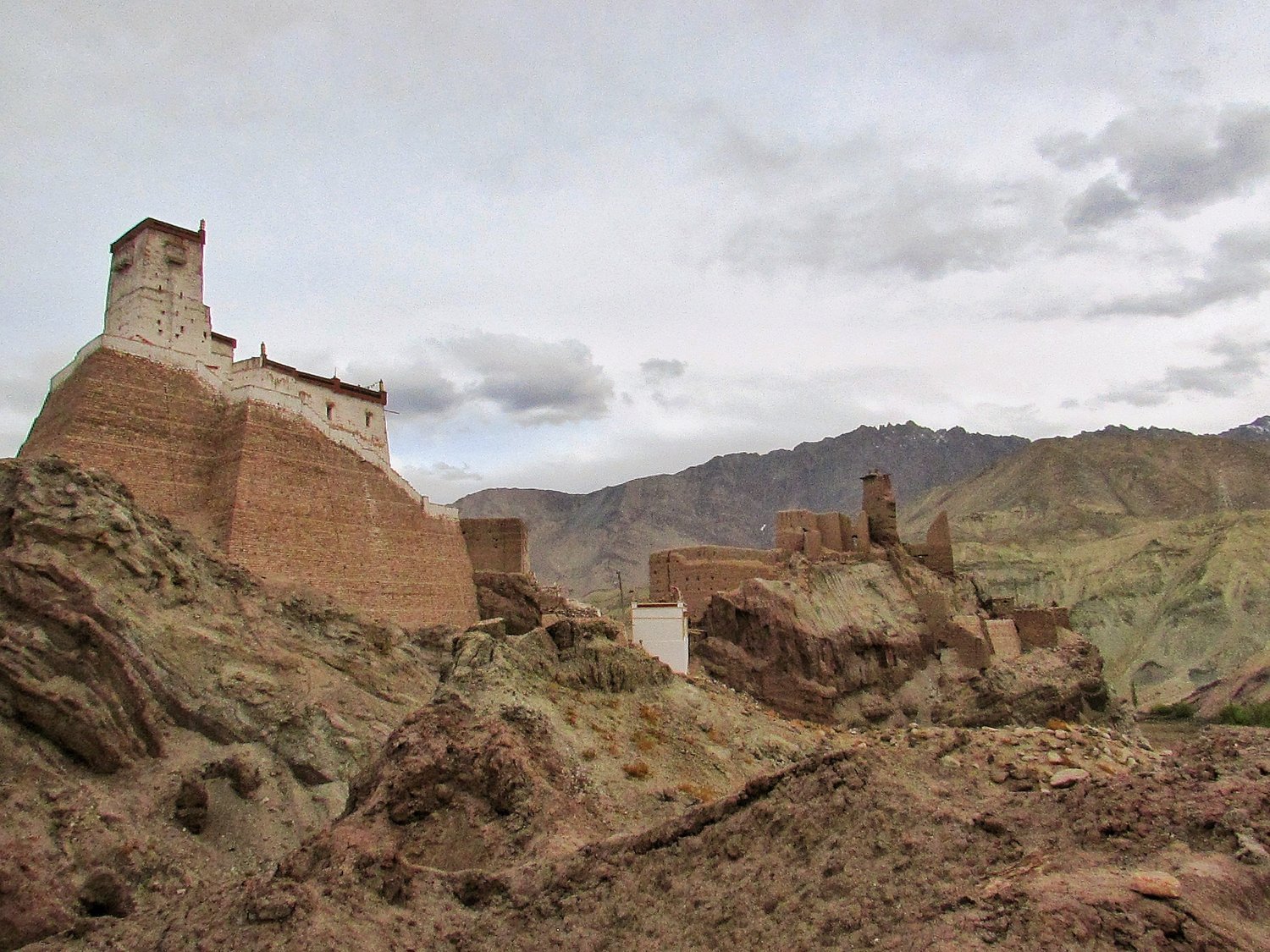
Basgo located some distance away from Leh was once the Capital of Ladakh and still the site of an impressive Monastery and a Fort. It was on the Plains outside that the Battle of Basgo was fought.
It was the Tibetans and their Mongol allies vs the Ladakhis and their Mughal allies. During the build up to the Battle the Mughal force crossed the Indus over two wooden bridges at Khalaste and marched towards Basgo. The two armies met at a plain called Jargyal between Basgo and Nimmu. This is referred to as the Battle of Basgo fought in 1679.
And the battle hardened Mughals along with their Ladakhi and Kullu allies proved too strong for the Tibeto-Mongols and their Bushahri allies. The Tibeto-Mongols were pushed back and routed all the way to Spituk where after a brief lull the fighting erupted again until they were driven beyond the Pangong Lake to a place called Tashigang.
They built themselves a Fort and shut themselves in and the Mughal Army now turned back, confident that the Tibeto-Mongols were gone for good. But of course Mongols being Mongols, they were wrong, but more of that later.
Read More about the Battle of Basgo
2. Gaze at the Stars at the Astrohub : A Great New Stargazing Experience in near Leh
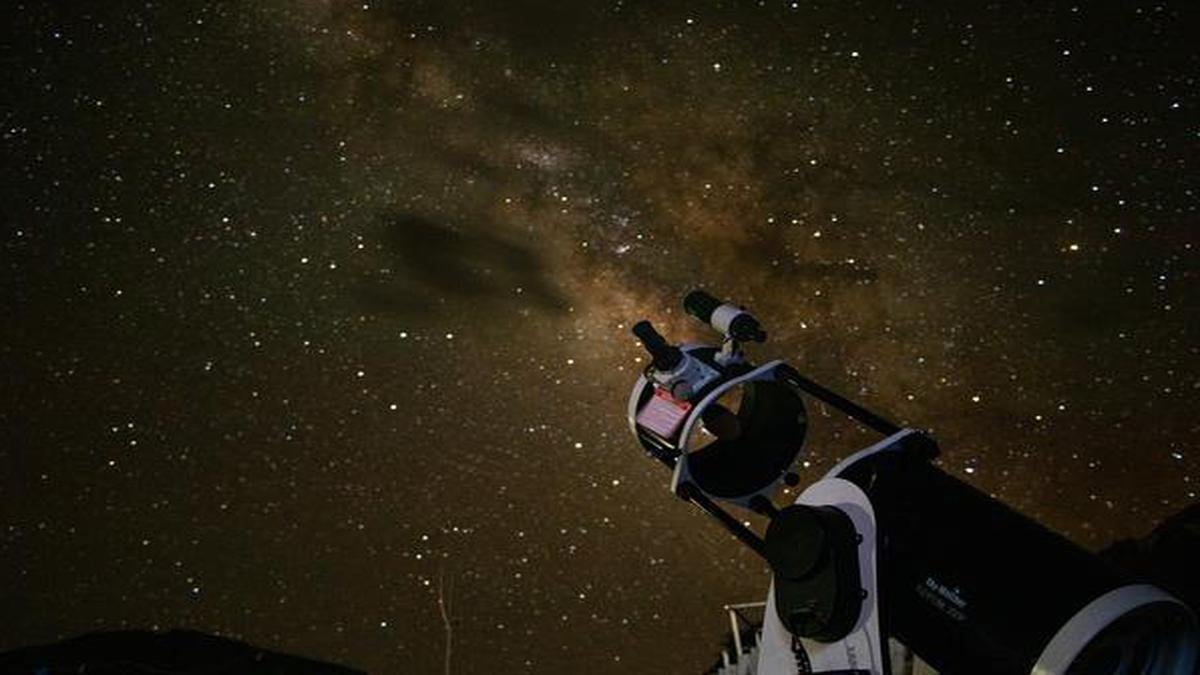
Introducing the Cosmohub in Phyang around 30 kms from Leh. An Initiative totally handled by the Local Village Ladies.
The Cosmohub has a Telescope which enables you to gaze even further into Space in the already very clear Ladakh skies.
Cosmohub- A New Stargazing experience near Leh. This women-led Astro-tourism initiative offers stargazing through a Telescope along with local folklore about skies narrated by trained local women.
You also get to Experience local Cuisine and Handicrafts prepared by a local self help group of women in addition to a guided tour of the nearby Monastery.
3. Visit the abandoned Village of Old Hundarman :
Ladakh offers many gems set in the Trans Himalayan landscape.
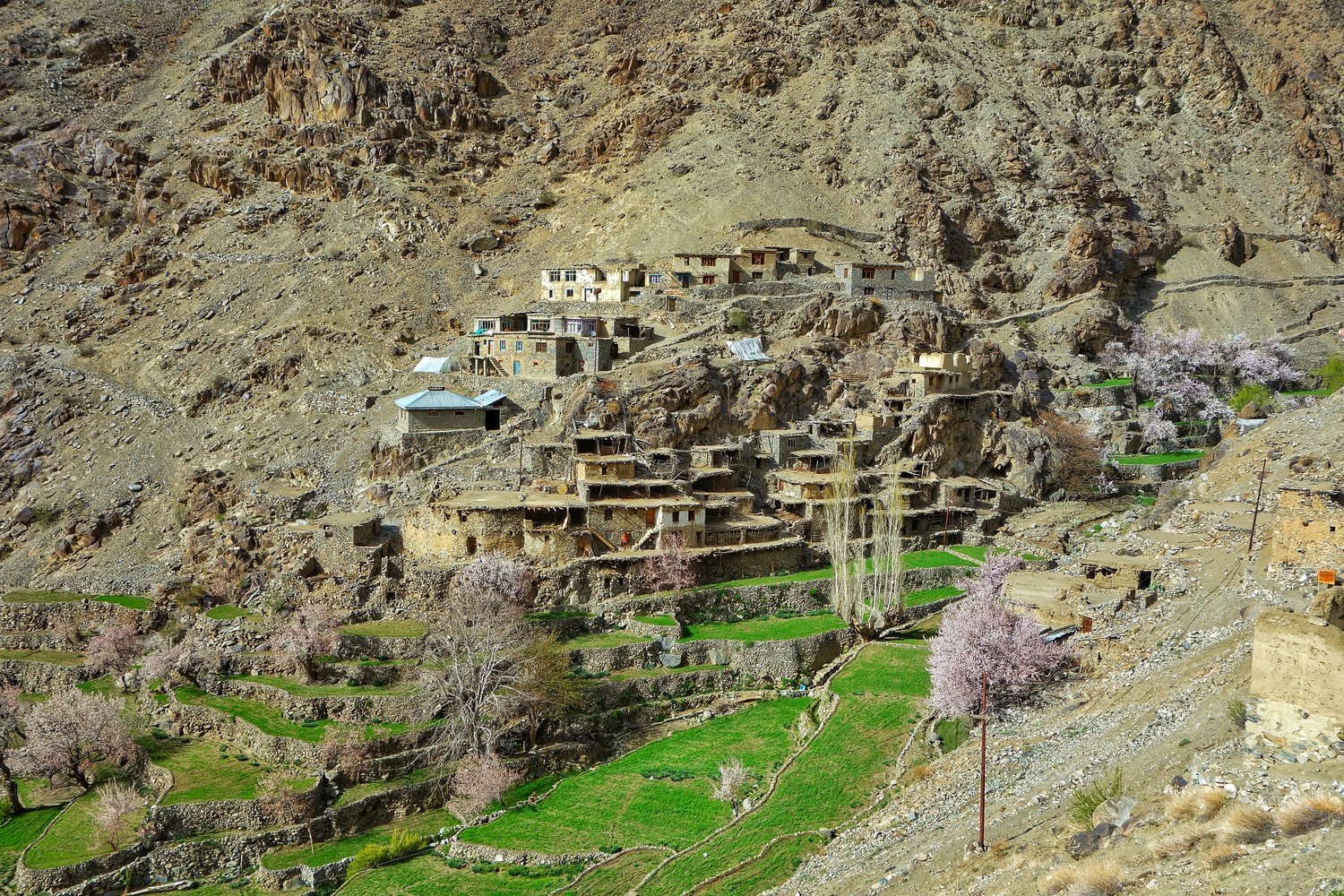
One such place while travelling to Ladakh is the Village called Hundarman near Kargil. Set in a sharp mountain gully 11km from Kargil, the tumbledown ghost village of Hundarman is a remarkable sight.
Rocky crags tower above, a steeply raked arc of stone-walled terraces sits below and virtually all of the low-ceilinged homes are stacked on top of one another, forming a fascinating core that has been (somewhat) preserved as a unique time capsule. And there is a neat little Museum in one of the abandoned Homes with antiquities found in these abandoned Houses.
This Village was till 1971 under Pakistani control but came under Indian Control after the 1971 War. And the fact that there are Warning Signs about Land Mines on both sides of the Road leading to Hundarman is a testament to the turmoil this Region has seen.
Yes you will hear the same Story about another place on this List.
4. Watch the Karakorams from the Khardung La :

Yes Khardung La is famous as one of the Highest Passes in the World but what most people dont know is that one gets a great view of the mighty Karakoram Range while looking North standing atop the Khardung La.
And now for some fun facts on the Karakorams in India. The Karakorams is a Mountain Range and like all Great Mountain Ranges it has a number of sub Ranges. And it has been classified into Nine Sub Ranges and out of these 3 lie fully on the Indian side and a 4th lies partly on the Indian side.
The Sasser Muztagh is the southernmost sub Range of the main Range and lies between the bend of the Shyok when it changes direction and heads in a Northern direction. The Shyok rises in the Rimo Muztagh which lies above the Sasser Muztagh.
The same trend is shown by the Nubra which also joins the Shyok and its at this point the Baltoro Sub Range starts which is partly on the Indian side. So the Sasser and the Baltoro Ranges are divided by the Nubra which rises in the Siachen Glacier. The Sasser La runs roughly between the Sasser Muztagh and the Rimo Muztagh. And in the extreme North along the Siachen Glacier runs the Siachen Muztagh.
Read More about the Karakorams in Ladakh
5. Visit the Donkey Sanctuary in Leh :

You must have seen a lot of Donkeys roaming around in the Streets of Leh. They are used as beasts of Burden in these rugged Mountains and many of them are unfortunately abandoned one they are older or are injured.
Sonam Dorje runs a Donkey Sanctuary on the outskirts of Leh where these unwanted Donkeys are taken care of. Its a Happy Place for these unwanted Donkeys where they can just do their Donkey things and get Food to eat and even basic Medical facilities.
The Donkey Sanctuary runs solely on Donations so its a good idea to visit the places, spend some time with the Donkey Bros and give whatever you can for the Welfare of these Donkeys.
Read More about the Donkey Sanctuary in Ladakh
6. Visit the Munshi Aziz Bhat Museum / Central Asian Museum :
Munshi Aziz Bhat was a trader also on the Central Asian trade Route and owned a number of shops in Kargil and his trading company was called Munshi Aziz Bhat and Sons. He set up a Serai, the Kargil Serai in 1920 to offer boarding lodging and storage places to the Traders. Soon the Serai became a stopover place for all kinds of traders from all kinds of places in Kargil. The Kargil Serai also served as a kind of an unofficial Post Office which received a lot of mail especially from the Hoshiarpuri Punjabi traders. The Serai had in its front a couple of shops as well which the Traders could use to display their wares. The Serai was a busy one in the late 1800s as well as the early 1900s and it saw many traders come and go.
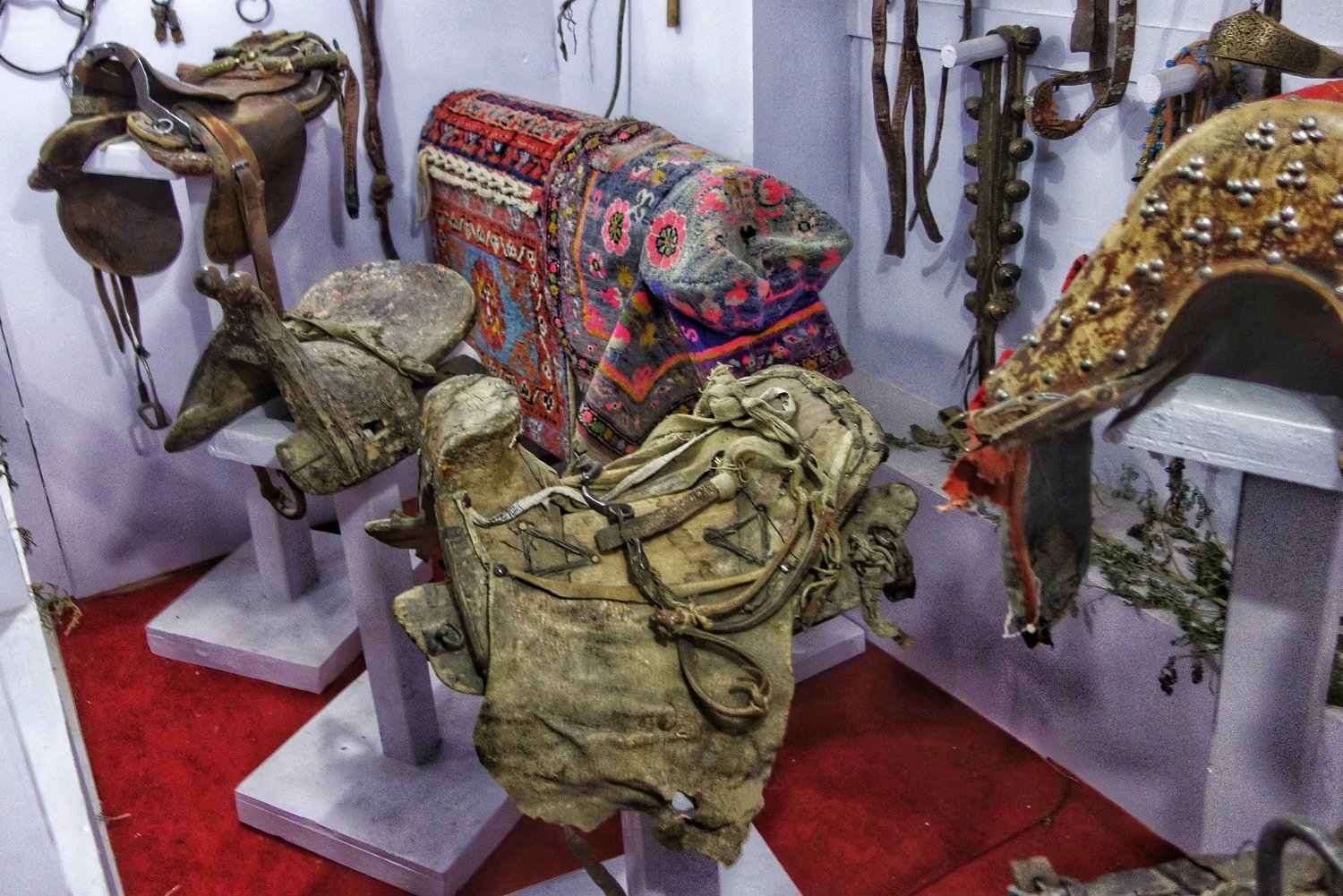
It was a chance discovery in the beginning of this century that some workers were sent to the place to clear some mess as parts of the structure had collapsed. The workers unearthed some very interesting items and reported these to the owners. The Owners then decided to come and check for themselves and they unearthed what can only be called a priceless treasure in the form of various items related to the Central Asian trade and items from all over Central Asia, the Indian subcontinent, Tibet and even Europe. As luck would have it a visiting historian persuaded the family to preserve this price-less collection instead of it ending up in some antique shops. And so was set up the Aziz Bhat Museum of Central Asian and Kargil Trade Artefacts to display the Collection.
The range of artefacts unearthed from the Munshi Aziz Bhat Sarai has given invaluable insights into not only the forgotten trade history but also into the cross-cultural, cosmopolitan past of Kargil. These artefacts aren’t mere antiques but they are a testimony to the fact that Kargil was a melting pot of cultures, languages, lifestyles and ideas. They are now on display in a part of the Munshi family’s house that has now been converted into the Museum.
Read More about the Munshi Aziz Bhat Museum
7. Panikhar and watch the Twin Peaks Nun and Kun :

Have you ever wondered what it feels to stand at the foot of the Greatest Mountain Range on the Planet, the Great Himalayan Range itself and stare at a 7000 Meter plus feet Mountain ?
The sheer grandeur of the Great Himalayan Range on one side and the Zanskar Range on the other side can be experienced in the Suru Valley. You can watch in awe the Twin Peaks of Nun and Kun which are a part of the Great Himalayan Range and tower above the Suru Valley and from places like Panikhar and Parkachik you get a superb view of these Giants.
Read More about the Suru Valley
8. Visit the Alchi Monastery :

Out of all the beautiful Monasteries in Ladakh the Alchi Monastery is probably the most fascinating one because of its Paintings and Murals said to have been done by Artists who came from Kashmir and they have a certain Kashmiri touch to them.
As per a leading researcher on Himalayan and Tibetan Art : “The world-famous Buddhist monastery of Alchi in Ladakh, India, is the best-preserved temple complex in the Himalayas. Proposed for inclusion in the UNESCO World Cultural Heritage list in 1998, the monastery's artworks reveal influences from India and Tibet across Central Asia and Iran, even as far back as Ancient Greece. Housing thousands of rare paintings and sculptures from the area dating back to the eleventh century, it provides fascinating insight into the spiritual and secular life of mediaeval Kashmir and Western Tibet.
9. Pay a Visit to Baltistan :

The neighbouring Region of Ladakh to the West is Baltistan Region. The people share almost the same Ethnicity as the people of Ladakh but over the centuries their Culture has changed and Religion is mostly Islam. The language of the Baltis is still quite similar to Ladakhi and is actually the closest language to the Old Tibetan language.
At the time of Partition almost the whole of Baltistan was occupied by Pakistan with its main City of Skardu. However over the Years in subsequent Conflicts the Indians managed to get back a little part of Baltistan and nowadays one of these Villages, Turtuk has become quite a Tourist destination.
Visit Turtuk to get a taste of Balti Culture and besides Turtuk there are a number of other Villages where you can see Balti People and Experience Balti Culture. You can now even visit the Northernmost Village of Thang which is located right on the Line of Control.
Read More about Ladakh and Baltistan
10. Drive from Pangong Tso to Tso Moriri over the Changthang :
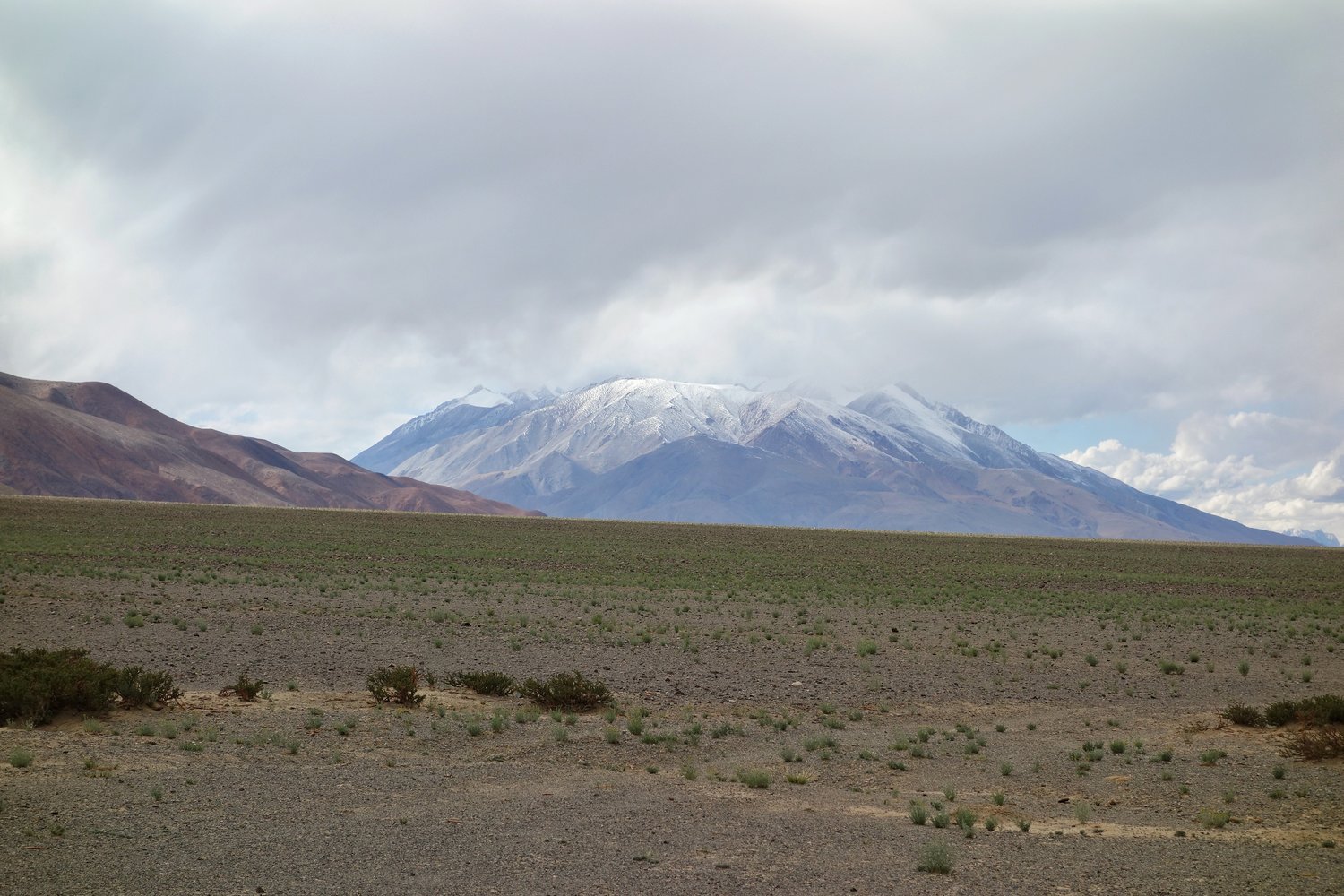
Of all the drives one can do in Ladakh the most fascinating for me is the one of going over the Changthang while driving from the Pangong Lake to the Tso Moriri Lake. The Changthang is a vast High Altitude Plateau that stretches over thousands of kms and includes parts of Tibet as well as Ladakh and goes all the way to Xinjiang.
It is an extremely inhospitable place but at the same time its beauty is quite unparalleled. Its dotted with certain Wetlands and on this stretch the Indus River enters Ladakh from the Tibetan side. The Changthang is largely uninhabited except for the hardy Changpa Nomads who raise their flocks of the famous Pashmina Goats on this Plateau.
Read More about the Changthang
Addendum : A Note on Understanding the Geography of Ladakh
The Mountain Geography of Ladakh
Kiki’s Ten Things to Do in Ladakh
Most People while visiting Ladakh just visit the same old Places, popular Tourist places and ones popularized by Bollywood and Influencers on Social Media. As a result a few Places bear the brunt of the Tourist footfalls which has serious Environmental and Social Impact.
I have always subscribed to the Philosophy that instead of sending 100 people to 5 places send 20 people to 25 places. Ecologically viable Tourism starts by spreading the load of the Tourists. And here is a list of Ten Things that I would recommend to do in Ladakh. And please remember that Ladakh is a large Region and most of it is rather unknown for most people. Ive added a Note on the Mountain Geography of Ladakh for easier understanding. You can also read my Ladakh Travel Guide for General Information.
So I have compiled a list of Ten Things that I would do in Ladakh, keeping in view all my Visits and Readings on Ladakh. They are in no particular order and each One is a Unique experience in its own.
Most People while visiting Ladakh just visit the same old Places, popular Tourist places and ones popularized by Bollywood and Influencers on Social Media. As a result a few Places bear the brunt of the Tourist footfalls which has serious Environmental and Social Impact.
I have always subscribed to the Philosophy that instead of sending 100 people to 5 places send 20 people to 25 places. Ecologically viable Tourism starts by spreading the load of the Tourists. And here is a list of Ten Things that I would recommend to do in Ladakh. And please remember that Ladakh is a large Region and most of it is rather unknown for most people. Ive added a Note on the Mountain Geography of Ladakh for easier understanding. You can also read my Ladakh Travel Guide for General Information.
So I have compiled a list of Ten Things that I would do in Ladakh, keeping in view all my Visits and Readings on Ladakh. They are in no particular order and each One is a Unique experience in its own.
1. Explore the Basgo Monastery and Fort :
Basgo located some distance away from Leh was once the Capital of Ladakh and still the site of an impressive Monastery and a Fort. It was on the Plains outside that the Battle of Basgo was fought.
It was the Tibetans and their Mongol allies vs the Ladakhis and their Mughal allies. During the build up to the Battle the Mughal force crossed the Indus over two wooden bridges at Khalaste and marched towards Basgo. The two armies met at a plain called Jargyal between Basgo and Nimmu. This is referred to as the Battle of Basgo fought in 1679.
And the battle hardened Mughals along with their Ladakhi and Kullu allies proved too strong for the Tibeto-Mongols and their Bushahri allies. The Tibeto-Mongols were pushed back and routed all the way to Spituk where after a brief lull the fighting erupted again until they were driven beyond the Pangong Lake to a place called Tashigang.
They built themselves a Fort and shut themselves in and the Mughal Army now turned back, confident that the Tibeto-Mongols were gone for good. But of course Mongols being Mongols, they were wrong, but more of that later.
Read More about the Battle of Basgo
2. Gaze at the Stars at the Astrohub : A Great New Stargazing Experience in near Leh
Introducing the Cosmohub in Phyang around 30 kms from Leh. An Initiative totally handled by the Local Village Ladies.
The Cosmohub has a Telescope which enables you to gaze even further into Space in the already very clear Ladakh skies.
Cosmohub- A New Stargazing experience near Leh. This women-led Astro-tourism initiative offers stargazing through a Telescope along with local folklore about skies narrated by trained local women.
You also get to Experience local Cuisine and Handicrafts prepared by a local self help group of women in addition to a guided tour of the nearby Monastery.
3. Visit the abandoned Village of Old Hundarman :
Ladakh offers many gems set in the Trans Himalayan landscape.
One such place while travelling to Ladakh is the Village called Hundarman near Kargil. Set in a sharp mountain gully 11km from Kargil, the tumbledown ghost village of Hundarman is a remarkable sight.
Rocky crags tower above, a steeply raked arc of stone-walled terraces sits below and virtually all of the low-ceilinged homes are stacked on top of one another, forming a fascinating core that has been (somewhat) preserved as a unique time capsule. And there is a neat little Museum in one of the abandoned Homes with antiquities found in these abandoned Houses.
This Village was till 1971 under Pakistani control but came under Indian Control after the 1971 War. And the fact that there are Warning Signs about Land Mines on both sides of the Road leading to Hundarman is a testament to the turmoil this Region has seen.
Yes you will hear the same Story about another place on this List.
4. Watch the Karakorams from the Khardung La :
Yes Khardung La is famous as one of the Highest Passes in the World but what most people dont know is that one gets a great view of the mighty Karakoram Range while looking North standing atop the Khardung La.
And now for some fun facts on the Karakorams in India. The Karakorams is a Mountain Range and like all Great Mountain Ranges it has a number of sub Ranges. And it has been classified into Nine Sub Ranges and out of these 3 lie fully on the Indian side and a 4th lies partly on the Indian side.
The Sasser Muztagh is the southernmost sub Range of the main Range and lies between the bend of the Shyok when it changes direction and heads in a Northern direction. The Shyok rises in the Rimo Muztagh which lies above the Sasser Muztagh.
The same trend is shown by the Nubra which also joins the Shyok and its at this point the Baltoro Sub Range starts which is partly on the Indian side. So the Sasser and the Baltoro Ranges are divided by the Nubra which rises in the Siachen Glacier. The Sasser La runs roughly between the Sasser Muztagh and the Rimo Muztagh. And in the extreme North along the Siachen Glacier runs the Siachen Muztagh.
Read More about the Karakorams in Ladakh
5. Visit the Donkey Sanctuary in Leh :
You must have seen a lot of Donkeys roaming around in the Streets of Leh. They are used as beasts of Burden in these rugged Mountains and many of them are unfortunately abandoned one they are older or are injured.
Sonam Dorje runs a Donkey Sanctuary on the outskirts of Leh where these unwanted Donkeys are taken care of. Its a Happy Place for these unwanted Donkeys where they can just do their Donkey things and get Food to eat and even basic Medical facilities.
The Donkey Sanctuary runs solely on Donations so its a good idea to visit the places, spend some time with the Donkey Bros and give whatever you can for the Welfare of these Donkeys.
Read More about the Donkey Sanctuary in Ladakh
6. Visit the Munshi Aziz Bhat Museum / Central Asian Museum :
Munshi Aziz Bhat was a trader also on the Central Asian trade Route and owned a number of shops in Kargil and his trading company was called Munshi Aziz Bhat and Sons. He set up a Serai, the Kargil Serai in 1920 to offer boarding lodging and storage places to the Traders. Soon the Serai became a stopover place for all kinds of traders from all kinds of places in Kargil. The Kargil Serai also served as a kind of an unofficial Post Office which received a lot of mail especially from the Hoshiarpuri Punjabi traders. The Serai had in its front a couple of shops as well which the Traders could use to display their wares. The Serai was a busy one in the late 1800s as well as the early 1900s and it saw many traders come and go.
It was a chance discovery in the beginning of this century that some workers were sent to the place to clear some mess as parts of the structure had collapsed. The workers unearthed some very interesting items and reported these to the owners. The Owners then decided to come and check for themselves and they unearthed what can only be called a priceless treasure in the form of various items related to the Central Asian trade and items from all over Central Asia, the Indian subcontinent, Tibet and even Europe. As luck would have it a visiting historian persuaded the family to preserve this price-less collection instead of it ending up in some antique shops. And so was set up the Aziz Bhat Museum of Central Asian and Kargil Trade Artefacts to display the Collection.
The range of artefacts unearthed from the Munshi Aziz Bhat Sarai has given invaluable insights into not only the forgotten trade history but also into the cross-cultural, cosmopolitan past of Kargil. These artefacts aren’t mere antiques but they are a testimony to the fact that Kargil was a melting pot of cultures, languages, lifestyles and ideas. They are now on display in a part of the Munshi family’s house that has now been converted into the Museum.
Read More about the Munshi Aziz Bhat Museum
7. Panikhar and watch the Twin Peaks Nun and Kun :
Have you ever wondered what it feels to stand at the foot of the Greatest Mountain Range on the Planet, the Great Himalayan Range itself and stare at a 7000 Meter plus feet Mountain ?
The sheer grandeur of the Great Himalayan Range on one side and the Zanskar Range on the other side can be experienced in the Suru Valley. You can watch in awe the Twin Peaks of Nun and Kun which are a part of the Great Himalayan Range and tower above the Suru Valley and from places like Panikhar and Parkachik you get a superb view of these Giants.
Read More about the Suru Valley
8. Visit the Alchi Monastery :
Out of all the beautiful Monasteries in Ladakh the Alchi Monastery is probably the most fascinating one because of its Paintings and Murals said to have been done by Artists who came from Kashmir and they have a certain Kashmiri touch to them.
As per a leading researcher on Himalayan and Tibetan Art : “The world-famous Buddhist monastery of Alchi in Ladakh, India, is the best-preserved temple complex in the Himalayas. Proposed for inclusion in the UNESCO World Cultural Heritage list in 1998, the monastery's artworks reveal influences from India and Tibet across Central Asia and Iran, even as far back as Ancient Greece. Housing thousands of rare paintings and sculptures from the area dating back to the eleventh century, it provides fascinating insight into the spiritual and secular life of mediaeval Kashmir and Western Tibet.
9. Pay a Visit to Baltistan :
The neighbouring Region of Ladakh to the West is Baltistan Region. The people share almost the same Ethnicity as the people of Ladakh but over the centuries their Culture has changed and Religion is mostly Islam. The language of the Baltis is still quite similar to Ladakhi and is actually the closest language to the Old Tibetan language.
At the time of Partition almost the whole of Baltistan was occupied by Pakistan with its main City of Skardu. However over the Years in subsequent Conflicts the Indians managed to get back a little part of Baltistan and nowadays one of these Villages, Turtuk has become quite a Tourist destination.
Visit Turtuk to get a taste of Balti Culture and besides Turtuk there are a number of other Villages where you can see Balti People and Experience Balti Culture. You can now even visit the Northernmost Village of Thang which is located right on the Line of Control.
Read More about Ladakh and Baltistan
10. Drive from Pangong Tso to Tso Moriri over the Changthang :
Of all the drives one can do in Ladakh the most fascinating for me is the one of going over the Changthang while driving from the Pangong Lake to the Tso Moriri Lake. The Changthang is a vast High Altitude Plateau that stretches over thousands of kms and includes parts of Tibet as well as Ladakh and goes all the way to Xinjiang.
It is an extremely inhospitable place but at the same time its beauty is quite unparalleled. Its dotted with certain Wetlands and on this stretch the Indus River enters Ladakh from the Tibetan side. The Changthang is largely uninhabited except for the hardy Changpa Nomads who raise their flocks of the famous Pashmina Goats on this Plateau.
Read More about the Changthang
Addendum : A Note on Understanding the Geography of Ladakh
The Mountain Geography of Ladakh
New Routes Opened in Ladakh
The Government has announced the Opening of some new Routes in Ladakh which were earlier Off Limits to the General Public except with Special Permits. Hopefully in the near future more such areas would be opened up for Tourism in Ladakh.
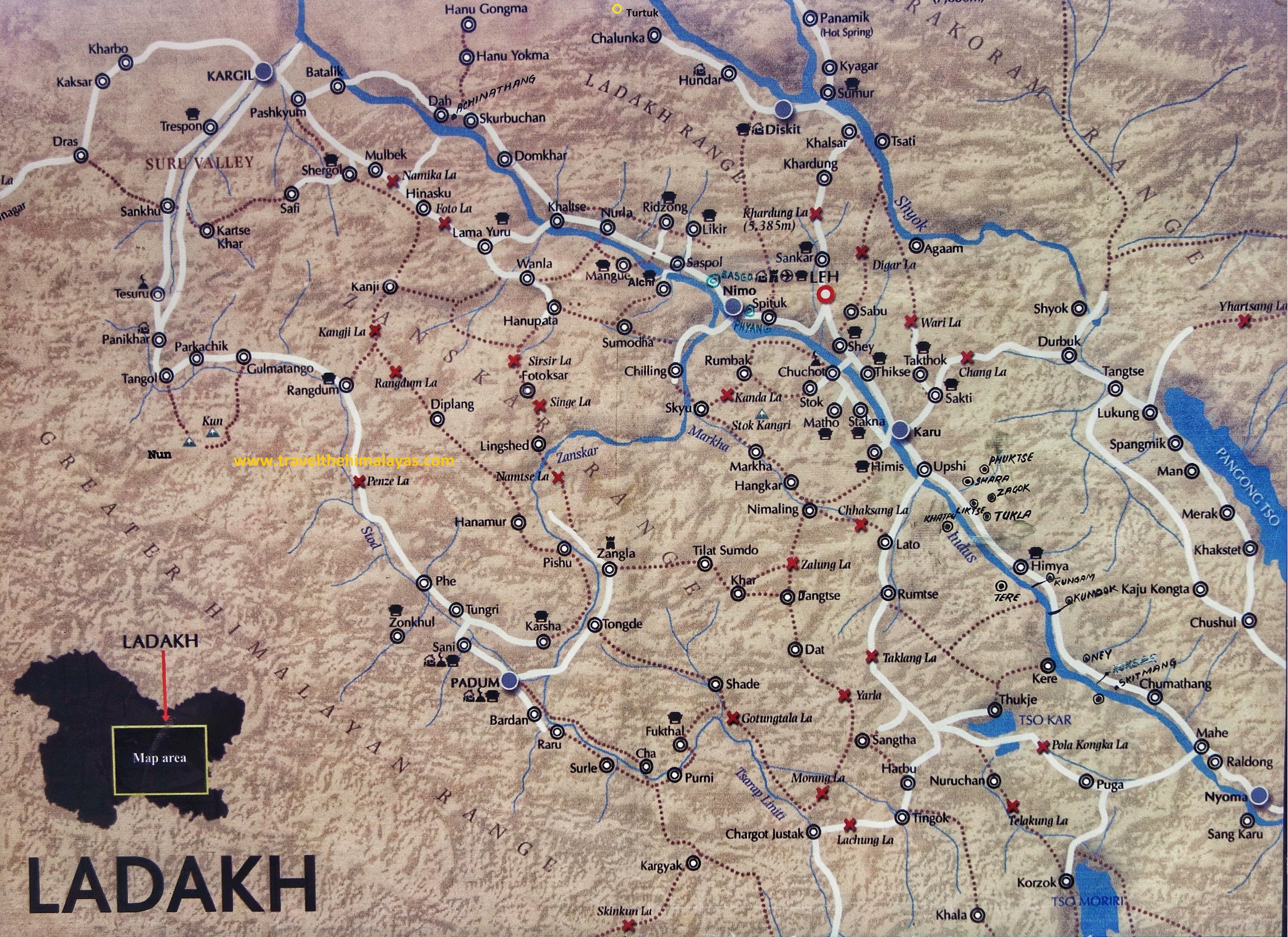
New Routes for Ladakh 2019
The Government has recently announced the Opening of new Routes in Ladakh in order to promote Tourism in some of the more Offbeat Locations in Ladakh. Some of these Routes have already been used by some Travelers who got a Permit but now its open for all.
This is a welcome step and will help the People living in these Remote areas as they now have the opportunity to make a living from Tourism as well. Also it shows that the Government is a mood to open up new areas in Ladakh, a large part of which still is off limits to the General Public due to the Border disputes we have with our neighbors in the Region. It also signals that relations with China are easing off and hopefully one day the Border disputes wil be settled and the whole of Western Ladakh would be open to the Public.
Below is the Map of the Areas around the Pangong Lake and the Tso Moriri Lake which are mostly covered in the new Routes that are opened. This would also enable greater access to one of the most mind blowing part of Ladakh, the Changthang which extends into Tibet.
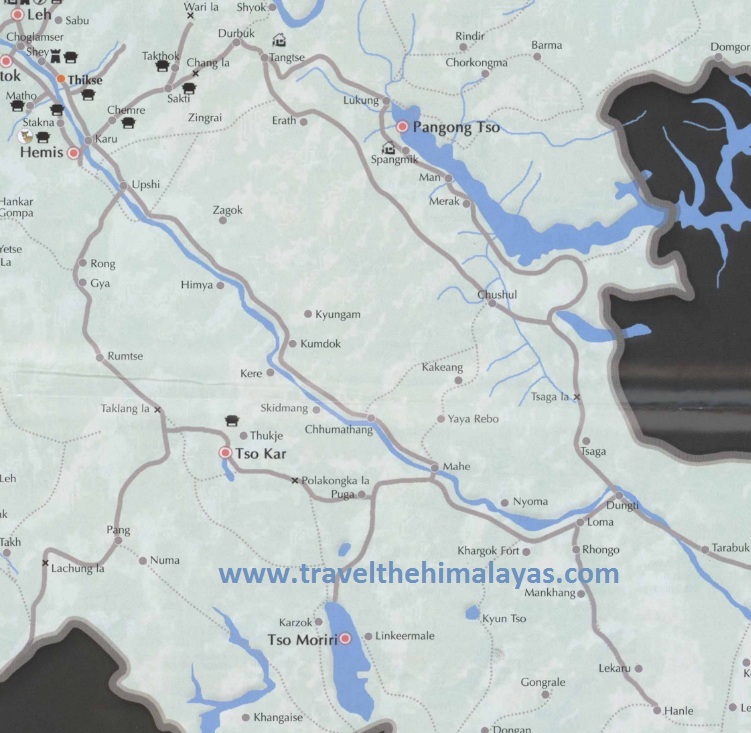
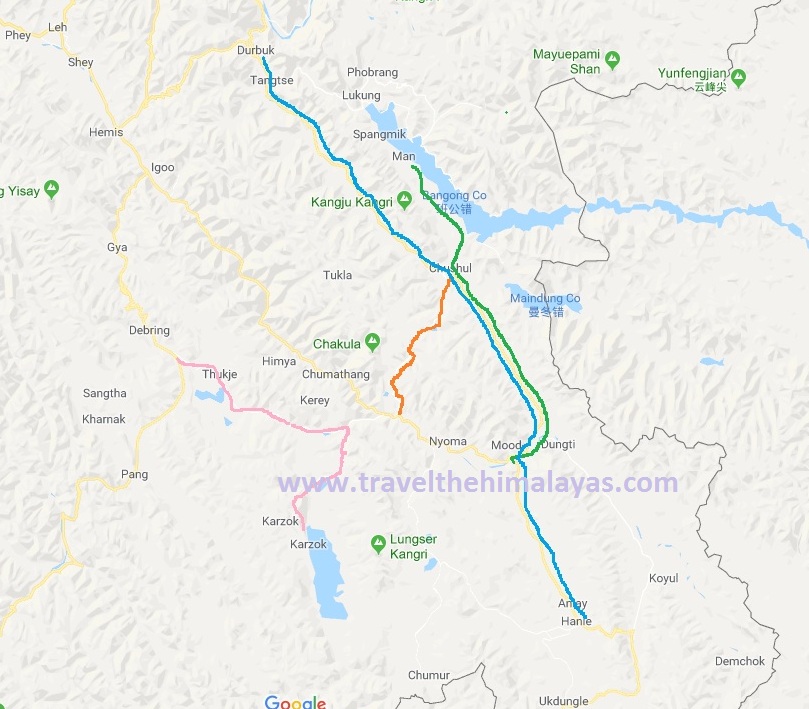
And these are the exact details of the Routes that have been opened and they have been Colour marked in the Map at the bottom
1. Merak - Loma Bend via Chushul (Instead of going straight from Chushul to Mahe you go left and get directly to Loma Bend. See Map 2 as well and this Route will take you over the Tsaga La Pass. (Shown in Green Colour)
2. Chushul to Mahe via Kakset La (The official release says Kartasangla but we assume this is an error). This is the direct Route over the Changthang and takes you to Mahe (Shown in Red Colour)
3. Dubruk - Erath - Chusul and then following no.1 Route onwards to Loma bend and then onto Hanle (Shown in Blue) : Instead of the traditional Route from Dubruk to Pangong Tso this Route will take you through the Route almost parallel to that and onwards to Chushul. From Chushul onwards you follow the Route 1 again.
4. Karzok - Nurbo - Sumdo - Parangla - Kazand (Shown in Pink)
A Place Called Chushul
On the desolate Changthang region of the Tibetan Plateau lies the Village of Chushul. It lies close to the Border with China. And it was here that a Treaty was signed and Ladakh became a part of the Sikh Empire.
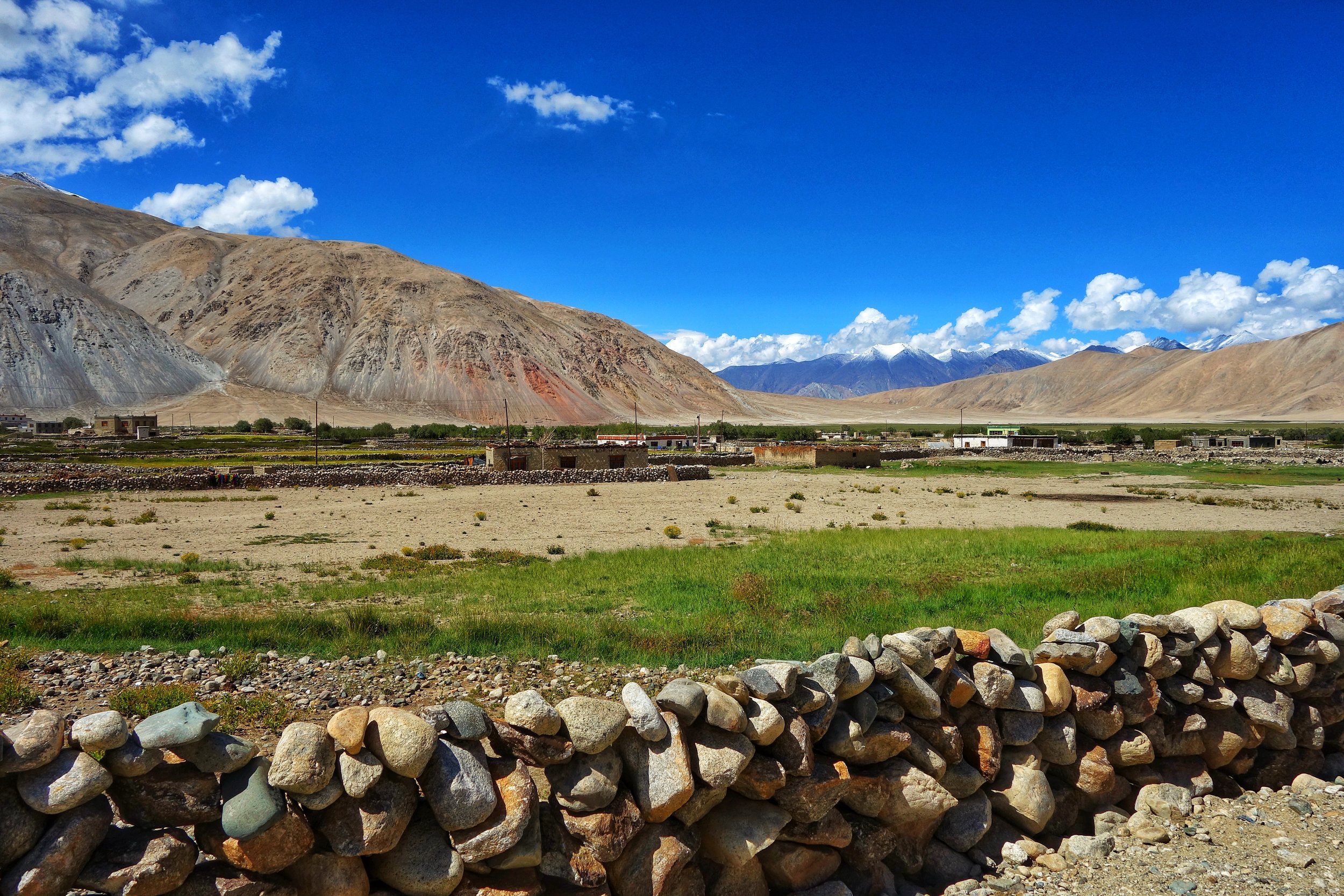
A Place Called Chushul
Chushul is a Village close to the Indian LAC with China in the Eastern Ladakh region close to Pangong Lake as well as Rezang La. At an altitude of around 4360 m it used to be the main Village of the Changthang block in the Ladakh region earlier. And it is one of the five designated locations along the LAC where the Border personnel from both countries meet to have formal meetings in order to maintain peace at the LAC.

On the way to Chushul and driving along the Pangong Tso.
We passed this place on our way from Pangong Lake to Tso Moriri which I must rate as one of the finest drive one can do in the Trans Himalayas cutting across the Changthang. Once we got to Chushul we realised that one of our Vehicles was short on fuel. And since Chushul was one of the main Villages on the way and uncertain of whether we will get fuel anywhere ahead we decided to look for Petrol in Chushul. We had already crossed Chushul when we decided to turn back and when we came back into the Village we passed by the Police Post . And there was an old Policeman sitting outside. We asked him where we could get Fuel. He told us and then suddenly he asked us for our Inner Line Permits.

The Village of Chushul and the Monastery in Yellow
All of us in 4 Vehicles were Residents of the state of Jammu and Kashmir and as such we dont require Inner Line Permits. J and K residents just need to show IDs to prove their credentials and they are good to go. And plus we had a letter from JK Tourism which pretty much gave us an open Pass as far as the ITBP/ Army guys were OK with it. The Policeman just saw the Letter and checked the IDs of the guys in the first Car and told us to go. Since I am no longer a permanent resident of JK being based in Gurugram I was carrying my old Passport photocopy which had been issued in Srinagar. But I had still got an ILP made for myself just in case. But it didnt come to that and the Policeman was satisfied that we were all JK residents and let us go.
And then we got the fuel had Lunch and we were on our way again. We again passed the Police Post and this time there was another younger Policeman there who signalled us to stop. We stopped and told him that we had already shown our papers. He looked at all of us. And then suddenly I realised that he was staring at me. The Policeman then said “ Iska permit Kidhar hai” pointing at me. He again said “Yeh foreigner ka Permit kahaan hai ?”. Out of all the Kashmiri guys he somehow assumed me to be a Foreigner. I was slightly amused and started smiling. I blurted “Sirji main Foreigner nahin hoon. Srinagar se aaya hoon” He started laughing and bade us n our way.

Before entering Chushul, traditional pile of Horns to ward off evil.
Now to more important stuff. Historically this was the place where the Treaty of Chushul was signed in 1842 which officially demarcated the border between Ladakh and Tibet as a consequence of which Ladakh became a part of the Sikh Kingdom of the Punjab. After the death of General Zorawar Singh in Tibet his Army had been routed. The Tibeto-Chinese Army then marched towards Leh and almost captured it. Except for a small Dogra detachment that was entrenched in the Fort. The Dogra Detachment held on till the time fresh troops arrived under Diwan Hari Chand and Wazir Ratnu. The Dogras drove out the Tibeto-Chinese and started chasing them and the Tibeto-Chinese forces dug in at Drangtse.
In a brilliant tactical move the Dogras flooded the Tibetan fortifications by diverting a local River and they were again forced to flee Eastwards. The Dogras were again on their heels as avenging the death of their beloved General Zorawar Singh was their most motivational factor. The opposing Forces finally met on the open fields at Chushul in August 1842 and in the engagement the Tibeto-Chinese force was defeated and their General was decapitated in a form of brutal medieval revenge. With their General avenged they could now go back as both sides had by now now lost the appetite for further engagements.

The fields of Chushul
Both sides then decided to have a treaty by the way of which their territories would be demarcated and recognised by each other. And the Tibetans and the Chinese gave up any claim whatsoever that they had over Ladakh. So on 16/ 17th September 1842 was signed the Treaty of Chushul at Chushul and it said
"As on this auspicious day, the 3nd of Assuj, samvat 1899 (16th/17th September 1842) we, the officers of the Lhasa (Governrnent), Kalon of Sokan and Bakshi Shajpuh, commander of the forces, and two officers on behalf of the most resplendent Sri Khalsa ji Sahib, the asylum of the world, King Sher Singh ji, and Sri Maharaja Sahib Raja-i-Rajagan Raja Sahib Bahadur Raja Gulab Singh, i.e.. the Muktar-ud-Daula Diwan Hari Chand and the asylum of vizirs, Vizir Ratnun. in a meeting called together for the promotion of peace and unity, and by professions and vows of friendship, unity and sincerity of heart and by taking oaths like those of Kunjak Sahib, have arranged and agreed that relations of peace, friendship and unity between Sri Khalsaji and Sri Maharaja Sahib Bahadur Raja Gulab Singh ji, and the Emperor of China and the Lama Guru of Lhasa will hence forward remain firmly established forever; and we declare in the presence of the Kunjak Sahib that on no account whatsoever will there be any deviation, difference of departure (from this agreement). We shall neither at present nor in the future have anything to do or interfere at all with the boundaries of Ladakh and its surroundings as fixed from ancient times and will allow the annual export of wool, shawls and tea by way of Ladakh according to the old established customs.
Should any of the Opponents of Sri Sarkar Khalsa ji and Sri Raja Sahib Bahadur at any time enter our territories, we shall not pay any heed to his words or allow him to remain in our country. We shall offer no hindrance to traders of Ladakh who visit our territories. We shall not even to the extent of a hair's breadth act in contravention of the terms that we have agreed to above regarding firm friendship, unity, the fixed boundaries of Ladakh and the keeping open of the route for wool, shawls and tea. We call Kunjak Sahib, Kairi, Lassi, Zhon Mahan, and Khushal Chon as witnesses to this treaty."
And to this day the territories as designated in this Treaty as held as the Official border as recognised by the Indian Government though the Chinese from time to time play some hanky panky as has become their norm in this Sector. But of course that doesnt take away from the significance of the Treaty or from the importance of Chushul itself.

Traditional Cow Dung for using as Fuel
A visit to Chushul would always be worth it if you love the Mountains and love some History as well.
Pic from August 2018. Chushul, Eastern Ladakh.
The Changthang
The Changthang is a part of the Tibetan Plateau which is located in the Western and North Western part of Tibet and it also includes Eastern Ladakh. Its a forbidding Plateau and is home to a number of Lakes like the Pangong Tso and the Tso Moriri. However it holds a large array of wildlife in its high altitude Wetlands. Its home to the Changpa People who are nomadic herders known to keep the best herd of Pashmina Goats.

The Changthang.
A place of immense beauty amidst desolation of the Tibetan Plateau. A place devoid of most human in habitation except for the Pashmina Goat rearing Changpas. With an average altitude of above 4000m it stretched from Tibet into Ladakh.

The Changthang is home surprisingly to a large number of wildlife species including the Snow Leopard, the Tibetan Wild Ass, the Chiru etc. The legendary Indus flows through the Changthang and it includes a number of wetlands and marshes which attract migratory birds such as the Black Necked Crane and the Bar Headed Geese.

The Changthang always fascinated the Western Explorers few of whom ever stepped into its splendid isolation. The unpredictable weather, the Artic conditions in the Winters and the paucity if human in habitation didnt help either.

I happened the drive from Pangong Lake to the Tso Moriri, two Lakes which lie within the Changthang. And to keep it simple it was one of the most beautiful places I have ever been to. The legendary Changthang. The home of the Changpa who produce the finest Pashmina bearing Goats. Pashm which for centuries bought neighbouring Kingdoms to War with each other.

Pic from this week. Some where on the Changthang between Pangong Tso and Tso Moriri.
Kiki’s Blog
Stories from the Himalayas
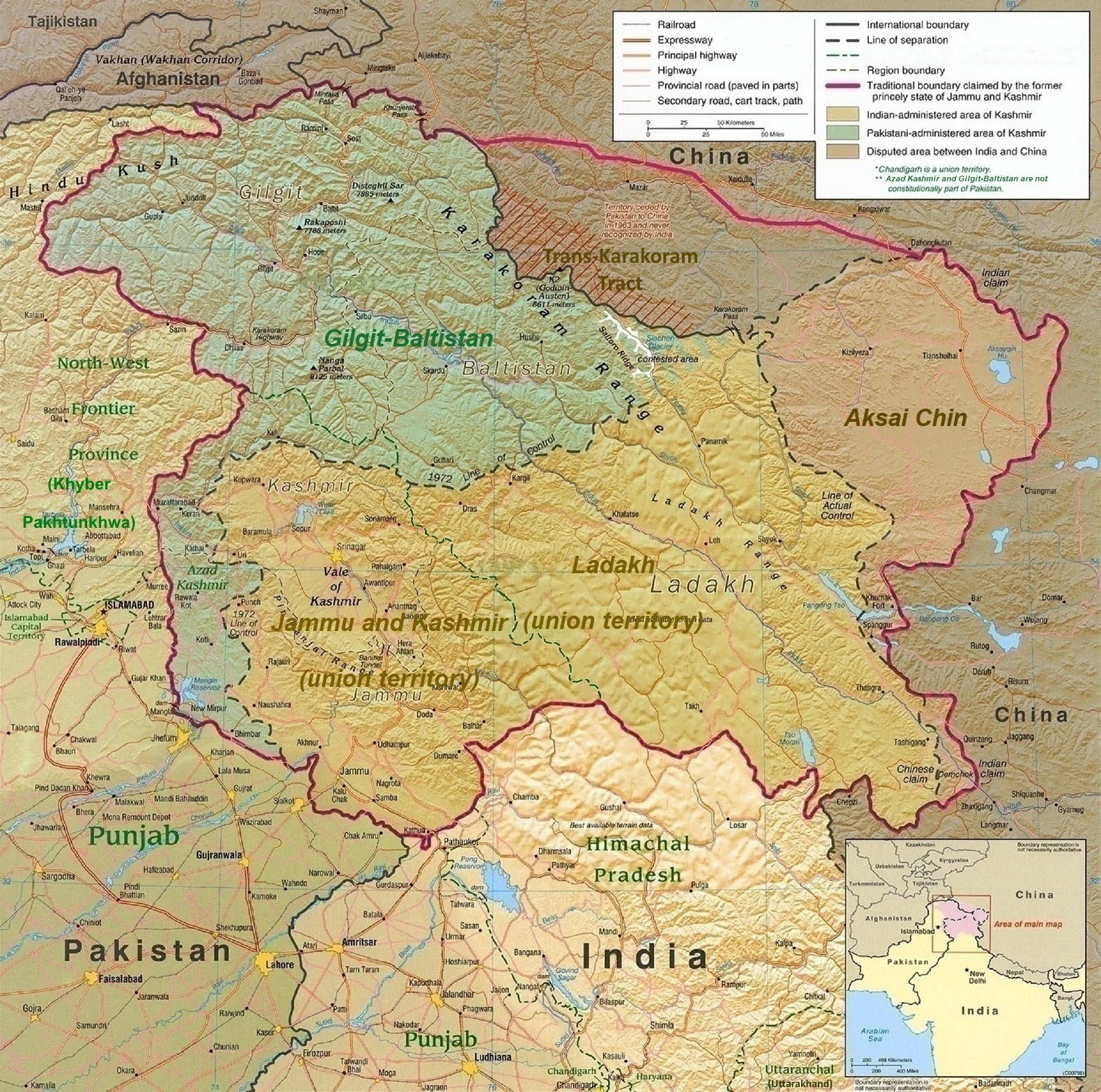
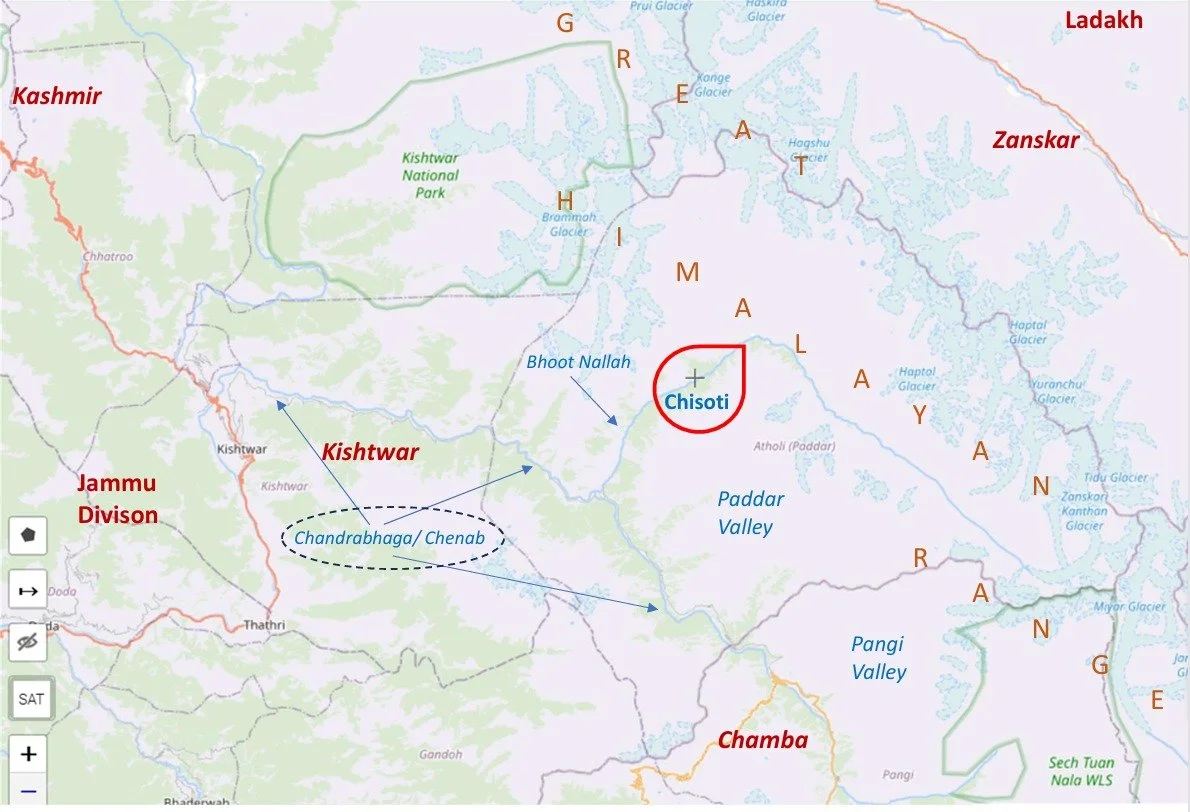


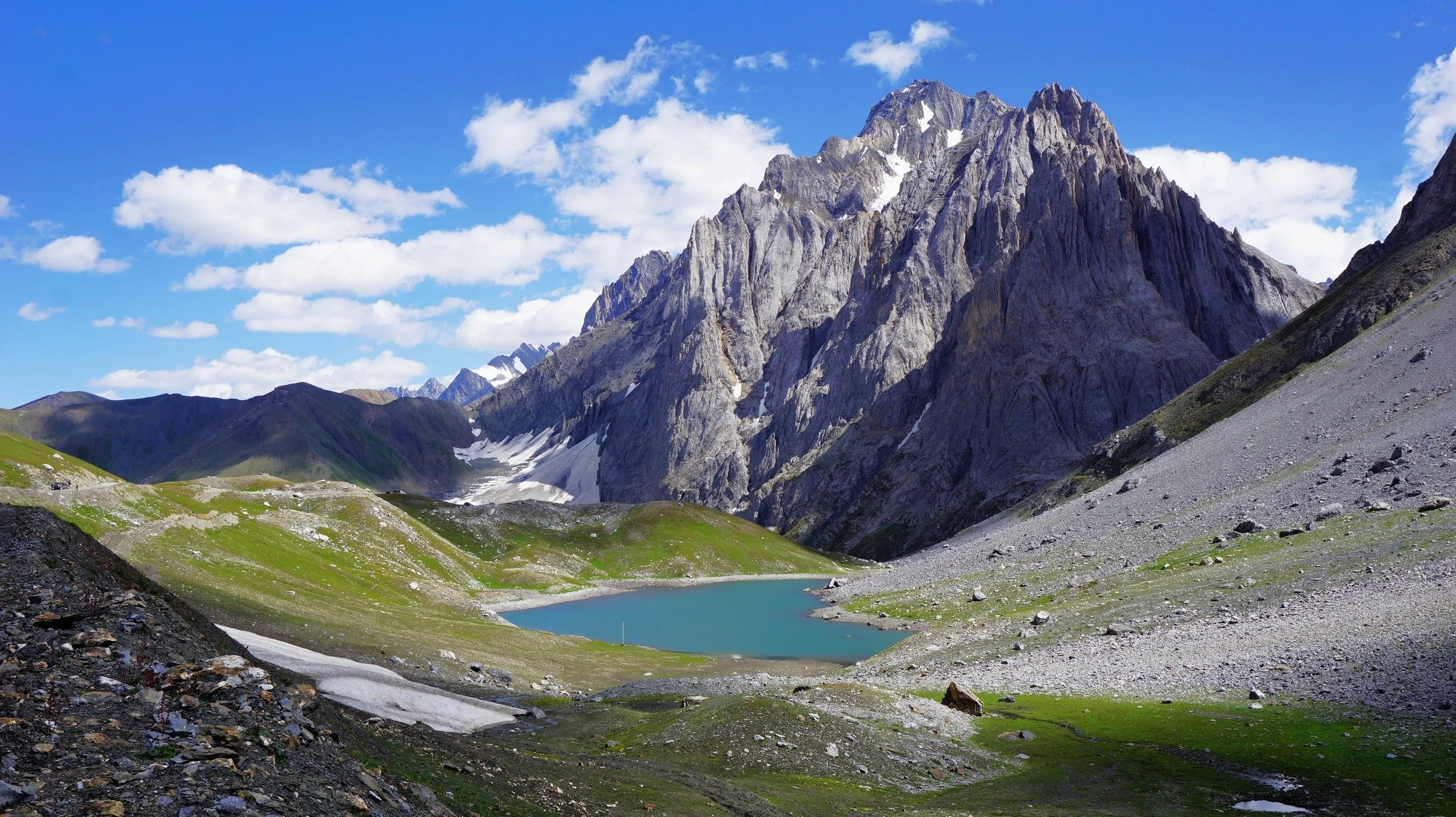
Five years ago the Galwan Valley was in the News for the wrong reasons after a deadly clash between the Indian and Chinese Armies in the Valley located in Ladakh lead to many deaths on the contentious Border between the two countries in wake of continued Chinese intrusions into Indian territory.
This area along the Shyok River, of which the Galwan Nallah or the Galwan River which forms the Galwan Valley has been off limits to Civilians since long but now the Indian Government has decided to open up the area for Civilians and we were amongst the First Civilians to venture into this beautifully desolate part of the Eastern Karakorams in Ladakh. Earlier Civilians could only venture upto the Village of Shyok from where the Shyok River takes a U turn and flows in a Northerly direction.