
The Gilgit Manuscripts

A leaf from the Gilgit Manuscript
The Gilgit Manuscripts : A Treasure Forgotten
A couple of cattle grazers in 1931, in a village Naurpur near Gilgit once came upon a wooden box in a circular chamber in side a Buddhist stupa which contained a large number old Manuscripts pertaining to Buddhism. Little did they know that they had stumbled upon one of the most important finds of the century. The Gilgit Manuscripts are the oldest surviving religious Manuscripts from the sub-continent and of the oldest ones in Buddhism.
The cattle grazers took the collection to the Wazir of Gilgit who in turn turned it over to the Maharaja of Jammu and Kashmir and the news of the discovery of this Great Treasure spread world wide. Opinions vary about the date of this manuscript. One branch of scholars says it was written in the second century AD., while another puts the date at somewhere between the sixth and seventh centuries.
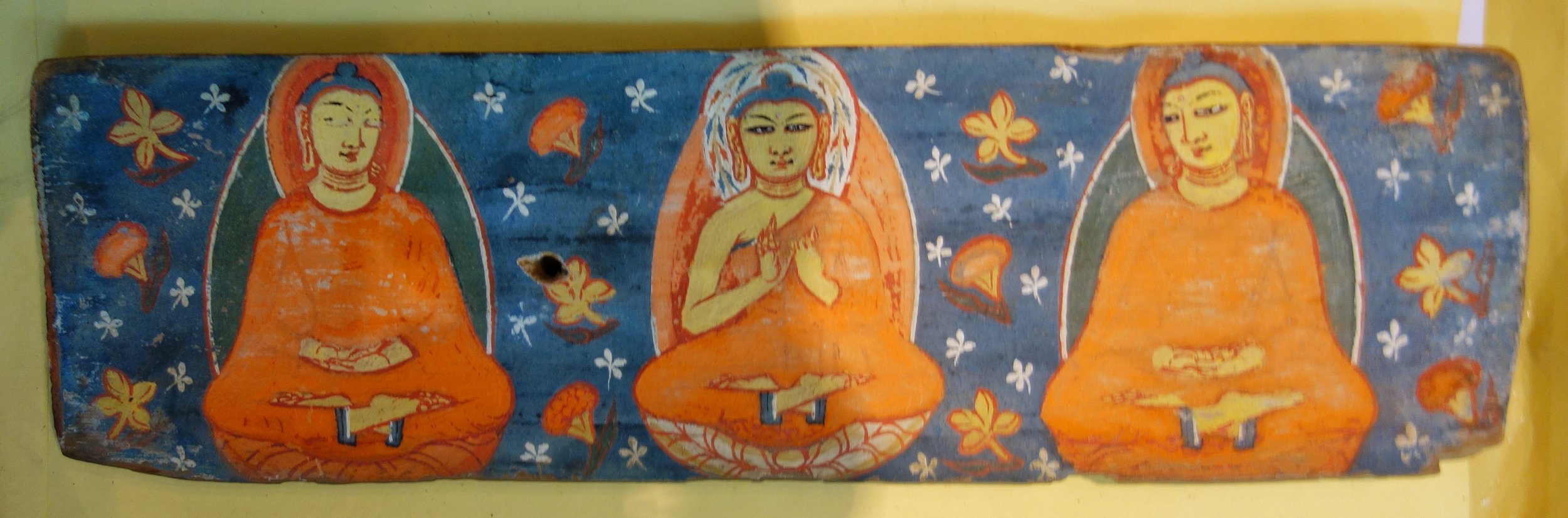
The Hand Painted Covers in which the Manuscripts were kept
Gilgit was at that time at the cross roads where South Asia, Central Asia and Eastern Asia met and it was an important stop on the Silk Road. Many monks from India carried the message of the Buddha from here to Tibet, China, Korea and even as far as Japan. It was along the Silk Road that Buddhism spread eastwards towards the rest of Asia. Gilgit hence played an important part in the spread of Buddhism and hence this find.
The almost seventeen centuries old Gilgit Manuscript has been giving historians a hard time, as no one has yet been able to fully decipher it. The lamination of the manuscript by the National Archives of India sometime ago has once again put the limelight back on this all-important literature concerning India, Tibet, China, Japan and other neighbouring countries.

Another leaf from the Gilgit Manuscipt
In fact in 1897 - 34 years before it was discovered - the Buddhist Text Society of Calcutta had published references to the Gilgit Manuscript saying that if it were ever to be found it would unravel the ancient history of several communities as it is considered to be the oldest Buddhist manuscript.
A corpus of many Buddhist texts such as the Four Sutras from the Buddhist canon, including the famous Lotus Sutra, the Manuscripts survived because they were written on the bark of the Bhoj (Birch) Tree which does not decay and obviously helped by the sub zero temperatures in Gilgit. They were written in the Buddhist form of Sanskrit in the Sarada or the Sharda Script. The Gilgit Manuscripts deciphered thus far cover a wide range of subjects such as religion, religious rituals, philosophy, iconometry, monastic discipline, folk tales, medicine and culinary art.
The most famous of the Gilgit manuscripts, the Gilgit Lotus Sutra is preserved in the National Archives of India in Delhi. Known as the Saddharma Pundarika Sutra – or the teachings of the white lotus and sun – the sutra is the basis of the Tiantai and Nichiren schools of Buddhism. In 2012 a facsimile edition of it was published by by the National Archives jointly with the Institute of Oriental Philosophy and Soka Gakkai, a Japan-based non-governmental organization.

Another cover for the Gilgit Manuscript
"In August 1938, seven years after the discovery of the texts, the archaeologist Madhusudan Kaul Shastri led a systematic excavation of the Naupur site and discovered another larger chamber at the base of the structure. The chamber contained another set of the Gilgit Manuscripts along with votive objects and probably Buddhist cult bronzes.
"According to renowned scholar Karl Jettmar, inscriptions on these bronzes “reveal that they were produced and dedicated due to the generosity and the religious zeal of a Patola Shahi”. The Patola Shahis, also known as Palola Shahis, were the rulers of Gilgit and Baltistan from the late sixth to the early eighth centuries AD.
"Shortly after, Kaul Shastri and his team outlined the specifications of the second group of manuscripts and other finds from the site including the hand painted covers of two manuscripts.
"In the third phase, the well-known Italian scholar Giuseppe Tucci secured another small group of the manuscripts in 1956. Obtaining them from a street vendor in Rawalpindi, he presented them to the Karachi museum.
"Roughly 60 manuscripts and 17 Avadnas emerging from Naupur are of unmatched significance in Buddhist studies. These are the oldest surviving collection of religious texts in the subcontinent. Based on the paleographical evidence, scholars agree that local Buddhist devotees compiled these texts between the fifth and sixth century AD. With the exception of only a few scripts, all the manuscripts were written on birch bark in Buddhist hybrid Sanskrit language in the Gupta Brahmi and post-Gupta Brahmi script.

More leaves from the Gilgit Manuscript
"The manuscripts contain sutras from the Buddhist canon, the Samghata Sutra, Samadhiraja Sutra, Saddharma Pundarika Sutra, and Bhaisajyaguru Sutra.The Samadhiraja Sutra is one of the important Mahayana canonical texts, which are collectively called Navadharma. The Saddharma Pundarika Sutra, popularly known as Lotus Sutra, figures prominently in the Gilgit Manuscripts and scholars agree it was the most venerated sutra of the Buddhists from the Gilgit area"
Though the grammatical and literature aspects of the text are gradually becoming more of historical interest in the contemporary world, what is of interest is the social relevance of some of the sutras mentioned in the manuscript. Experts feel that when the full text is deciphered a common thread will be found in the language and people of countries like India China, Japan, Thailand, Tibet and Korea which would have the potential of altering the very geo-political map of the region.
At present the main collection is with the National Archives in New Delhi and some parts with the British Museum in London and at the Karachi Museum. Apparently Nehru had the many body of the Manuscripts bought by a special Plane from Srinagar in 1948 after the Tribal Invasion. However a small part of the manu scripts still lie at the Shri Partap Museum in Srinagar though not on display.
The importance of the Gilgit Manuscripts can be guaged from this Report in the BBC :
http://www.bbc.com/news/world-asia-india-17935041
As luck would have it I managed to have a look and some parts of this Great Treasure at the Sri Partap Singh Museum yesterday and was even allowed to take pics. :)

Some more leaves
To come face to face with such a great treasure is truly a humbling experience and I could not help but tremble with excitement as the significance of what I was going to see. This is the Holy Grail of Buddhist Learning.
NOTE : Compiled from nformation on the Gilgit Manuscripts from various references on the Net.
PS : The Museum plans to put this on Display as it is shifting to a new Building and some Galleries are already open for Public viewing. The Museum has a great collection and is a must see when you visit Srinagar. I will try and share more treasures from the Museum here.