
Mahasu Temple Hanol
Mahasu Devta is the main Devta / Deity of the people living in the Jaunsar Bawar region of Uttarakhand as well as in the neighboring districts of Himachal Pradesh. The main Temple to Mahasu Devta is located in Hanol in Uttrakhand close to the border with Himachal Pradesh. Interestingly Mahsu Devta has a Kashmiri connection. We explore.

One little thing has always struck me since childhood. In the Western Himalayas there are a lot of places connected with Hindu mythology and the Mahabharata to be particular. And out of the Mahabharata about the Pandavas and the time spent in “Vanvas”. Any and every place had something or the other to do with the Pandavas. So it seemed everything which couldn't be explained or attributed to someone was made a part of the Pandavas vanvas. All this sounded nice and dandy till the time you don't put your mind to it. And then I thought how could they be at all these places at the same time ? And then I asked myself who were the Pandavas. Well they were a part of the Epic. But these places do exist for real and they must be someone’s handiwork. And looking deeper a pattern emerged. Of course at that time no one really questioned the authenticity of these claims. Most will not even now. But I have the right to know who built the “Pandava Temple”, who made the Horses at Ghoda Gali attributed to the “Pandavas” or the countless other things that are attributed to them. Because if I keep believing the Pandava theory then it means I keep denying myself the history of the people who actually built this. And on a larger scale everything was attributed to Hindu mythology / Gods which again was a something hard for me to swallow. I guess you would have got the gist of what I am saying. Ok moving on to a more particular example.
In parts of Western Uttarakhand and Eastern Himachal Pradesh the people share reverence to a particular Devta, known as the Mahasu devta. Infact the Mahasu Devta seems to reign supreme in the Hilly/Mountainous areas between the Satluj and the Yamuna River. His domain also spreads to neighbouring areas in the lower Hills. The main stronghold of Mahasu Devta domain is the Jaunsar Bawar area in Dehradun District but Mahasu Devta is also revered in the neighbouring parts of Himachal Pradesh in Shimla and Sirmaur Districts.
I have been hearing of Mahasu Devta since I was born as my Mother's family had Apple Orchards in the Kotkhai region and we used to visit on and off. The Village where we had the Orchards came under the purview of a bigger Village known as Mahasu. Infact during the older times the whole belt of Himachal from Chopal to Kotkhai to Jubbal to Rohru was known as the Mahasu District. Also in the neighbouring areas of Uttarakhand especially the Jaunsar Bawar region also Mahasu Devta was the one of the main deities. Infact one of the main Temples of Mahasu Devta lies in Hanol which is in Uttarakhand adjacent to the border with Himachal Pradesh. Infact its now the Jaunsar Bawar Region that is considered the stronghold of Mahasu Devta.
Mahasu Devta now holds precedence over all the other local Gods and Goddesses and is the the supreme Lord of the Region. As per the legend there are four main Deities and Mahasu Devta is the numero uno. It is said that Lord Shiva’s son Kartik is personified by the four Mahasu deities, who are brothers, as Botha Mahasu, Bashik Mahasu, Pavashi Mahasu and Chalda Mahasu. Out of all the four the most important one if Botha Mahasu or simple referred to as the Mahasu Devta. Of course in the present time all the Devi Devatas are connected with Hindu mythology and their actual origin has gone into obscurity.
Moving away from the mythological account, as per some accounts the name Mahasu is a derivation of the word Mahashiv and and it came along when Shaivism was introduced in the region. Infact the deity worshipped as Mahasu Devta at Hanol is still actually a Buddha in a seated position. This points out to the fact that Buddhism was prevalent in the Ref]gion before the Shiva cult came in and a majority of the people turned to worship him. This was a continuation of the same events that took place in Kashmir. Infact it is said that it was a Brahmin from Kashmir, Huna Bhat who introduced Mahasu Devta in this area. It is said that the Brahmin was earlier serving the ruler of Kashmir at that time, Mihirakula who was an avid Shivite. Now Mihirakula who was an Alchon Hun (or Svet Huna / White Huns) , was deemed to be very cruel and destructive towards Buddhism and he is supposed to have destroyed many Buddhist Temples and icons. The Alchon Huns had themselves come down from Central Asia and conquered the Gandhar and the Kashmir region and even carried on their conquests in the Northern Plains. Mihirkula sent emissaries to spread the cult of Shiva into other places in the Himalayas as well. And Mihirakula is detested in Buddhist text for the destruction he wrought upon the Buddhists in Kashmir and its him thought to be responsible for the eventual disappearance of Buddhism from Kashmir.
Huna Bhatt, was probably a name given to this Priest who was himself probably a Hun or of Hunnic descent. And Hanol was named after him. Think about it. A Central Asian Hun who came down from Kashmir to Garhwal and laid the foundation of one of the most revered Devatas, Mahasu Devta and introduced the cult of Shiva.
Of course there is another tale which does rounds of how Huna Bhatt was a local Brahmin who was sent for penance into the Mountains of Kashmir and how Lord Shiva himself appeared before him and granted him….he thence returned to Hanol and set up the Temple.
What this points out to the fact that the whole of the Himalayan Region from Kashmir to Himachal to Uttarakhand was predominantly Buddhist or Animist/ Local Devta worshipping by some accounts. And to counter Buddhism and the Buddha in particular the cult of Shiva was propagated. And it helped that Shiva was shown as the God of the Mountains with his home on the mighty Kailash but the fact remains that the first time Lord Shiva or Osheo as he was called appeared in any physical form was in the First Century in a coin issued by Great Kushan Emperor Kanishka. The physical postulation of the Buddha in the form of visuals and sculptures pre-dates those of Shiva, which is a clear evidence of who came first. It would also be pertinent to point out that the name “Shiva” does not appear in the Rig Veda and it is said by some that he was called Rudra in the Rig Veda.
Anyways before ruffling more feathers let me state that the Himalayas predate “Religion” by millions of years. Religion is matter of personal belief but the Himalayas are the eternal fact. And quite a big one at that.
Disclaimer : The Vedic Religion of the Vedas is the fountainhead of Hinduism, Buddhism and Jainism. All are Vedic Religions.
And I quote the Rig Veda Hymn 10:129
"But, after all, who knows, and who can say
Whence it all came, and how creation happened?
the devas (gods) themselves are later than creation,
so who knows truly whence it has arisen?"
This is what I believe in.
Apple Grafters
The Apple Grafters of the Apple Country in Kotkhai and else where in Apple growing regions are highly sought after men who specialize in grafting any Apple variety on any Apple tree. Their Story.

Apple Grafters
This is what all Apple trees should be like. Just dripping with Apples.
This was in a neighbouring Orchard and the amount of fruit on this particular Tree was quite amazing. As per the tradition here, an Orchardist can ask a fellow Orchardist here for a "Kalam" from the said Tree. The Kalam or a small branch can then be grafted on another Tree to hopefully get similar results as the parent Tree the Kalam came from.
But it's the master Grafts men who hold the key. They come around in the Grafting season and create their magic. Technically a single Apple Tree can grow as many as 10 or 20 or even 50 varieties of Apple as long as it's done by an expert Graftsman.
These Graftsmen are men of their own moods and need to be handled well. For example we pay an expert Graftsman Rs. 2000 per day plus a "Bottal". They work on the Grafts for a few days and then disappear into their own oblivion till the Grafting season comes again.
I should add that a grafted Kalam doesn't always give the same results as the parent Tree due to changes in the soil, location, sun angles etc etc of its new host Tree.
Anyways buy Himalayan Apples
Pic from August 2017. Mahasu Village, Kotkhai Tehsil, Himachal Pradesh
The Thanedaar of Balsan
A Tale of Man and his family who lived in a small Princely state or Thakurai called Balsan. He was the Thanedaar of Balsan and this is an ode to him.

The Thanedaar of Balsan
There was a princely state in the Shimla Hills called Balsan State. A small state comprising of 26 Villages and around 60 sq km and used to be a subsidary to the Raja of Sirmaur. The main town (Capital if you may) is a place called Ghodna. It was located on the left bank of the Giri River in an area which borders Sirmour on one side and Kotkhai Jubbal on the other and Theog on another side. After the expulsion of the Gurkhas, the Thakurai of Balsan was given to Thakur Jogjraj Singh by a Sanad bestowed by the British. For sheltering and protecting many Englishmen during the First War of Independence, the title of Rana was bestowed upon the Thakur of Balsan.
Balsan is situated in a belt that some people refer to as the Mahasu Kotkhai Jubbal belt and this region has always been steeped in mysticism with the Gods, the Devtas and the Demons being a central part of life. And to this day, as this is a region bereft of any tourists, outsiders though received warmly are usually kept away from things held sacred. I dont really have the words to explain the attitude to outsiders here ie outsiders as in non Pahadi. This is today. But back in the Rana days outsiders were not really welcomed as the Pahadis had enough trouble coming up down from the Plains.

The Rana Sahib of Balsan had a Thanedaar. As in the Law Enforcer. As in the local tough guy who ensured that the edicts issued by the Rana were followed to the T. As well as the name suggests, policing the Kingdom. The Sanad granted by the British meant that the Rana was pretty much in control of everything except giving a death sentence which could only be given by the approval of the British resident for the Shimla Hill states. The Thanedaar had quite a reputation and there was a local saying that if the Thanedaar bit a man he would draw blood. What it really implies I could never get my head around. There were other details on what the Thanedaar did which I have conveniently left out because I simply feel that our modern views on morality and wrong / right cant be used to judge a man who lived in another time, another era. He was a good man. To his Ranaji.
For the all the orthodoxy of the region and the strong belief in the Hindu devtas the Thanedaar happened to be a Muslim. And he was probably more loyal to the Ranaji than Ranaji himself. The state treasury of Balsan State which had unknown quantities of wealth in the form of Gold/ Precious metals/ Precious stones was kept in cave and it was said to be guarded by Serpents. Serpents of a very venoumous variety and no man could go in without getting bitten and eventually dying. They were the Guardians of the Royal treasure. Many had gone in and only met a painful death which the toxins of the Serpents caused. No one could get anywhere near the Royal treasure as long as the Serpents were there.

No one except one guy. The Thanedaar. Due to some unexplained phenomenon the Thanedaar was the only one that the Serpents would let in and do whatever that he wanted to do. He could take in anything and he could take out anything without coming to any harm. It was as if the Serpents could see something and trusted this man. Or maybe even they had heard of the Thanedaar and were in awe of his reputation. Whatever the reason, the Thanedaar was the only one who could go in and transact the business of the Treasury, like getting the Gold out and putting Gold in. And the Ranaji had complete utmost faith in him as he could see it decreed by the Gods themselves as interpreted from the fact that the Serpents did not harm him.
Ofcourse there were other people around the Ranaji who could not fathom how the Thanedaar, despite being a Muslim, was unharmed by the Serpents. They themselves being devout to their religion and Devi Devtas were not accepted by the Serpents, the same Serpents which adorn the neck of the Shiva the Destroyer, but they let the Thanedaar through. Maybe they didnt realise that the Serpents didnt judge a man by his religion but by his deeds, due to some higher divine power vested in them. Maybe this was a lesson which holds true for us even in today’s day and age.

Anyways moving on the times changed and the Rajas / Ranas lost power and a State Police System came into being and there was no place in such a system for the old relic, the Thanedaar of Balsan. Age had caught up with him and though well respected the Thanedaar didnt have a job and whiled his time away and gradually fell into ill health. And one day the winds of time swept the Thanedaar into the nether world. He was survived by his wife and a son.
The son was quite the opposite to his father. Maybe when you have such a dominating man as a father you tend to be a very timid, quiet and kept to his own devices. The Thanedaar had earned great respect both because of his loyalty and ferocity amongst the people. But seemingly one thing he didnt acquire was wealth. No land, no property, just a house. With time after his passing his wife also fell ill and one day on her death bed she called her son. And the son as usual asked him that what did my father leave me ? She said that the father has left you all that you need and more. Never sell this house. This is your treasure and having said this she breathed her last and passed away.
Meanwhile the son had taken up a job as a caretaker of an Apple Orchard in Chakrot Village. He worked hard, he worked well. And it was clear to all that one trait that he had inherited from his father and that was loyalty. He still kept that house but it was falling into disrepair as he moved with his family to the Orchards where he worked as a care take. So one day he decided to get rid of the house and sell it. And thence the house was sold.

It is told that the person who bought the house decided to demolish it and make a new one. While breaking down the old house the new owners discovered a treasure of Gold and precious stones. And to think that the son had been told by his mother that the house is more than enough. So it seems that the Thanedaar did leave behind something for his progeny but fate had it other wise. How exactly was this treasure accumulated ? Was it the Ranaji who gave him ? Or did the serpents let him take this for his own account ? Nobody knows the answer. Neither do I. It just happens that the new ownners of the house are today one of the richest families in what used to be the Balsan State. They never really revealed the extent of the treasure of the Thanedaar of Balsan that they had uncovered.
The Ranaji had passed away but the old Rani Sahiba got this news and called the son of the Thanedaar to see her. The loyalty of the Thanedaar was not lost of the Old Rani Ma. The Royals knew that the Land Ceiling Act was coming and rather than turn in all the land to the Government they would rather give some of the land. A few acres of what was very good land for growing Apples. She asked him to visit the location of the said land and pick the piece of land that he wanted.
The son went back home and thought he would plan and go some day to that land and pick up his piece of land. The days turned into weeks and weeks into months and something or the other kept delaying his plans. Maybe it was his procastination. And then one day the news came. The Rani Ma had passed away. And with her were gone the award of land that the son of the Thanedaar of Balsan had been given.
This is the way we have been told this story. The veracity remains doubtful at places. I dont know. I take it as I am told. Would have surely loved to have met the almost legendary Thanedaar of Balsan.
Our Family Orchard’s were also situated on one edge of the Balsan Stae right where its border met that of Kotkhai state. Its is said that the Rana of Balsan had moved his most warlike people and settled them on the border with Kotkhai, where the two were
seperated by a mountain stream called the Koku Nala. This was because the British had taken control of the Kotkhai state through their vissicitudes and the Rana of Balsan didnt want any of that in Balsan.
Oh yes I forgot to tell you. The son took care of our Family Orchards and I knew him well. He was quite a gentleman. And we were very fond of him as kids as he would always take care of us and carry us around whenever we were tired of our endless games in the mountains. He also passed away a few years back.They served the family faithfully for over 30 years and took care of the Orchards as their own.
After he passed away a part of the Orchard was given to the family in perpetuaty by my Mamaji. And they have built a house and continue to grow Apples in their part of the Orchards. Though they now they no longer take care of our family Orchard.
That legacy of loyalty ended with the son.
The son of the Thanedaar of Balsan.
Pic from August 2017. A village in the erstwhile Balsan State, District Shimla, Himachal Pradesh
Ghosts and Pahadi Dogs
A Himalayan Tale of some strange encounters around an Apple Orchard in the Shimla Hills in Himachal Pradesh more than 25 years back. And then we were in for surprise. There were Dogs, Ghosts and much more.

Ghosts and Pahadi Dogs
The house at the Orchard after a light snowfall. Pic courtesy a cousin. In BW for Vintage effect.
Hurry Up, I told my friend as we ran towards the Lakkar Bazaar bus stop in Shimla. It was already dark and the last bus to Kotkhai was leaving in another 10 minutes. We were still at the Mall and started running down the hill towards the Skating Rink which stood next to the Lakkar Bazaar bus-stand. We managed to reach the bus stand just in time to get into the bus which was headed towards our destination.
It was April but the evening were still crisp as the summer had not set in yet. Evening times rides in Himachal Roadways buses in those time in the early 90s were always special as there would be number of characters who would be nicely high on whatever their choice of poison was. The atmosphere in the bus was a distinct Himachali one as Kotkhai is not really on the Tourist map even today there were only locals in the bus except me and my friend who were just given our 12th exam and were visting our Family Orchards just before Kotkhai. Being from Kashmir I probably passed off as semi locals anyway.
We had come with a group of friends to spend a few days at the Family orchards near Kotkhai and all the other guys had left in the morning but me and my friend had stayed put due to a romantic entanglement that I found myself in with a very pretty lass from Sanjauli. Nothing much came out of it as she didn’t turn up at the rendezvous point at the fixed time and after much heart ache and facing a barrage of jokes from my friend we decided to go to the orchard that evening itself. I was down and nothing lifted the spirit like a couples of pegs. So after getting nicely happy with my friend I realized that we had little time to catch the bus and hence our rush to the bus stand.
All said and done me and my friend were now in the bus as it slowly snaked through Shimla town. It was a slow a tedious crawl to get out of the town and soon we were on our way to Kufri which was on the way. Kufri went by and so did Fagu until we reached Theog and here as the bus stopped briefly we had some tea and we realized that it was already 9 pm and it would take us atleast 1 hour more to be dropped at Koku Nalla which was the place where we were to get off the bus just before the bridge. The Orchard itself was around a 3 km walk from there on a kacha road.
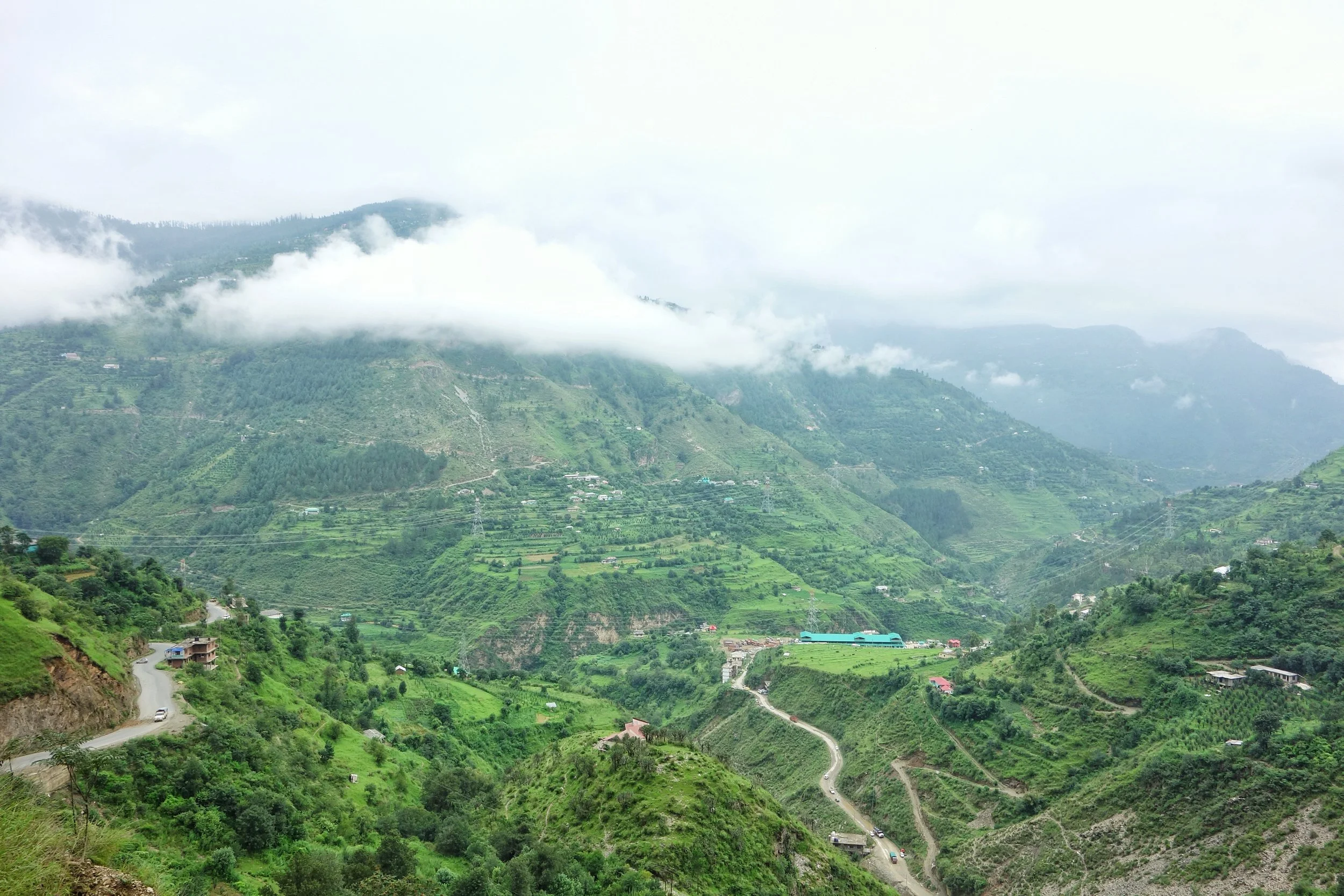
The Road snakes down the Hills in Theog
Again the bus started and it started to descend on the curvy mountain road towards Gumma. After what seemed an eternity we reached Gumma and Gumma always had the close to the Orchard feeling for me. Whenever I used to go to the Orchard, Gumma was the place reaching which I would tell my self that the Orchard is not far now. Had the same feeling again thsi time. So again after travelling for a while the conductor shouted Koku Nallah, anyone for Koku Nallah and I immediately shout yes and I realize that my friend had dozed off. I nudged him and we picked up our bags and got off the bus.
We just watched the bus leaving and it was then that I realised (now that the pegs were wearing off) that it was already 10:30 in the night. There was not a soul around and the only noise one can hear is the of the Pahadi dogs warning each others and idiots like us to stay off their turf. The Lalaji’s shop right at the road head was also shut and there was no light whatsoever.
It was then that I realized that all the years travelling to the Orchard we had never walked up in that late in the night and it was always in the day time or we always had a vehicle to take us up the kacha rasta upto the orchard. It was eerie at night and all the ghost stories that I had heard about these mountains and hill started coming to my mind. The house close to our house where three people were apparently murdered or the lady in a white gown which was seen in the Orchard at times in the night looking for her beloved or how one of my cousins had been possessed by the Demon himself one night at the orchard.
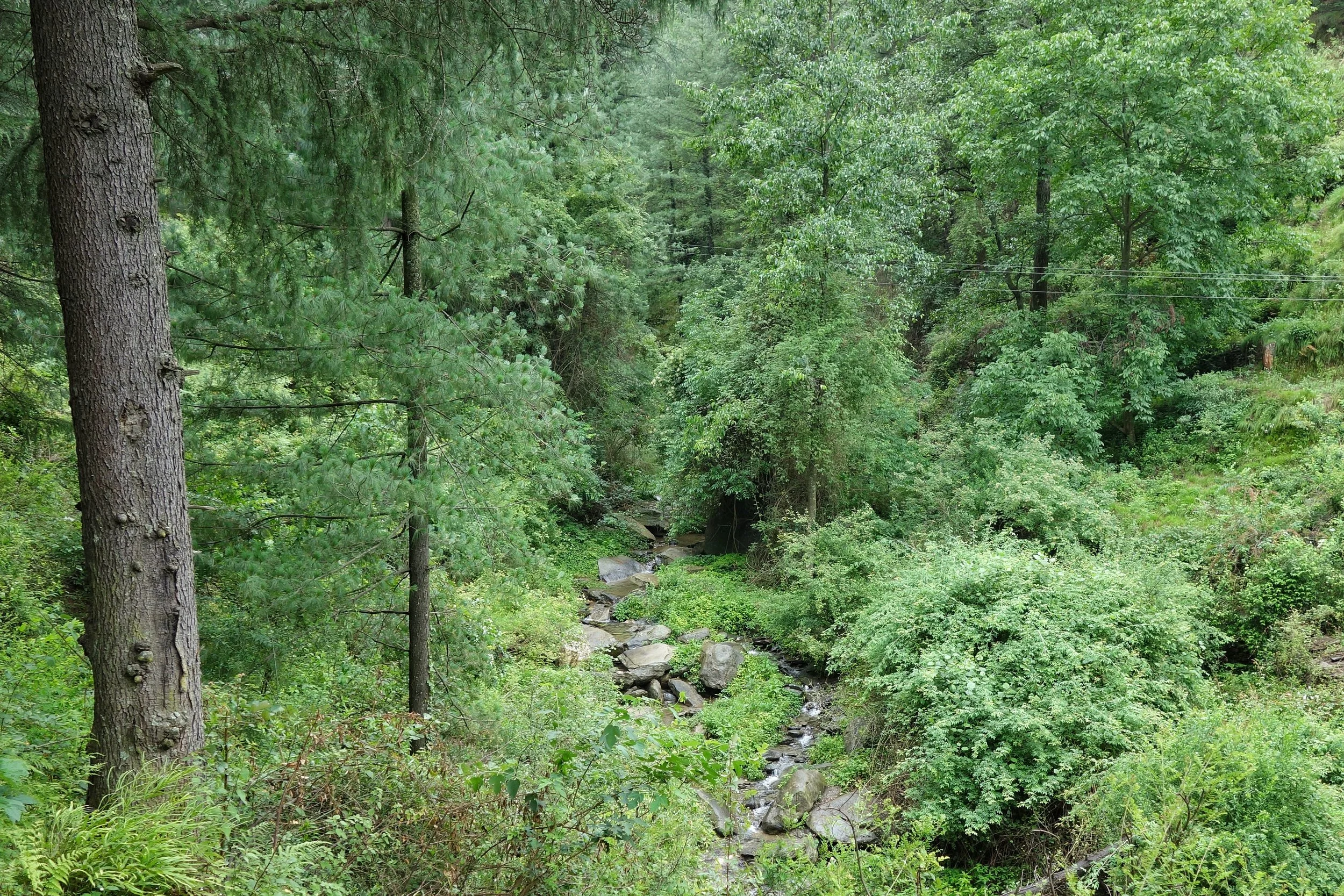
The Koku Nallah running through the thick forests
But I was always a rational man and I didnt believe in one bit of this bhoot wala mumbo jumbo. But my friend did as it was routine practice for me and my cousins to scare the hell of our friends who came to stay at the orchard by telling them mostly made up ghost stories around the bon-fire. Seeing all the almost grown men almost frozen in their chairs with fright was something we all cousins enjoyed but especially me as I didnt believe in all this bhoot stuff.
Ghosts aside there was one thing that I was really scared of at this time of the night. It was a present and clear danger and I could hear it as we started our walk up the rasta towards the Orchard. It was a completely still dark night and not even a leaf was shaking. There was just the sound of the Nallah that ran along the road. And it was then that we heard a bark. It was a bark with a deep bass accompanied by other barks. These were the Pahari Dogs which protected the Orchards and they were quiet languid lazy creatures in the day time but come night they were transformed into the hounds from hell. Among other duties they had to keep marauding monkeys out and also as a warning when the occasional leopard or a bear decided to visit the Orchard. These Dogs also didn’t fancy unknown humans coming anywhere near the Orchards as well in the night time.
Being a dog lover I understood that they were doing their job and doing it well but that did not lessen in anyway the fear I had of a chunk of my calf being taken by Moti the alpha dog at the Orchard. He even let me pat him in that day time but come night time and he was nobody’s friend.
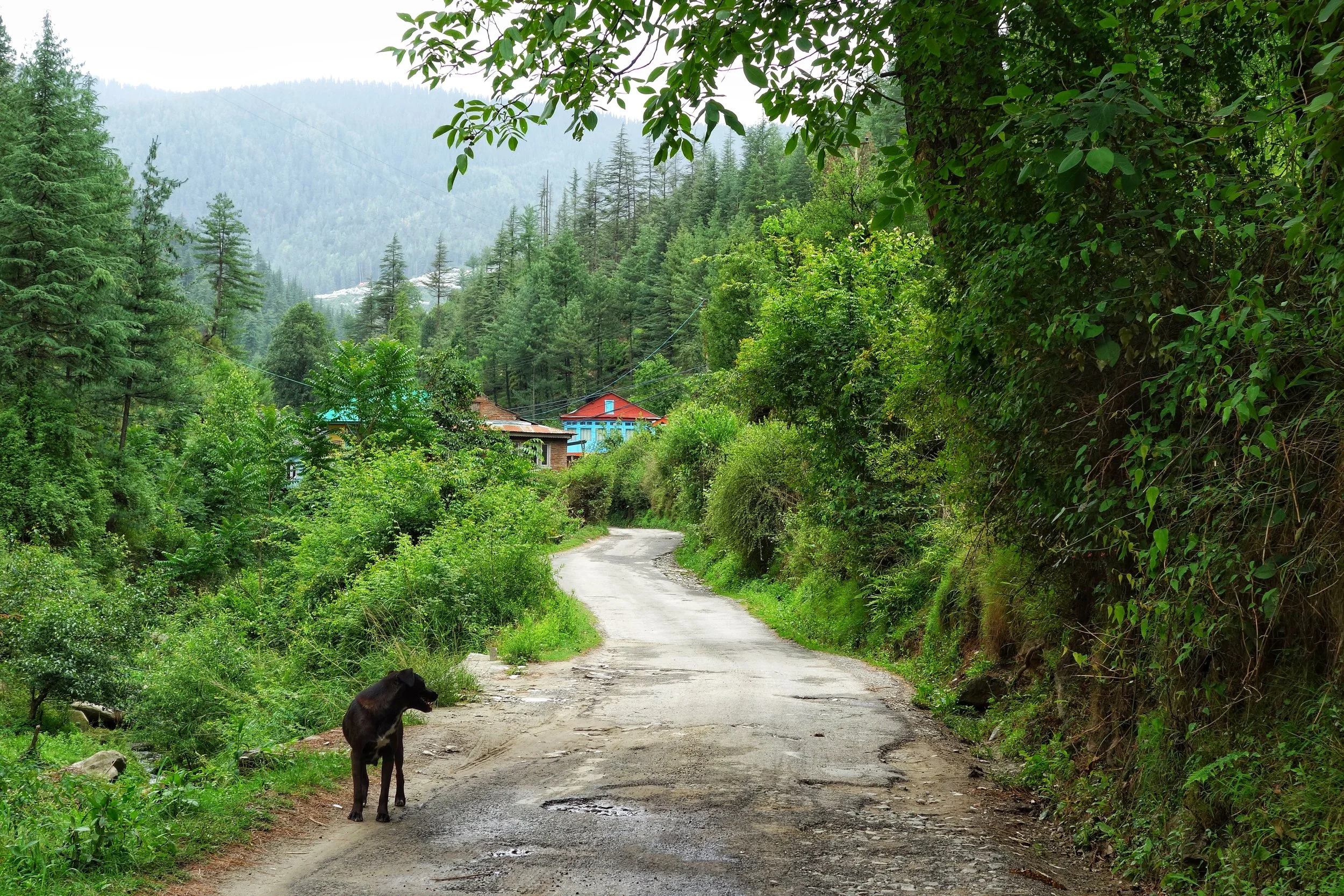
The Road to the Orchards
But we didn’t have any choice and I told my friend who was more scared of the Ghosts, ok lets do one thing I will fight the Ghosts if they come but you should fight the Dogs if they come. Seemed a reasonable trade off. So if a Ghost came I will go in front and face him and if it was the Dogs then my friend would face them. And it was then that the small flashlight went off. We had just walked a few steps and it went off. Just like that. Kaput. Murphy’s Law. So we had no choice but to slowly walk upwards with sticks in our hands and the barking constantly growing louder and coming closer.
We couldn’t see anything so we just lit of our lighter to give us whatever light it could. We walked closer to the gate of the Orchard till where cars could go. Finally after around 15 minutes we reached the gate of the Orchard. The thing was as long as you are not inside the Orchard gate the Dogs would just bark. But once you stepped past the Gate you were trespassing the territory of Moti and his band of brothers who knew how to rise up to the occasion and protect their turf. My friend was a little relieved that we reached the gate but I just grew more tense. The house was still a kilometer up the mountain and we had to walk through narrow pakhdandis through the Apple trees to get to the house. Anyways I opened the gate and stepped in.
The moment I stepped in I saw a moment in front of me. An animal just walked past the pakdandi around 10 meters in front of us. As we froze we saw the shining eyes just look at us for a moment and then it just slipped away and vanished. We just froze in our tracks. I asked my friend whether he had seen it. And he said yes I saw those eyes. Standing there we could hear the dogs barking very viciously but I realized they were not barking at us and something else had caught their fancy. The possibilities ran through my head as to what it was that we just saw ?
Taking no chances we went through our bags and we took out some newspapers. Bundled a few together and made a torch type thing and lit it. There was no way we were going to walk anymore in the dark without any light source. And soon we had some light and warily we started walking again. Up through the trees and we could hear the Dogs coming closer but by now we were pretty sure that they were not after us but probably after whatever creature that we saw. We just kept walking and walking hurriedly cause now we were close to the house and approaching the big tap right outside the small fence of the house boundary.
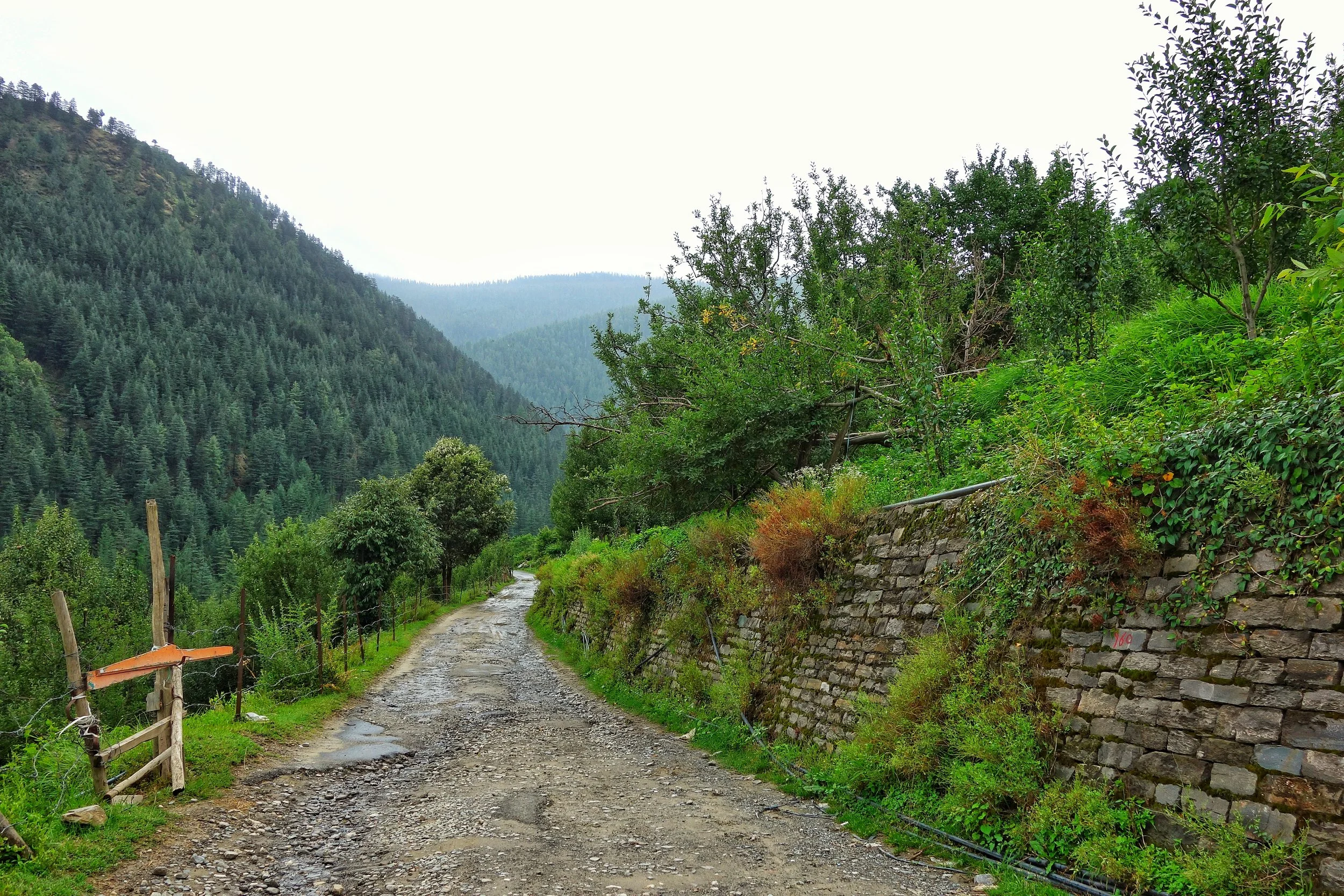
The Road cutting through the Orchards on either side. Nowadays its Motorable.
And then it happened again and we could feel those eyes looking at us again. And this time instead of just walking it just stood and we could feel the stare of those eyes if only for a few seconds. But as we froze the creature suddenly jumped the tap and disappeared into the night. As soon as he did that we saw Moti and two of his accomplices come running in and going in the direction of where the creature went. They didn’t even look at us, probably much more excited in getting their paws and teeth on whatever they were chasing. We stood for a moment and then just ran towards the house. We knocked the Door and the chowkidaar opened and he was surprised to see us there at that time. Why did you come so late ? he asked. Should have stayed in Shimla. It is not safe at night here he said again. I just ignored and walked up to where my cousins and friends were. Some sleeping some drunk.
We were also very tired and just hunkered down without telling anyone our story as the ones who were awake were just too sozzled to be interested in our story. So we just dropped into bed and slept. Early morning we woke up to a commotion and the chowkidaar was there and asking everyone especially me to come down and have a look at what had transpired in the night. There was a half eaten goat lying just outside the house boundary near the tap. Yes the same tap where we had seen the creature in the night. The goat was taken from a neighbors shed around 300 metres from there. Looking at the half eaten body I asked the chowkidaar, who did this ?
It was a Leopard he said as he showed me the teeth marks on the throat. The whole of last night suddenly flashed before me and in hind sight I realized what it was we saw, a Leopard. Yes a Leopard and that also at close quarters. I just looked at my friend and smiled. Not the Ghosts, not the Dogs, it was the Leopard !
Kiki’s Blog
Stories from the Himalayas
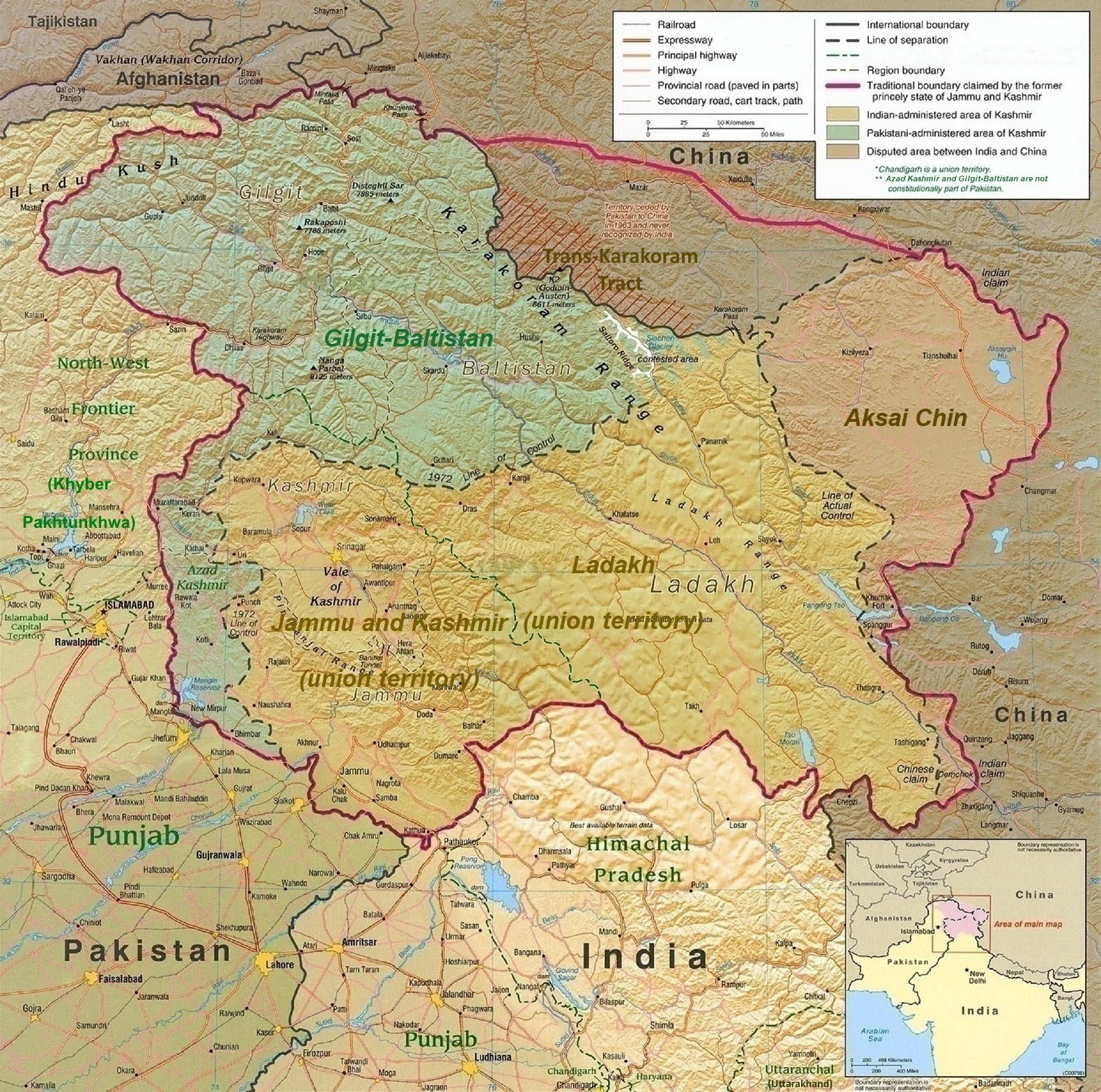



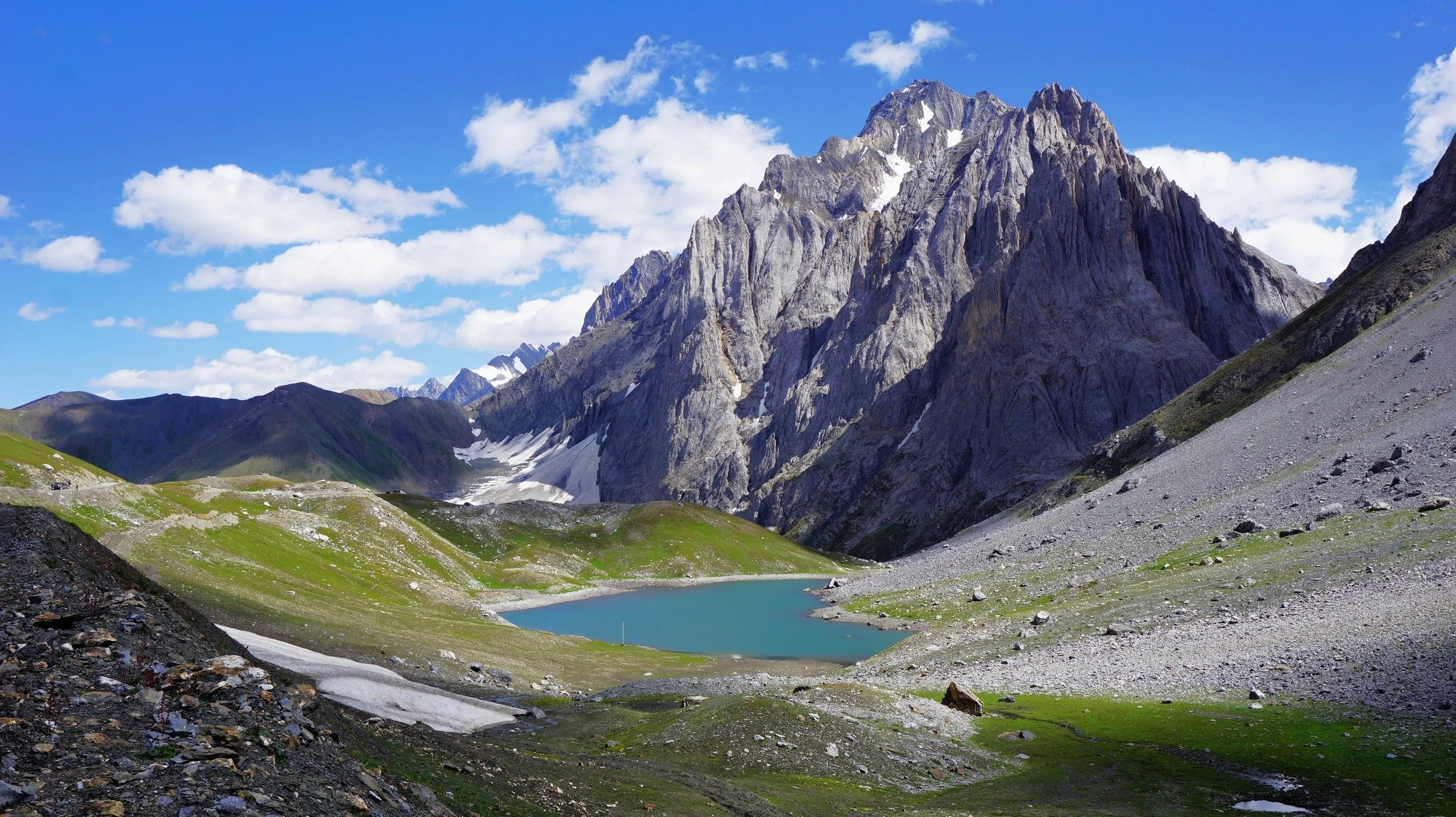
Five years ago the Galwan Valley was in the News for the wrong reasons after a deadly clash between the Indian and Chinese Armies in the Valley located in Ladakh lead to many deaths on the contentious Border between the two countries in wake of continued Chinese intrusions into Indian territory.
This area along the Shyok River, of which the Galwan Nallah or the Galwan River which forms the Galwan Valley has been off limits to Civilians since long but now the Indian Government has decided to open up the area for Civilians and we were amongst the First Civilians to venture into this beautifully desolate part of the Eastern Karakorams in Ladakh. Earlier Civilians could only venture upto the Village of Shyok from where the Shyok River takes a U turn and flows in a Northerly direction.