

Wazir Lakhpat Rai Padari of Padar, Kishtwar
Well it starts with the Raja of Kishtwar called, very interestingly, Raja Mohammed Teg Singh also known as Saifullah Khan. Though the Rajas of Kishtwar had converted to Islam they kept a mix of Muslim Hindu names and followed many Hindu costums and this Raja was no different. He was a vassal of the Afhna Governor of Kashmir who fell out with the Rulers in Kabul. A force was sent to Kashmir from Kabul but the Governor stood up to it and was assisted in the same by forces from Kishtwar. And by this time Raja Mohammed Tegh Singh had got into a service a new Minister called Wazir Lakhpat Rai Padari, who as the name suggests was from Padar.

People familiar with Kashmir and Srinagar with particular must have seen it one time or the other though most of the time one misses it. Situated right on the Maulana Azad Road is the Smamadhi and accompanying it a small Temple which says Wazir Lakhpat Rai Trust from what I re-collect. It is the Samadhi of Wazir Lakhpat Rai Padiar, a Wazir and a Warrior who took part in many Battles and Intrigues in the first half of the 19th Century in the Western Himalayas. He is not to be confused with his namesake Lakhpat Rai, the Wazir under the Durranis in the 18th Century.
Well it starts with the Raja of Kishtwar called, very interestingly, Raja Mohammed Teg Singh also known as Saifullah Khan. Though the Rajas of Kishtwar had converted to Islam they kept a mix of Muslim Hindu names and followed many Hindu costums and this Raja was no different. He was a vassal of the Afhna Governor of Kashmir who fell out with the Rulers in Kabul. A force was sent to Kashmir from Kabul but the Governor stood up to it and was assisted in the same by forces from Kishtwar. And by this time Raja Mohammed Tegh Singh had got into a service a new Minister called Wazir Lakhpat Rai Padari, who as the name suggests was from Padar.
This done Raja Tegh Mohammed Singh set his sights on Bhaderwah which was under the suzerainty of Chamba, though it had its own Raja, and for the same he asked the Afghan Governor of Kashmir for assistance and soon his forces arrived in Kishtwar led by General Khuda Dost. Wazir Lakhpat led the Kishtwari forces and they advanced on Bhaderwah. A force was dispatched from Chamba under Wazir Nathu but they were defeated at Basnota and Gallugarh and the town of Bhaderwah was burnt. The Raja of Kishtwar was all praises for Wazir Lakhpat and a Jgir was bestowed upon him in Bonjwah, where his descendants still live. Later the Raja under the influence of his Hindu Purohit decided to revoke his alliance with Kashmir and decided to ally with Chamba and as a consequence an Army of from Kashmir landed in Kishtwar defeated the local forces and took away what it could and returned to Kashmir. But the Raja was still left in Power.
After that the Afghans in Kashmir were focused on the Sikhs and because of its location Kishtwar was pretty independent and not bothered by the intrigues going on in the Punjab Plains between the British, Sikhs and the Afghans. As it so happened the on the run Afghan King Shah Shuja landed in the custody of Maharaja Ranjit Singh (thats a separate story which includes the Koh I Noor). After enjoying his “hospitality” for sometime in 1815 Shah Shuja escaped from his custody and after swimming the Ravi and passing through Sialkot and Jammu landed up in Kishtwar. The reason he came to Kishtwar was obvious, as he assumed that the King being a Muslim would receive him well. And he was correct. Not only was he welcomed but also allowed to raise an Army to invade Kashmir. Shah Shuja went ahead with the invasion through the Marbal Pass but his Army was defeated and he had to return to Kishtwar defeated and his Army in tatters.

In the meanwhile the news of Shah Shuja being in Kishtwar reached Maharaja Ranjit Singh and at once a demand was raised upon Raja Mohammed Tegh Singh to hand over Shah Shuja. But Raja Mohammed Tegh Singh refused and this would have very grave consequences for him. Shah Shuja in the meanwhile escaped to Warwan Valley and from there on to Suru Valley. From there he went to Zanskar and then Lahaul and the Kulu Valley to finally land up in Ludhiana where he went to the British. Of course this greatly annoyed the Sher- E - Punjab and he deputed Gulab Singh of Jammu to take care of Kishtwar. And so Gulab Singh went about with a plan which would finally throw Kishtwar into his lap without any Military campaign.
Gulab Singh got in touch with Raja Mohammed Tegh Singh and told him that some of his own men were conspiring against him, their leader being none other than his faithful Wazir Lakhpat. He forged letters that were said to have been sent by the Wazir to Ranjit Singh inviting him to invade and take Kishtwar. The Kishtwar Raja was convinced and he planned to have the Wazir murdered in open Court. The eventful day two of his men fell over the Wazir who was grievously injured but survived. The Wazir also came to know that the plan was sanctioned by the Raja so on the purpose of getting back to health he asked the Kings leave to go back to his native Village. The King agreed but instead of going to his native Village he landed up with Gulab Singh and took up service with him and also pointed out how Kishtwar could be taken.
So Gulab Singh messaged the Kishtwar Raja to come and make a personal appearance in the Court of Ranjit Singh to mend fences with him. The reluctant Raja agreed but as soon as he reached Doda he was arrested and put into prison. Gulab Singh and Wazir Lakhpat Rai now took possession of Kishtwar without any resistance. And the person put in charge of Kishtwar was a gentleman Zorawar Singh. Of course assisted by the very able Wazir Lakhpat Rai.
Wazir Lakhpat Rai was also a part of Zorarwar’s Expeditions into Ladakh. During the the first Expedition he was instructed to take Zanskar while the main body of Zorarwar’s troops were engaged in Purik and further towards Leh. Wazir Lakhpat Rai marched to Zanksar and having subjugated it decided to return back via the Umasi La Pass which connected Zanskar directly with Padar and the Wazir being a Padari knew of it. Just the small thing that Padar at that time was under the Rule of Chamba. So whence the Wazir marched in there was some resistance which was taken care of by the Wazir’s troops. Also a small Group of Dogra soldiers were stationed in Padar as well which was again not taken kindly by Chamba. Wazir Lakhpat had an old History with Chamba and Wazir Ratanu, the Chamba Officer in charge of the Region was well too aware of it.

In the subsequent year there was again news of an uprising in Ladakh and in particular in Zanskar and the Dogra Garrison there was put to the sword. The news of the same drifted across the Great Himalayan Range and reached Padar and Wazir Ratanu. Emboldened, he decided to get rid of the Dogra soldiers stationed there and attacked them. A few were killed and many were taken as prisoners to Chamba. Of course this had extremely grave consequences as Zorawar Singh returned and had his vengeance. The whole Town of Chattargarh was burnt down and renamed Gulbagarh. To absolve himself of the blame the Raja of Chamba handed over Wazir Ratanu to Raja Gulab Singh.
In the aftermath of the death of Zorawar Singh there was again an uprising in Ladakh and Baltistan and the Dogra Garrison was under siege in Leh. Raja Gulab Singh who was engaged on the Afghan Frontier at that despatched Troops to quell the uprisings as well as to carry punitive actions against the Tibetans who had now occupied Ladakh. One body of Troops under Wazir Lakhpat Rai was assigned to go to Baltistan to take the situation in control over there. And thence he marched to Baltistan to do the needful and he relieved the Garrison in Skardu and got things under control. After that he teamed up with the other force which was assigned to Leh and they started fighting the Tibetans and driving them back. One of the Commanders of the Force sent to Leh was none other than the Wazir’s old friend, Wazi Ratanu of Chamba who had been handed over to Jammu. The Tibetans held up the the fortifications in Drangtse which were flooded by the Dogras. And finally they gave in and fled back beyond Chushul when finally Peace was made and the Treaty of Chushul which demarcated the boundary between Ladakh and Tibet which even stands today.
Even after that the Wazir wasnt quite done yet. In 1846 in the aftermath of the signing of Treaty of Amritsar, Kashmir was passed onto Raja Gulab Singh who paid the War indemnity on behalf of the Sikhs. It is pertinent to note that Jammu and neighbouring Regions, Ladakh and Baltistan were firmly in the possession of Raja Gulab Singh at that time due to actions carried by men like Wazir Lakhpat Rai who had seen action on all the fronts. A small Dogra Force led by none other than Wazir Lakhpat Rai, who was now the designated Governor of Kashmir, went to Kashmir in order to take possession of the territory from the Sikh Governor Shiekh Imam Ud Din. Its said that he was under instructions from General Lal Singh not to hand over possession without a fight and that's what he did. Unknowingly Wazir Lakhpat Rai turned up with his small Force asking for possession which was denied and a confrontation started. And it was in this confrontation that Wazir Lakhpat Rai lost his life. He was destined to be the first Governor of Kashmir but fate had other plans for him. Of course a Memorial was built for him on the M A Road in Srinagar probably close to the place he fell. The man though little known in contemporary History still left his mark in the different Regions of what came to be the Riyasat E Jammu Kashmir.
Old Soldiers Never Die, They Just Fade Away as they Say.
His descendants still continue to live in a place called Sarol Bagh near Bhaderwah and I am attaching some pics of the Heritage buildings over there some of them being built during the Wazir’s time. Photos by Shri D K Dogra.
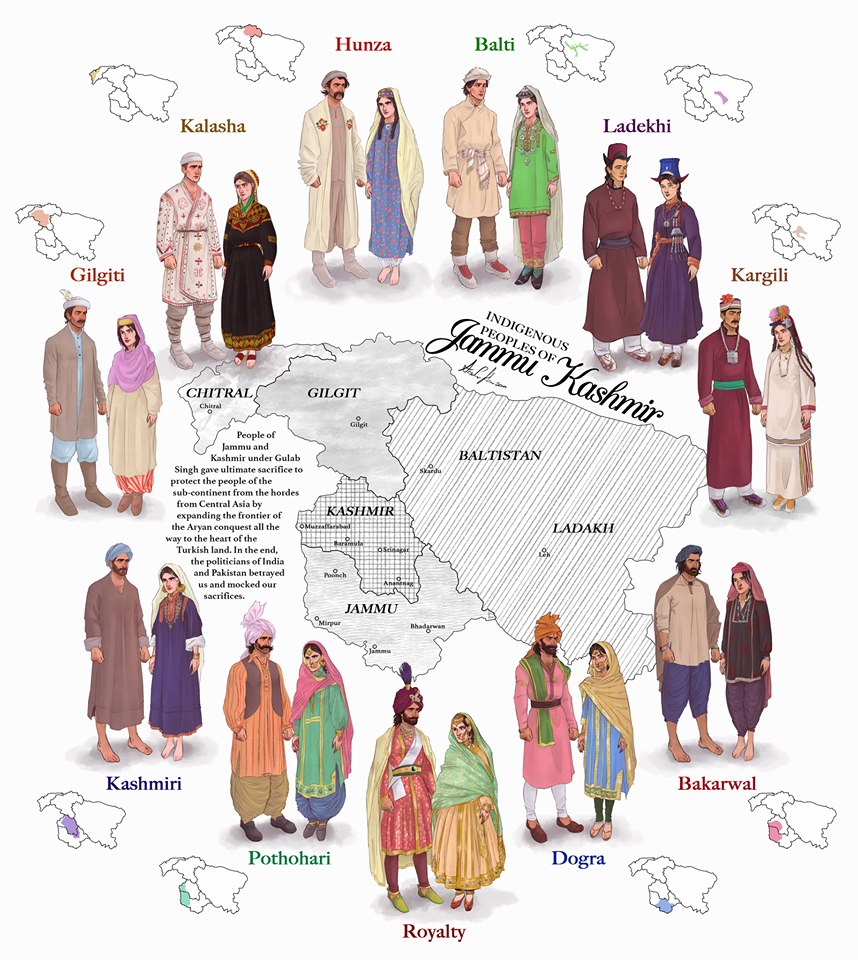
The Indigenous People of Jammu and Kashmir
The erstwhile State of Jammu and Kashmir was one of the most diverse State in the country in Ethnic, Religious and Lingual dimensions. The main "People" of Jammu and Kashmir and its different regions are briefly described in this Article.
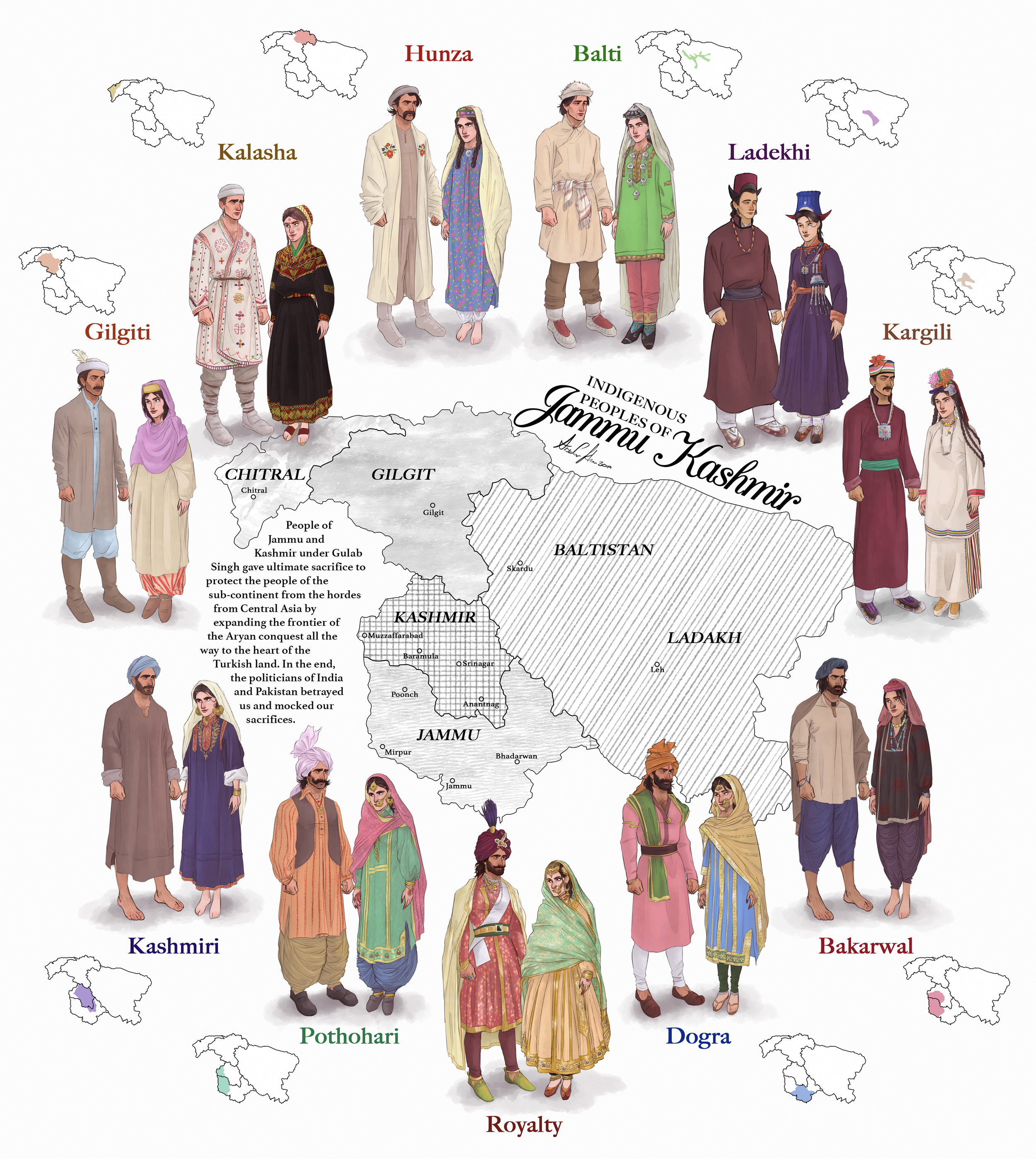
The Indigenous People of Erstwhile State of Jammu and Kashmir.
This is a graphical representation of the people of Jammu and Kashmir made by Arsalan Khan and Rajja Sourav Singh Sarmal. A brief description of each by me to help in better understanding (Clockwise from top) :

Hunza (Burusho) Ladies. Pic credit Wikipedia
The Hunza : The Hunza or the Burusho people inhabit the Hunza Valley and neighboring Valleys in the extreme North of the state. They speak the Burushaski language which as a language has not been identified with any language Group. The Hunzai now mostly follow different schools of Islam.
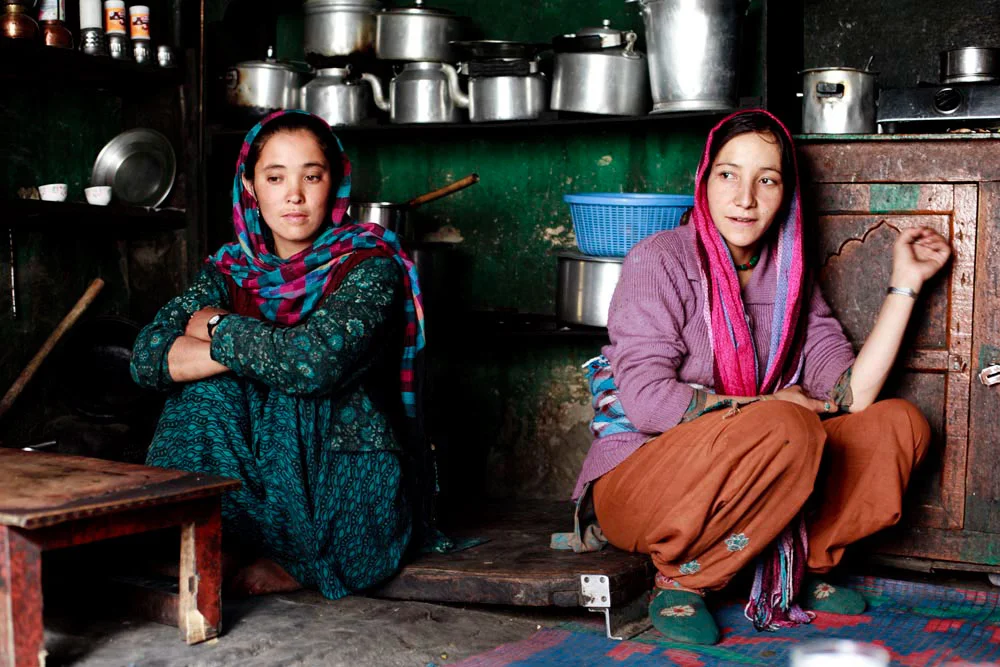
Balti Ladies. Pic Courtesy : https://www.behance.net/gallery/12289037/The-Balti-People-of-India
The Baltis : The Baltis are the inhabitants of the Baltistan and are of Tibetan origin with Dardic admix. Their language is Balti, which is a part of the Tibetan language Group. Infact it has the greatest similarity to old Tibetan. The Baltis follow Islam.

A :Ladakhi Lady in traditional Dress. Pic Courtesy Jimmy Nelson
The Ladakhis : The Ladakhis are the inhabitants of the Ladakh region and are of Tibetan descent. The Ladakhi language is from the Tibetan family. Ladakhis are Buddhists as well as Muslim.

Ladies in Kargil. Pic Courtesy Roots Ladakh
The Kargilis : The Kargilis or the Purigpas as they are called inhabit the Western part of Ladakh at the crossroads with Baltistan and Kashmir. Their language Purigi is a dialect of Balti and as such they are also a part of the Tibetan family. Purigis are mostly Muslim.

Bakarwal Men
The Bakarwals : The Bakarwals and their close cousins the Gujjars are traditionally nomadic pastoral people who inhabited the foothills of the Himalayas and moved to the Mountains in the Summers with their livestock. They (Gujjars/ Bakarwals) form the majority in the Poonch Rajouri region and spread among the Jammu Division and in Kashmir as well. They follow Islam.

Maharaja Ranbir Singh, the Dogra Ruler of Jammu and Kashmir state during who’s Rule the Dogra Kingdom reached it largest extent and also included Chitral
The Dogras : The traditional dwellers of the Jammu region or the “Duggar” as the region was known. They live in the foothills of Jammu and are spread into Himachal Pradesh as well. The Dogras speak the Dogri language which is from the Western Pahari Group of languages. The Dogras are mostly Hindu though a significant number converted to Islam and were referred to as Chibalis.
The Potohari : The Potohari/ Pahari are the most Punjabic people of Jammu and Kashmir and live across the Potohar Plateau which stretches well beyond Rawalpindi. They are in sizeable numbers in Poonch. Their language Pahari-Pothwari belongs to the Lhanda Family of Punjabi. They are majorly Muslim but there is a strong Hindu minority as well.
The Kashmiri : The people of the Kashmir area found mostly in the Kashmir Valley. They are the biggest Indegenous Group of people in the state. They speak Kashmiri language which belongs to the Dardic family of languages. Kashmiris are mostly Muslim though a small minority of Kashmiri Hindus also exists.

Dard - Shina People in Kargil
The Gilgiti : The Gilgiti or the Dards are the inhabitants of the vast Gilgit Valley in the North West of the state. They speak the Shina language. They (Dards) are also found in other areas of the state like Gurez and Drass where they have said to have migrated from Gilgit. They follow Islam though a few follow Buddhism as well in Ladakh.
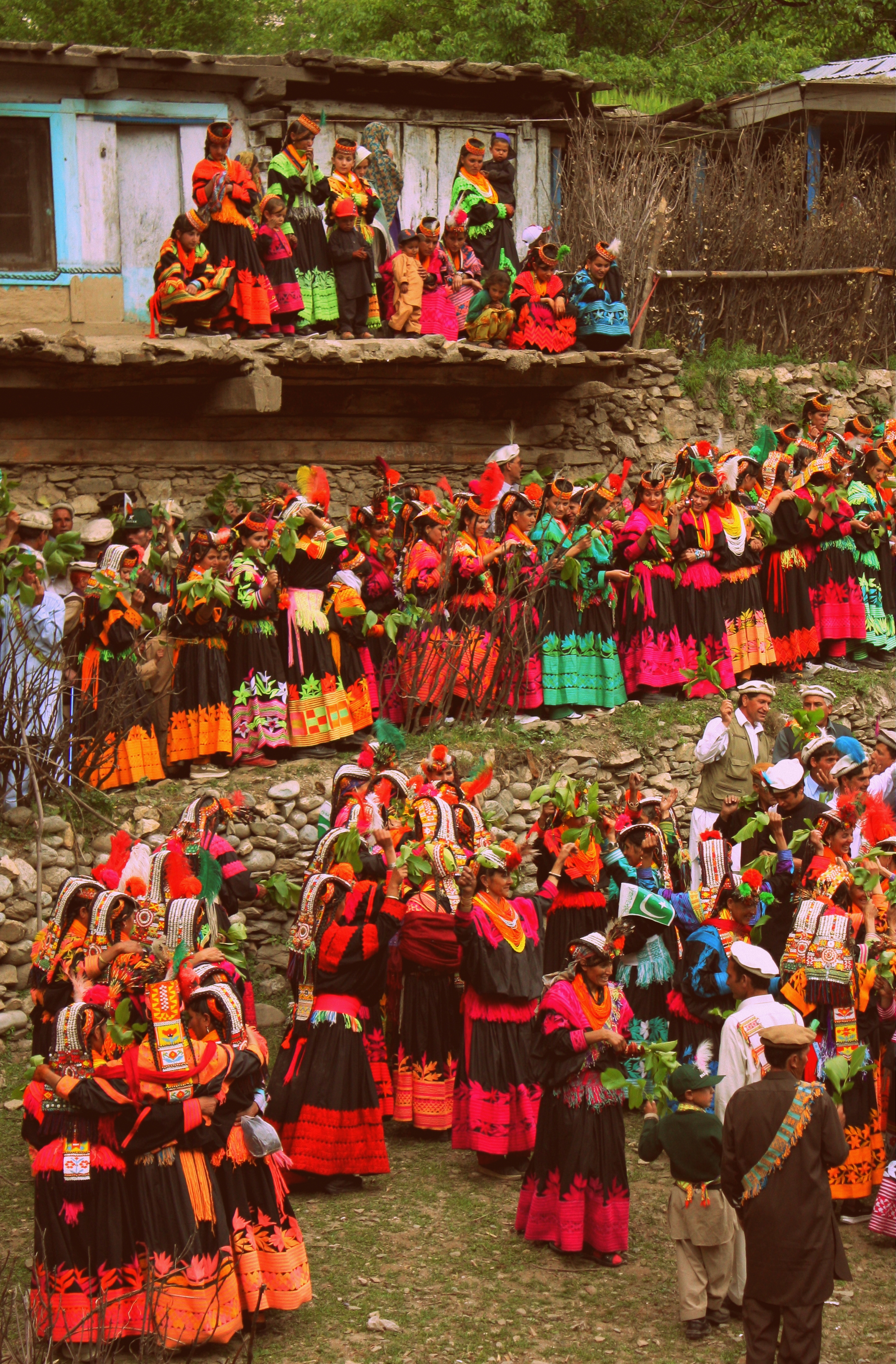
Kalash People during the Chillam Joshi Festiva. Pic Courtesy Wikipedia
The Kalash : The Kalash inhabit three Valleys in the Chitral Region now in KPK though at one time the Chitral Kingdom paid tribute to the Kingdom of Jammu and Kashmir. The Kalsha speak the Kalasha language which is a part of the Dardic family of languages. They have a distinct culture which has been under threat. Most Kalasha have converted to islam though a small number (3000 app) still follow traditional Animist beliefs.
Hi Res of Graphic can be downloaded from the link in the first comment.
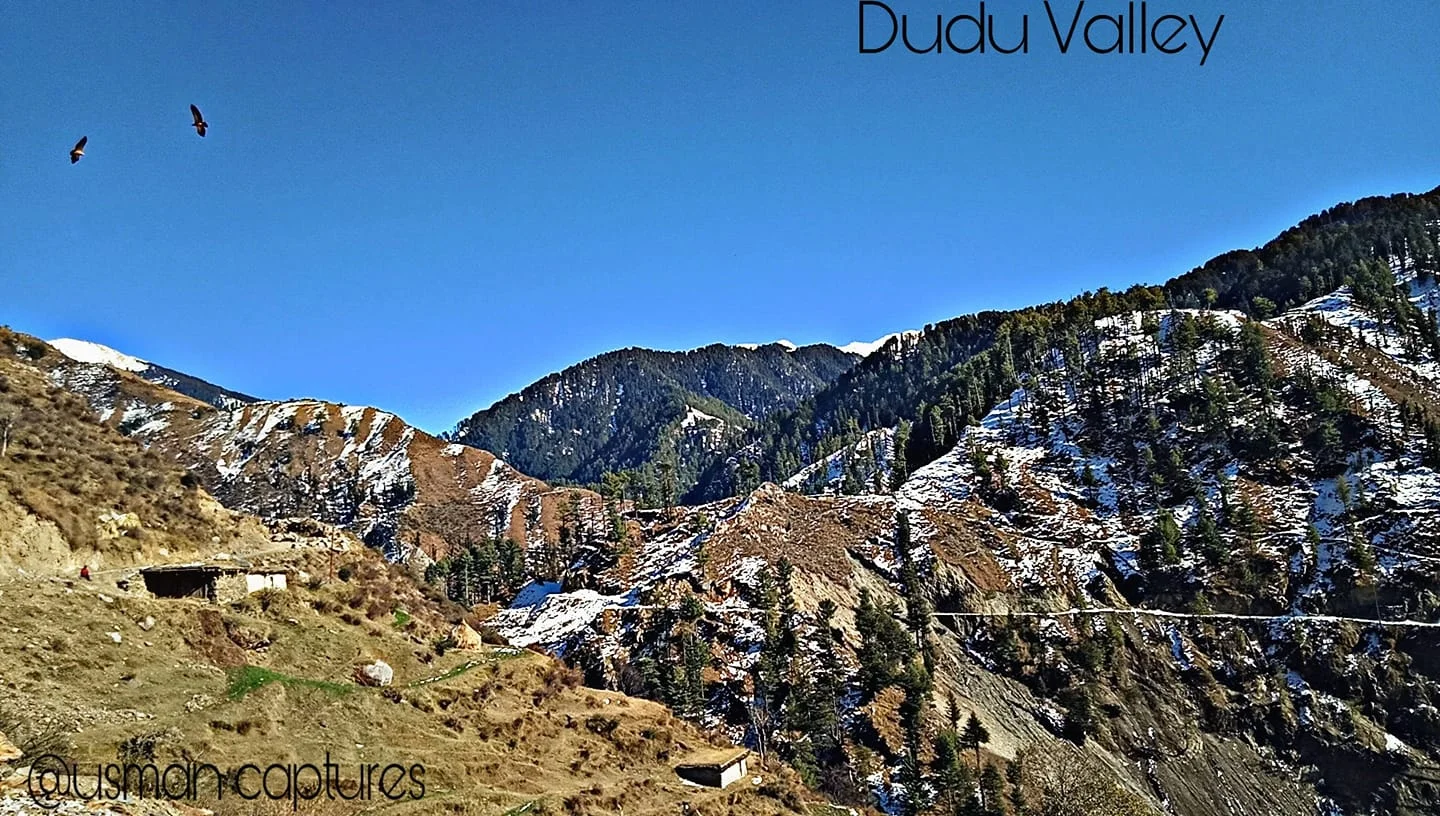
The Dudu Timber Saga
A tale from a time gone by when Forests were seen as great Resources of Timber and vast tract of these Himalayan Forests were given out on contract for Timber extraction. My Family was also involved in this Timber trade and were known as others in this business at Forest Leasees. This particular story is from the remote and unknown Dudu Latti Valley in Udhampur District in the Jammu Division of the Union Territory of J&K.
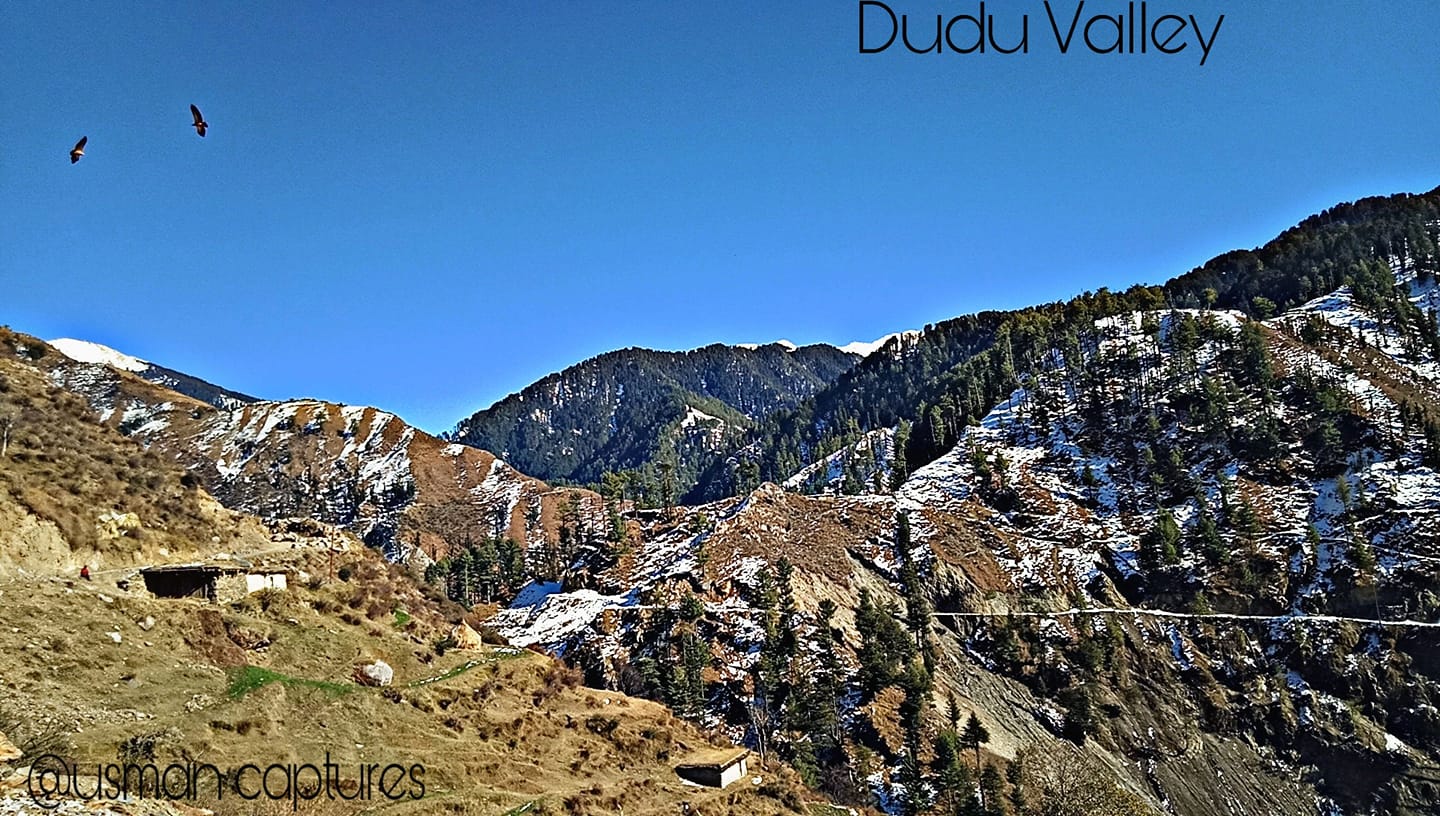
The Dudu Timber Saga
In today’s day and age the cutting of Forests is an abhorretion frowned upon by one and all. It was not always the same as once upon a time Timber was a great resource with multiple uses. Especially Himalayan Timber.
My family was involved in Timber business or “Jangalaat” as it was called back in the good old days when Timber and Forests were a resource to be exploited for Commercial gain. Cutting forests and selling them in the Market was an established big business in the Himalayan states especially in Jammu and Kashmir where Timber was one of the main resources of State Revenue.
Amongst the other hats he wore, my Grandfather was a Forest Leasee. A Forest Leasee was a person who took on contract a certain part of Mountain from the Government a part of Mountain. Under the terms of the Contract the Forest Leasee bid a certain amount for an area in Government floated Tenders. And once you got the Contract the whole Mountain was your and so were all the Trees. So once you landed up a Contract you sent your Men to the Jungle to cut down as many Trees as possible in the Contractual period.
It was a profitable Business I must say but not always as you would read as we go on. From the forests of Thandipora North of Kupwara, around Boniyar in Uri and even Pogal Paristan and Dudu Valley in Jammu. I grew up listening stories from my Father about those Forest Leasee days about how he would go to one of these remote Forestry Camps and spend the night there in Tents amidst the Bears and the Leopards. Of all the stories of those days my favourite one is about an incident which occured in a far away place in Jammu and Kashmir called the Dudu Valley in the Jammu Division somewhere in the wilderness between Udhampur and Kishtwar. Dudu Valley is now a part of the Latti Tehsil in Udhampur District.
Dudu Valley is today a secluded unknown beautiful part of Jammu so you can well imagine what it would have been back in those days over a 50 years back. But what Dudu had in those days were thick Forests which it still retains in parts till today as Iam made to believe. My Grandfather landed a Forest Contract in the Dudu Valley which was quite an isolated part of the state at that time. Also it was quite far from our base in Srinagar in Kashmir, in the back and beyond of Jammu Division. But my Grandfather thought he got a good deal and went ahead and took up the Contract along with a Partner who was based in Jammu and Pathankot.
Dudu Valley is drained by the Tawi River as it emerges out of its source near the Kailash Kund Lake from the Kailash Kund Glacier in the heights of the Pir Panjals. As it happened none of the younger men in the family were ready to go to this place in the back and beyond of nowhere. So it was upto my Grandfather to make the Journey all the way from Srinagar to Dudu Valley partly by Vehicle, partly by Horse and partly by foot. My Grandfather was a tough and sturdy Pahadi guy who was always up for the challenge. And he took it up.
So religiously he used to come to the place every other week to check on how stuff was going on at the isolated Camp.And of course things used to be fine when he was there but due to other business matters he could but spend just a few days in the wilderness of Dudu and had to return to Srinagar after a few days.
Now in those times half the challenge lay in getting the Contract for a lucrative Jungle and the other challenge was getting the cut Timber down to the Depots in Srinagar and Jammu from where it was sold in the Market. The way the Timber was transported in those days was kinda elementary. You just lobbed the cut Timber into the Mountain River and it would do the hard work and transport the Timber down River to more plainer areas where they were corralled and fished out of the River and sent to the Depot. This might sound very funny but this practice is still in use in parts of the World and even I have seen it being used in Kashmir long after we got out of the Forest Leasee business.
So one fine day when the Dudu harvest was done the logs were as usual tossed into the River. It was a good harvest and a large amount of high quality Dudu Forest Timber was now afloat the Tawi on its way downstream. And there were always teams of our guys downstream at the collection point to collect the Timber and get it out. But as it turned out that someone messed up and my Grandfather who was supposed to be on top of the operation was busy elsewhere, with full confidence in his Partner who was incharge of team for collection. The Timber arrived at the collection point but it seems no-one was there to corral it and the look out posted there had passed out after a bout of drinking. As a result all Timber just floated down. All the high quality Dudu Timber just floated downriver still and soon crossed over to Pakistan. It was a great loss.
Of course Daddy, as I used to call my Grandfather, let loose his wrath on all the incompetent people responsible for this debacle and decided that he would give up the Forest Business. And from the vast experience he had amassed working in areas in JK which even today most people have not heard of he decided to move to Government Contracts for construction in these areas. Besides the experience he had also at his behest a large Group of the hardiest men of these Mountains, the Gujjars in his employment as we shared Lingual similarity with them and our language dialects were quite similar. This of course helped him getting many Government and Military Contracts. The crowning glory of his career being bagging the prestigious Contract to build the High Altitude Warfare School at Gulmarg.
Sometimes I wonder what it would have been to have lived in those times. That Era. When Exploring Mountains could be made into a profitable business. Anyways.
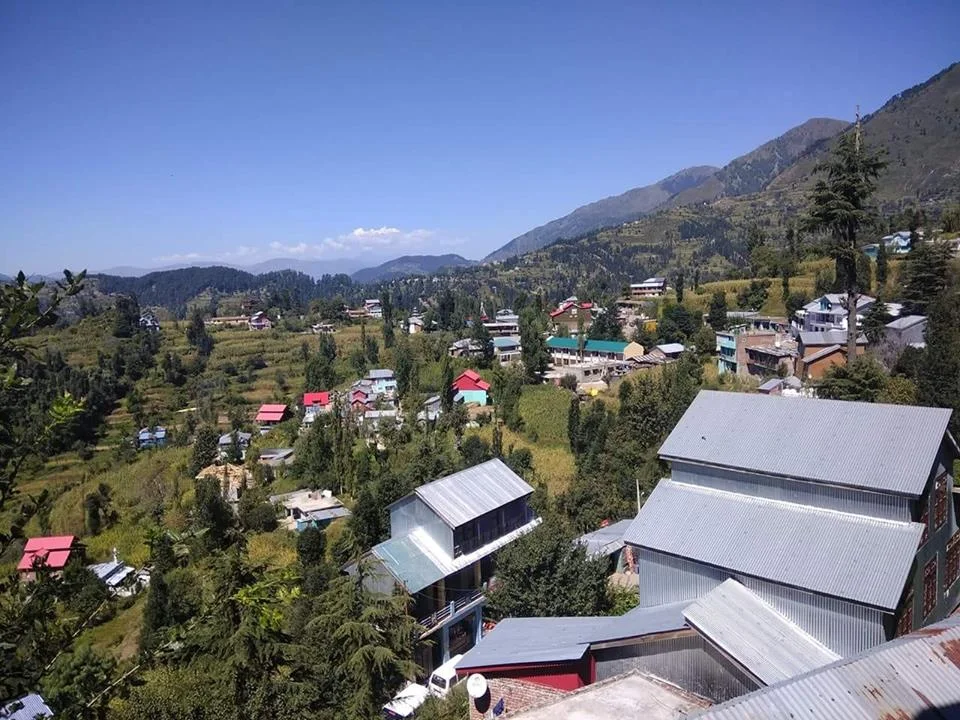
Try visiting the Dudu Valley. Its still as pristine, almost, as it was during my Grandfather’s time. :)
A pic of the Dudu Valley. Summer’s, this year. Pic credit the FB Page of Latti Dudu https://www.facebook.com/LATTItehsil/
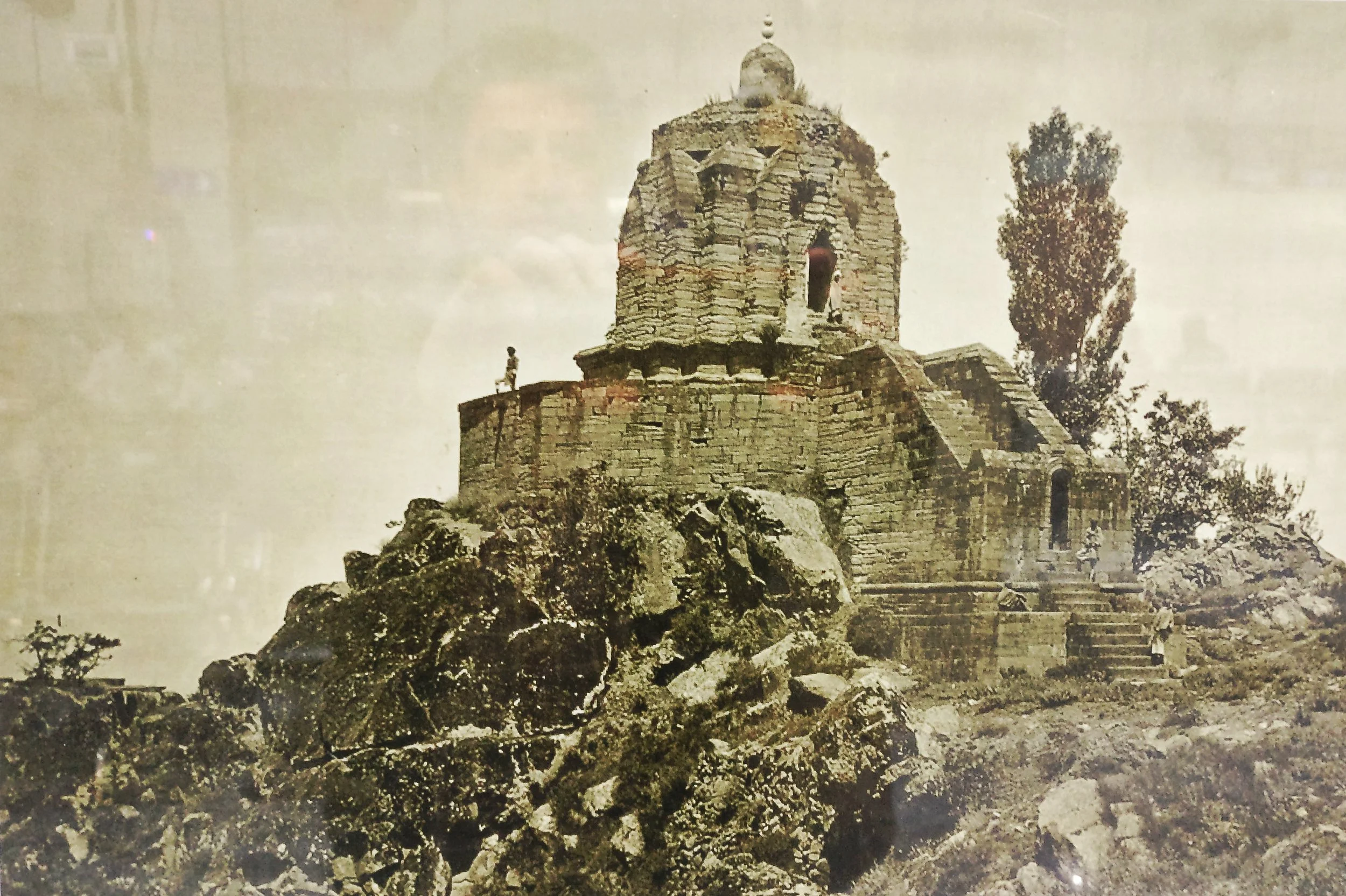
The Lingual Diversity of the state of Jammu and Kashmir
The state of Jammu and Kashmir is made up of a number of geographically separate Regions divided by Ranges of the Himalaya. Its home to a diverse variety of Ethnicity, Cultures, Religions and of course Languages and Dialects. This article looks at the language diversity in the state of Jammu and Kashmir.

The Lingual Diversity of the state of Jammu and Kashmir
The State of Jammu and Kashmir is not only Geographically and Ethnically diverse with the two Highest Ranges in the World, the Himalayas and the Karakorams and also hosting Peaks of over 8000m from both these Ranges. Ethically it has a diverse mixture of people and distinct Regions dominated by different Religions such as Islam, Buddhism and Hinduism. But one of the little understood and little know fact in the Lingual diversity that exists in this state which we study as it existed in 1947 before the Partition.
The state was basically made of of 5 different Regions which were all Mountainous and it was the Mountains and the Rivers which divided the Populations. The main Regions as we can name in today’s context were (in Alphabetical order) were Baltistan, Gilgit, Jammu, Kashmir and Ladakh. And of course we have a major language language associated with the Region. Balti with Baltistan, Shina with Gilgit, Dogri with Jammu, Kashmiri with Kashmir and Ladakhi with Ladakh. But these classifications only sum up the language of the perceived majority in that Region but doesn't really give a true picture of the lingual diversity and how the languages sometime merge to create hybrid languages.
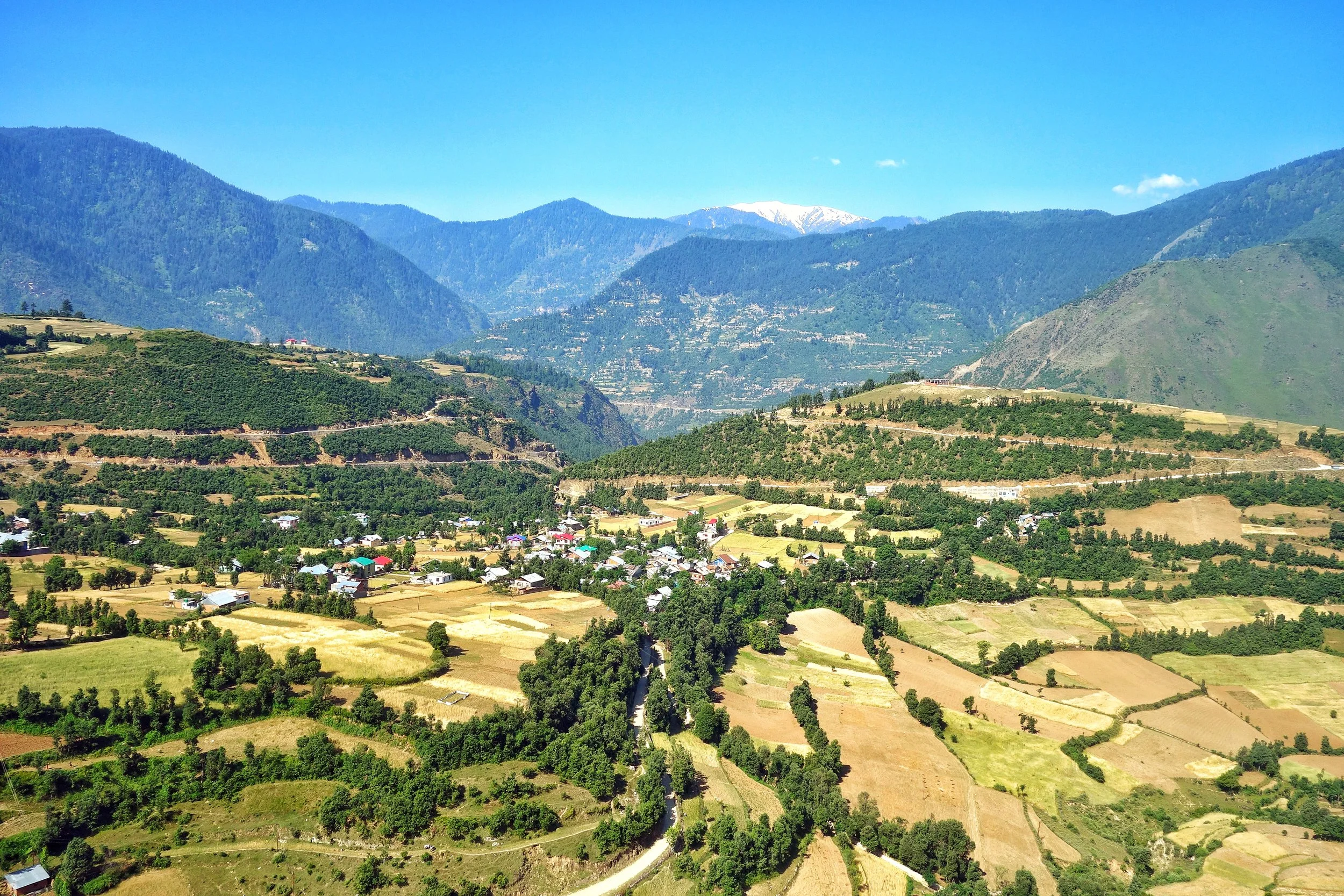
Starting from the Jammu Region which has a diverse language influences. Starting from the bottom at Poonch and Rajouri where the spoken language is Poonchi or Pahari or Potohari. This language belongs to the Lahnda/ Punjabi family of the Indo Aryan languages. Moving Eastward we have the Dogri language, which was considered as a Punjabic language and still has a lot of commonality with Punjabi. But now Dogri is considered an independent language and one of the main languages of the Western Himalayan Pahari language Group.
And then we have the Gurjuri spoken by the Gujjars. Gurjuri is closely allied to the Marwari dialect of Rajasthani and also has a fair mix of Punjabi in it. In fact the Gujars living in Punjab speak Punjabi and the languages are intermixed. Gurjuri is also spoken in the Kashmir Valley where also there are communities of Gujjars. However a number of Kashmiri words have overtime have become common usage by the Kashmiri Gujjars influenced by their Kashmiri neighbours.
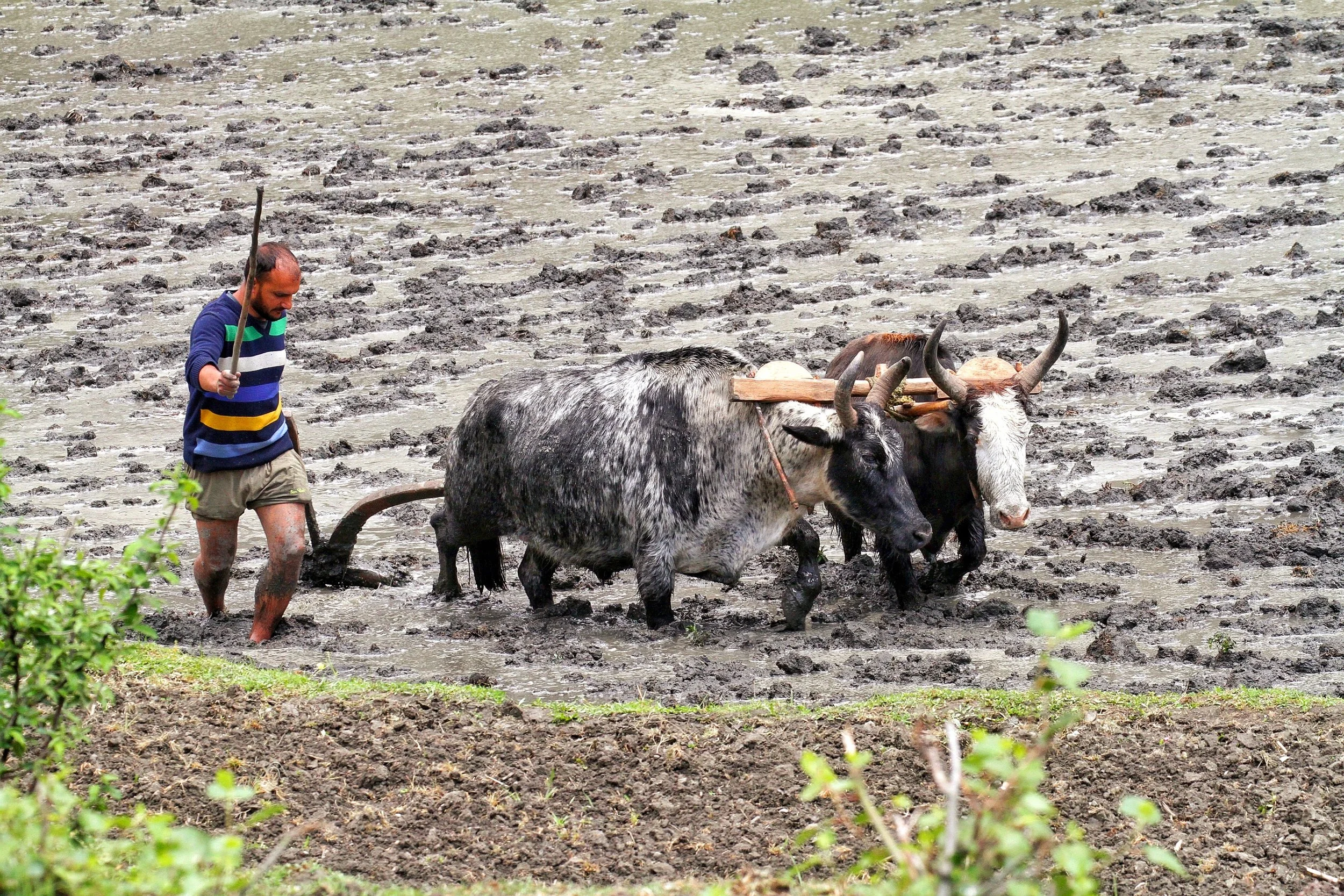
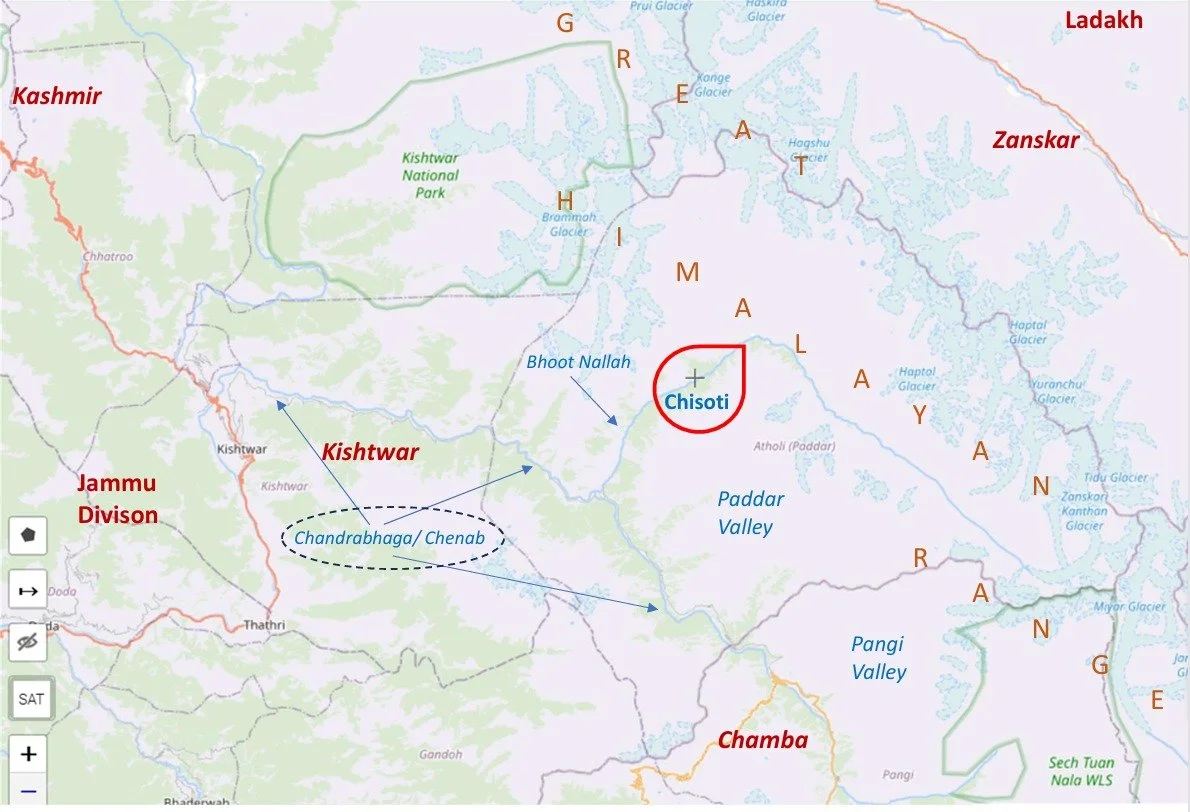
Moving upwards into other parts of the Jammu Division we see increasing influence of Kashmiri language which is a part of the Dardic Language family of the Indo Aryan language Group. Bhadarwahi, Bhalesi and Curahi from an intermediate forms of speech bridging the gap between the Punjabi or Dogri and the Kashmiri System. Padari is an extremely interesting dialect, spoken in Padar region of Kistwar on the banks of the Chinab. It has a striking similarity to Pangwali, spoken in the Pangi Valley in Chamba.
Siraji is the language spoken in country north of Chinab between Ramban and Bhart on the way to Kishtwar. It is central to Doda and is also called Doda Siraji at times. Due to its location, to the North it gives was to Kashmiri, on West to Rambani, on the North East to Kishtwari, and on the South and South West to Bhadarwahi and Chamba dialect. Its generally frameworked like Punjabi but has many points in agreement with Kashmiri.
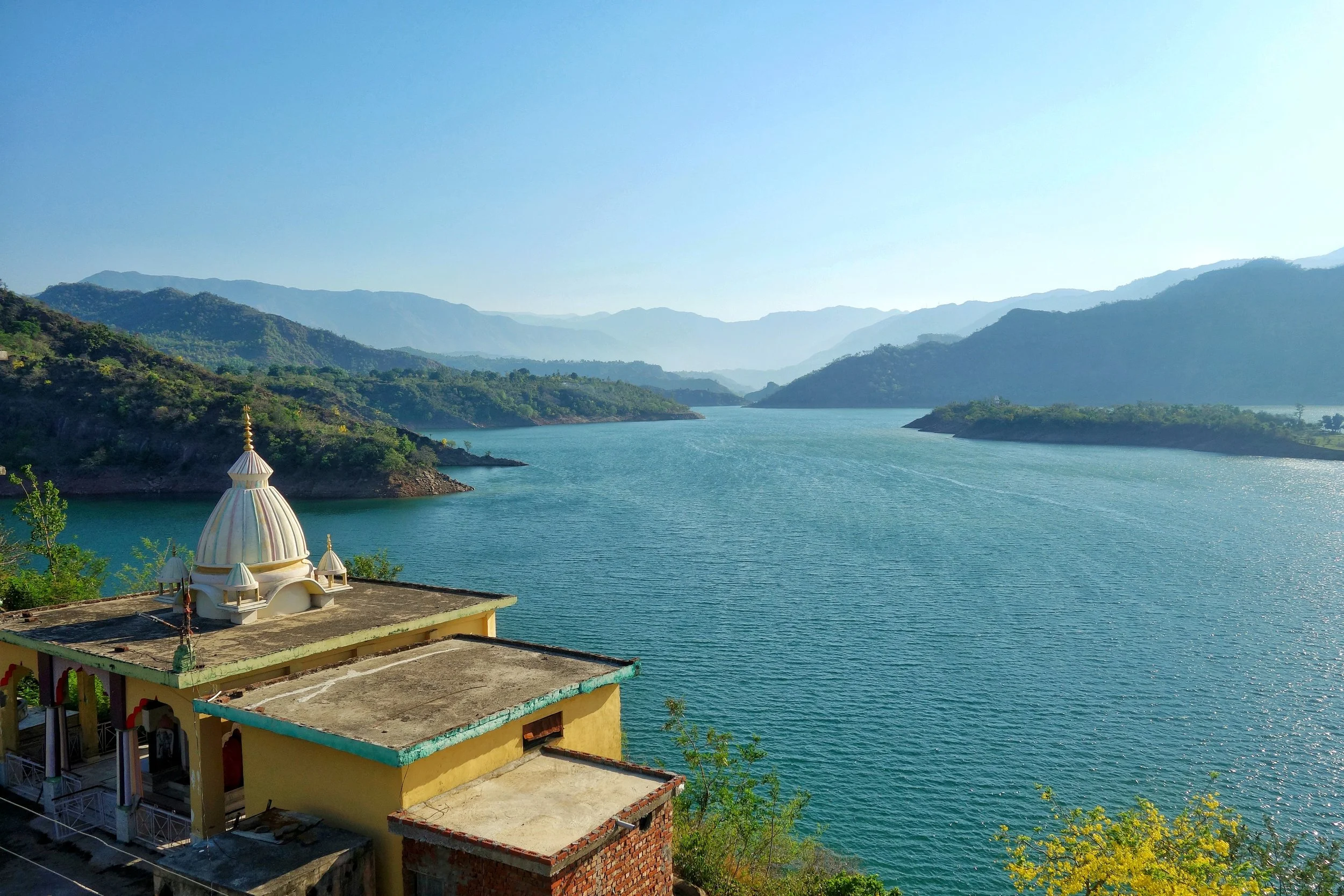
Rambani as the name suggests is the language spoken around Ramban and like the Poguli which it closely resembles it is connected with Kashmiri though further away than it than Poguli. Rambani has a very largely Punjabi pronunciation whereas Poguli pronunciation is more like Kashmiri.
Poguli is a language spoken in a small area to the East of Ramsu. It resembles Kashmiri though it is unintelligible to speakers of the Kashmiri language. However it seems that all speakers of Poguli have some basic understanding of Kashmiri. Nearly all peculiarities of Kashmiri are found in Poguli which however contains a number of points in common with dialects which look to Punjabi as a fountainhead. Kishtwari is spoken around the Kishtwar area of the Kishtwar region. It is considered a sub-dialect of Kashmir which it resembles very much. Kashmiri is well understood in Kishtwar.
And of course then we come to the Valley itself where the main spoken language is Kashmiri. The second most spoken language in Kashmir is Gurjuri probably followed by Punjabi / Pahari spoken in the Border areas adjoining the LOC in the West. However there are still speakers of Shina in the Gurez Valley, a couple of Villages in Tral and the Sarbal Village in Sonamarg. There is also a small community of Shina people who live in Srinagar city and they also speak Shina. Shina BTW is the main language of people in Gilgit.

Shina itself is a part of the Dardic family, same as the Kashmiri language. Its the most spoken language of the Gilgit region and it has a number of dialects such as Gilgiti (the prestige dialect), Astori, Chilasi Kohistani, Drasi, Gurezi, Jalkoti, Kolai, and Palasi. Related languages spoken by ethnic Shina are Brokskat (the Shina of Baltistan and Dras), Domaa, Kohistani Shina, Palula, Savi, and Ushojo. Shina is also spoken in the Drass area, Dah and Hanu and other “Aryan” Villages of Ladakh. Shina is also spoken in areas adjoining Gilgit like Kohistan in Khyber Pakhtunkhwa.
And then we come to Baltistan, where the main language is Balti. Balti is a part of the Tibetan family and belongs to the Ladakhi Balti Group. Infact many words that were used in old Tibetan are still found to be in use in modern Balti whereas they are not used in modern Tibetan anymore. Balti is widely spoken in Baltistan and a dialect, the Puriki is spoken in the Kargil area and the Suru Valley. Proper Balti is spoken in the Turtuk area of Ladakh as well. The language is also used by Balti communities settled elsewhere including the small Group of Balti people settled around Dehradun in Uttarakhand.
And finally Ladakhi which like Balti belongs to the Tibetan language family and is related to Balti as well. Besides proper Ladakhi it has a dialect called the Zanskari which is spoken in the Zanskar region. Interestingly both Ladakhi and Balti belong to the Ladakhi Balti family of Tibetan language. These are also called Western Archaic Tibetan languages as they have a lot in common with Old Tibetan unlike the more modern Western Tibetan language of the Lahaul Spitian language. Ladakhi has other sub-dialects if you may like Lehskat after Leh, where it is spoken; Shamskat, spoken in the northwest of Leh; Stotskat, spoken in the Indus valley and which is tonal unlike the others; Nubra, spoken in the north of Leh. In my personal experience I think all these Tibetan languages are mutually intelligible to some extent as I see people speaking Puriki and Ladakhi being able to have a conversation.
This should give you an idea of the languages spoken in the state of Jammu and Kashmir and we know that in the Mountains in the older times populations evolved in isolation and hence the vast array of languages and dialects and sub dialects. Infact in some cases the language changes from Valley to Valley so the actual number of dialects are well impossible to even comprehend but this gives you an idea of the diversity.
Source : Language of Northern Himalayas by Bailey 1908 and other Internet sources including Wikipedia.
And adding a language Map of Jammu and Kashmir by Drew from the late 1800's.
The Enchanting Padri Gali
The enchanting Padri Pass or Padri Galli or Padri Top which connects Chamba in Himachal Pradesh with Bhaderwah in the Jammu Division of Jammu and Kashmir at around 10,400 feet amsl. It is located around 110 kms from Chamba Town and around 40 kms from Bhaderwah and is the highest point of the Chamba Bhaderwah Highway. This is one of the important Passes which connects J and K with Himachal. In older times Bhaderwah was a part of the powerful Chamba Kingdom which held Kishtwar as well and even Zanskar.

The Enchanting Padri
The enchanting Padri Pass or Padri Galli or Padri Top which connects Chamba in Himachal Pradesh with Bhaderwah in the Jammu Division of Jammu and Kashmir at around 10,400 feet amsl. It is located around 110 kms from Chamba Town and around 40 kms from Bhaderwah and is the highest point of the Chamba Bhaderwah Highway.
This is one of the important Passes which connects J and K with Himachal. In older times Bhaderwah was a part of the powerful Chamba Kingdom which held Kishtwar as well and even Zanskar. For many years Bhaderwah was the bone of contention between the Jammu Kingdom and the Chamba Kingdom until in the mid 1800’s it was taken over by Raja Gulab Singh of Jammu as terms of settlement of the Territorial boundary with the Chamba Kingdom after he acquired Kashmir as per the Treaty of Amritsar.

Bhaderwah today is a part of the Doda district and lies in the lap of the Pir Panjals. The Town of Bhaderwah itself was an important one and the Bhaderwah Fort stands watch over Town. Bhaderwah has a mixed population of Hindus and Muslims and the languages spoken include Bhaderwahi and Kashmiri.
There are many beautiful places in Bhaderwah which have for long been away from the Tourist lime light. Some of them are described below (Taken from JK Tourism Catalog) :
Kailash Kund : The Kailash Mountain overlooking the Bhaderwah Valley is supposed to be the abode of Shri Vasuki Nag. At 13067 ft the Kailash Kund is the source of the River Neeru which drains the Bhaderwah Valley. The Yatra follows Mani Mahesh Yatra and starts with the Chari Mubarak from the Village of Gatha in Bhaderwah and then goes to Vasuki Nag Temple in the heart of the Town. At Ramkund one halts for the night and there on to Kailash Kund. The annual Kailash Yatra takes place in the month of August.
Seoj Meadows : The Meadow of Seoj is flanked by a gushing River on its West which emanates from the Hills surrounding the Kailash Kund. The Landscape across the River is a replica of Pahalgam whereas on the Eastern side there are long stretches of Grasslands. On the Western side the Meadows take a descent along the crystalline water of the Seoj Rivulet and roll towards Ramnagar area of Udhampur District.
Chinta Valley : Situated at a height of 6500 ft Chinta Valley is a beautiful Valley with thick Coniferous Forests on all sides and the Chinta Nallah flowing through it. A grassy Meadow called Bagan on one side of the Village is favoured by picnickers.
Jai Valley : Ten kilometers from the Chinta Valley is the picturesque longitudinal Jai Valley at a height of around 7000 ft. Located around 32 kms from Bhaderwah it is an extremely beautiful Region spread over 6 kms. The Valley is surrounded by thick Deodar forests on steep slopes with a sprawling Meadow in the middle.
Khellani : Khellani, overlooking the Kellar Valley is a Deodar clad Plateau 15 kms from Bhaderwah. Drained by the Bankut Nallah it is an ideal leisure spot. From late Summer to Autumn the Valley provides a bounty of fruits like Apricots, Peaches, Plums and Apples. While at Khellani one can walk through Khellani Pass amidst various Villages connected at Maulote and take the Road back to Khellani.
Pic from March end, 2018
The Chingus Sarai
The Chingus Sarai or Fort is an old Mughal era Sarai on the Mughal Road which connected Punjab with Kashmir over the Pir Panjals. The word “Chingus’ is derived from the Persian word for “Intestines”. It got this rather unflattering name after the intestines / entrails of one of the Great Mughals, Emperor Jahangir were buried here.

The Entrance to the Sarai
The Entrails of an Emperor : Chingus Sarai
(Advisory : Please use your discretion while reading this Post. Some parts of it might sound distasteful to sensitive people.)
On the Old Mughal Road or the Mughal Road as its called now lies a Sarai called the Chingus Sarai. This was among a series of Sarais built by the Mughals to serve as stop over points on their Journeys to Kashmir via the Pir Ki Gali. Some of these Sarais still exist though in a dilapidated condition on the Road. These include the most well known of these Sarais as well, the Aliabad Sarai which was right below the Pir Ki Gali. The Road and the Sarais on it were built by the Kurdish Governor of Kashmir and Lahore, Ali Mardan Khan

Inside the Chingus Sarai / Fort
Situated at an around 2000 ft the Sarai is around 130 kms from Jammu and around 35 kms from Rajouri. It is situated near the Village of Chingus along the banks of the Sukhtao River. It offers a spectacular view of the snowy Ranges of the Pir Panjals. This was the fifth Sarai on the way from Gujrat (now in Punjab, Pakistan) across the Pir Panjals into the Kashmir Valley and ending at Srinagar. The name of the Village earlier used to be called Khanpur and was established by the Jaral Hill Rajas. So why was the name changed ?
As most of you known that the Mughals were great patrons of Kashmir and none of the Mughals was as enamoured with Kashmir as Emperor Jahangir, also called Saleem, the somewhat rebellious son of Akbar the Great. Yes the same Saleem of Saleem Anarkali fame. As per historians Emperor Jahangir visited Kashmir a total of 13 times. In contrast Akbar visited Kashmir twice and Shahjahan and Aurangzeb once each. The Mughal Gardens in Kashmir are a legacy of the Mughal love affair with Kashmir. Emperor Jahangir himself is credited with the creation of the Shalimar Bagh while the others were laid down by his son, Emperor Shahjahan, who could never really enjoy Kashmir as much as he would have liked to. Jahangir’s grandson, the unfortunate Dara Shikoh was also a great Patron of Kashmir and the Chashmashahi Garden is said to have been a gift for Dara from his father Emperor shah Jahan.

The staying Quarters at the Chingus Sarai
Coming back to Chingus. The word Chingus is derived from the Persian word “Chingan” which means intestines or entrails. So why such a seemingly gory name for a halting Sarai on the way to what the Mughals called the Paradise on Earth. Well it so happened that in 1627 while on his way back from Kashmir, Emperor Jahangir fell ill at a place called Behram Gali (Behramgala) in the Poonch area. He was advised rest and the Royal Caravan decided to halt for a few days at Behram Gali before moving on. It would give the Emperor time to recover from ill health. And so they bade time and soon the Emperor health began to recover. And soon he got back to that Royal favourite past time of Shikar ie Hunting.
One day while on a Shikar it is said that it so happened that one of the Royal attendants was trying to drive a group of Deer into within the hunting Range of the Emperor. Apparently while doing so he slipped and fell down from a certain height on the top of the Hillock. This happened right in front of the Emperor and while he watched a big rock dislodged by his fall fell on top of the attendant and the poor fellow died a painful death in front of the Emperor Jahangir. And tragically the Royal attendants Mother was also present on the scene and after watching her son’s life end so painfully she started wailing and crying as any Mother would do in such a scenario. This chain of events had a great adverse effect on the Emperor.
The Emperor fell ill again and this time the Empress Nurjahan decided to rush him to Lahore. But alas his time had and this time there was no recovery. The Great Moghul Emperor Mirza Nur-ud-din Beig Mohammad Khan Salim aka Nur-ud-din Muhammad Jahangir Badshah Ghazi aka Jahangir died at the age of 58 at the next halting station in Rajouri.

A fairly recent addition, a Mosque inside the Sarai.
The Empress decided to keep his death a secret in order to avoid a war of succession (which was quite vicious amongst the Mughals) before the time that she got to Lahore and took control of the situation. If the news of the death leaked out while she was far away from the Imperial Courts she and the claimants she backed would be at a distinct advantage. And as it is there was a lot of conflict between her and Prince Khurram (who would later become the Emperor Shahjahan) and they were engaged in a bitter power struggle. And she knew once Prince Khurram came to knew of the death of his father all bets would be off. They decided to prop up the body of the Emperor on top of the Royal Elephant so as to give the impression that he was alive.
But there was a slight issue. Now that they were almost in the heat of the Plains the Body would start to smell and it was impossible to hide the smell that emanates from a dead body. A close confidant, a Royal Doctor I assume, suggested that they take out the Intestines and the Entrails of the Emperor so that they can delay the process of the Body decaying and giving off the smell. And hence the Intestines of the Mughal Emperor were removed and buried in what would henceforth be called the Chingus Sarai. The Sarai which holds under its soil the entrails of the Emperor. And while doing so they also made a Grave where they buried the intestines.

The Garve of the Mughal Emperor, Jahangir
To cut a long story short they made it back to Lahore and as envisaged a bitter conflict ensued but eventually it was Prince Khurram who emerged on top and was crowned the Emperor and Nur Jahan ended up in prison. However subsequent to that the late Emperor was buried at Shahdara near Lahore. This gave Emperor Jahangir the unique distinction of having two graves, one at Shahdara and one in the foothills of the Pir Panjals at the Chingus Sarai.
The Chingus Sarai has got some attention from the authorities but not really the kind of attention that one of the Great Emperors of Hindustan deserved. And that's the story of the Chingus Sarai.
For those who venture into Kashmir using the Mughal do go have a look. History and its knowledge can even make the most mundane looking old structure suddenly come alive and the same holds true for the Chingus Sarai. There is a Marble Tomb at the place where the entrails were buried.
Pics Credit :Parshati Dutta
Kiki’s Blog
Stories from the Himalayas
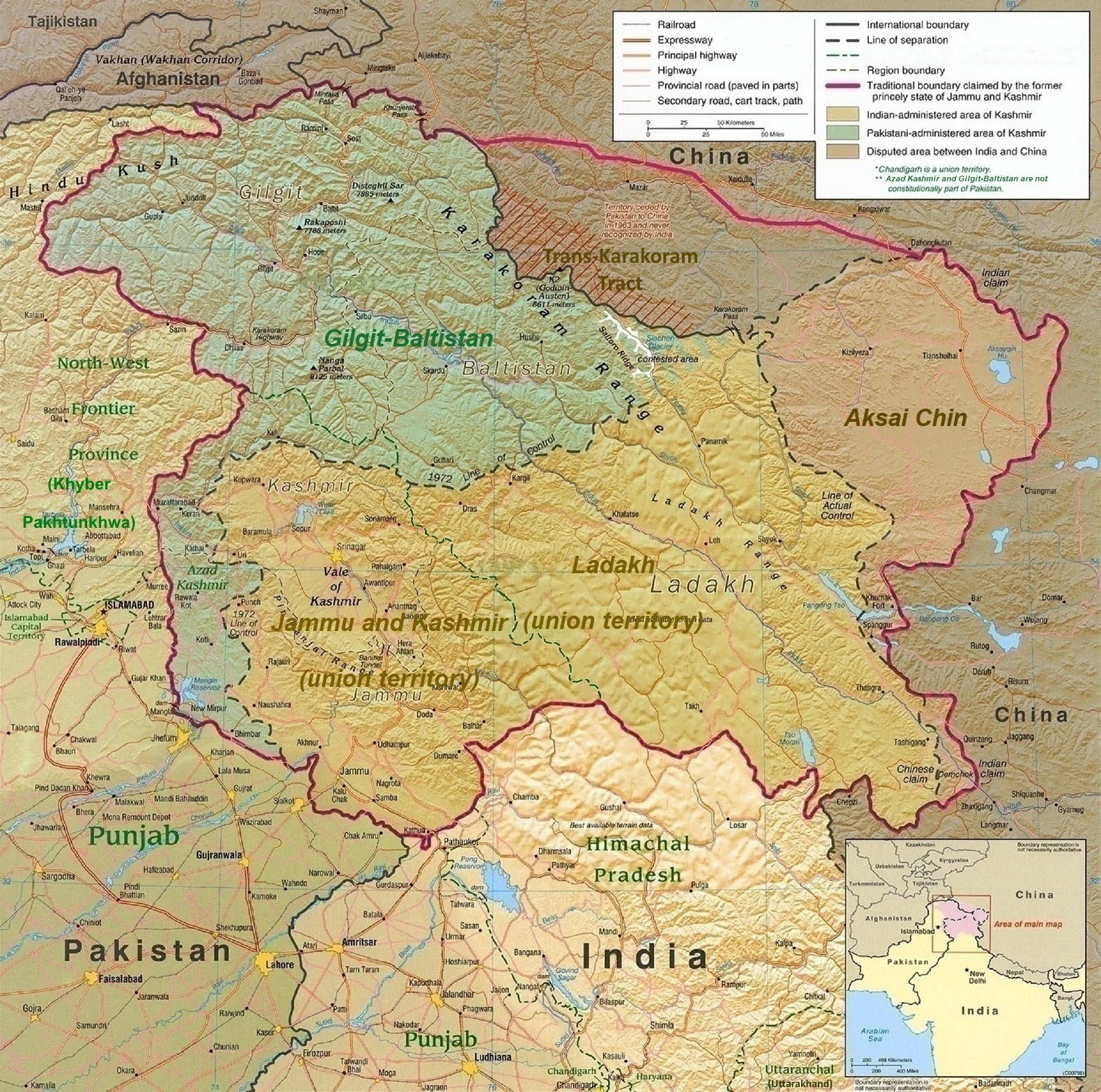



Five years ago the Galwan Valley was in the News for the wrong reasons after a deadly clash between the Indian and Chinese Armies in the Valley located in Ladakh lead to many deaths on the contentious Border between the two countries in wake of continued Chinese intrusions into Indian territory.
This area along the Shyok River, of which the Galwan Nallah or the Galwan River which forms the Galwan Valley has been off limits to Civilians since long but now the Indian Government has decided to open up the area for Civilians and we were amongst the First Civilians to venture into this beautifully desolate part of the Eastern Karakorams in Ladakh. Earlier Civilians could only venture upto the Village of Shyok from where the Shyok River takes a U turn and flows in a Northerly direction.