Cart 0
Curated Experiences in the Himalayas
avantisvara-temple

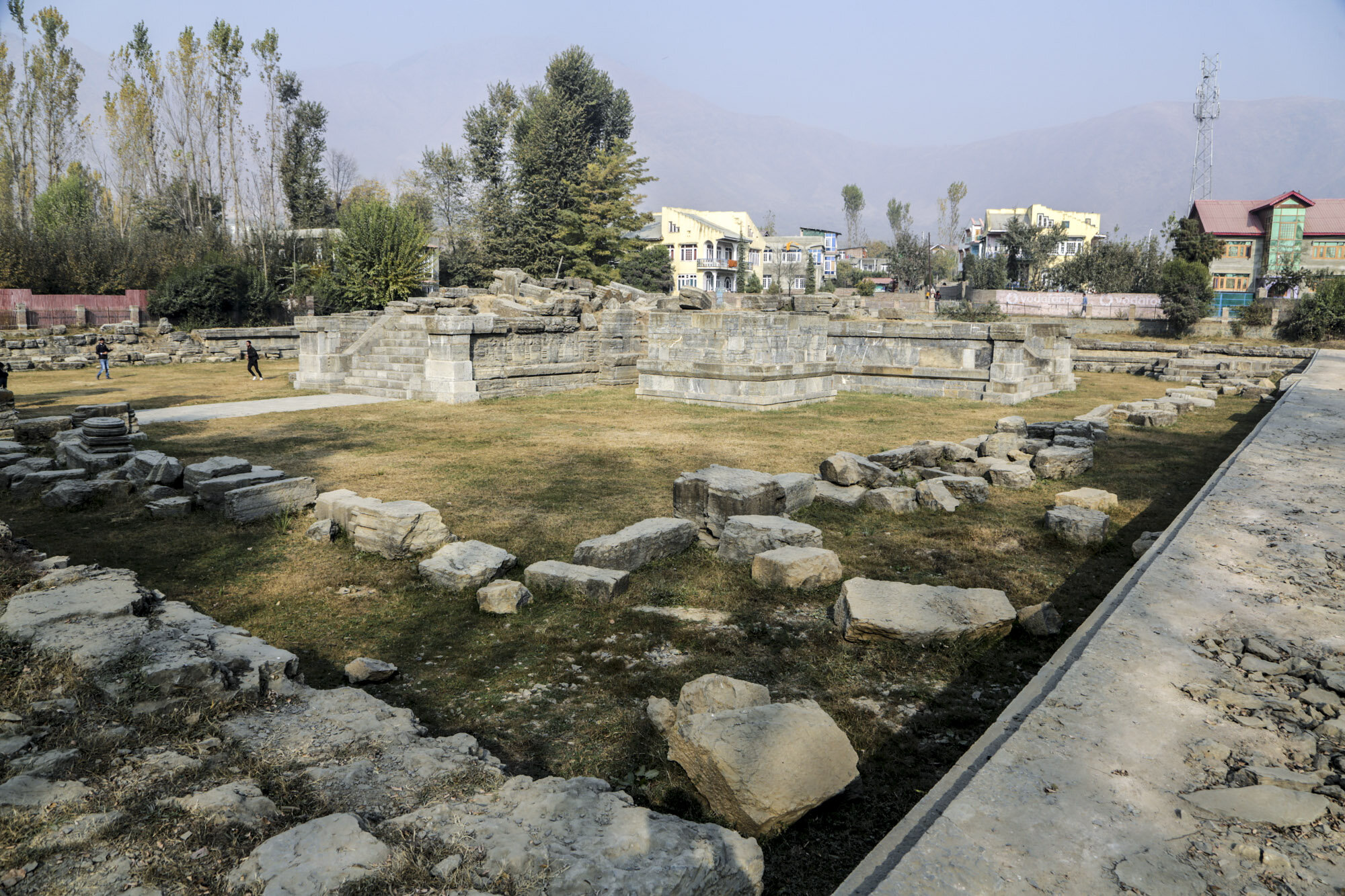
 Avantisvara Temple

The village of Avantipru-, situated at a distance of i8 miles from Srinagar on the Anantnag cart-road, represents the town of Avantipura, founded by Avantivarman, who reigned from a.d. 855 to 883. Its chief interest centres in two magnificent temples with which its founder embellished it. The first and larger is the temple of Siva-Avantisvara, whose massive walls rise in forlorn grandeur outside the village of Jaubror, half a mile below Avantipur. The temple, which has been sadly mutilated, is situated in a courtyard enclosed by a massive stone wall, the western face of which is adorned externally with a row of fluted columns, but without any recesses behind. The gateway is in the middle of this wall, and is divided into two chambers by a cross wall. Its walls are not decorated with figure sculpture. The niches and the panels are quite plain.

avantisvara-temple1

The base on which the shrine in the centre of the courtyard stands is 57' 4'" square and 10' high. To each of its corners was attached a platform about 16' square, which must originally have supported a small subsidiary shrine. It has a stair on each of its four sides like the temple of Pandrethan. The stairs have a width of 28^', and are supported on either side by Hank walls 17^' in length. The sanctum has been reduced to a “confused mass of ruins.”

avantisvara-temple2

The platforms seem to have originally been attached to the plinth of the temple at one point only, but afterwards they were completely joined with it by means of a connecting wall built of architectural fragments which had fallen from the temple. This arrangement can best be seen at the south-eastern corner of the base.
avantisvara-temple4

The sole exterior decoration of the temple base, the only part of the building that exists, is a series of projecting facets, the larger of which were originally surmounted by plain rectangular capitals.

avantisvara-temple6

In the two rear corners of the courtyard are two subsidiary shrines.

avantisvara-temple7

There is a large assortment of architectural fragments strewn about in the courtyard, the most interesting of which are (i) the spandrel of an arch in front of the southern stair, (2) the flower-and- vase capital of a dodecagonal pilaster, (3) the spa^nckeL of '^another arch by its side, and (4) the base of a pilaster decorated with two seated rams and a dancing girl who plays upon a damar^ (small hand- drum) standing on a throne ornamented with two lions at the sides and an elephant, facing, in the middle.

avantisvara-temple8
AF_2X2A2439 Avanti Shovra not Avanti Swami.jpg
avantiswamin-temple-1

 Avantisvamin Temple

Half a mile farther up is the small but much more ornate and better preserved temple of Avantisvami-Vishnu. It is the work of Avantivarman’s youth, before he came to the throne. It has been reclaimed by the removal of an enormous mass of silt and debris which during a thousand years of neglect (for the temple had already silted up when it siiffered from the iconoclasts) had accumulated to a height of about 15' and buried the whole structure except the upper part of the walls of the gateway and a shapeless heap of stones in the centre.

avantiswamin-temple-2

The edifice comprises a colonnaded peristyle (Plates XLVIII and XLIX) enclosing a paved courtyard 174' by 148' 8", in the centre of which is the main shrine, built on a double base with four smaller shrines at the four corners. The peristyle is com- paratively plain externally except on the west side, which has a row of fluted columns. The only decoration on the other three sides is a rectangular string-course and pilasters enclosing rect- angular spaces, corresponding respectively with the cyma recta cornice of the plinth and the cells inside. The entrance, which is in the middle of the west wall, is divided by a cross-wall into two chambers, and is approached by a flight of steps bounded on either side by a plain rail and a side-wall. The front pilasters of the side-walls bear figures of Vishnu and of his consorts carved in relief. On either side of it was a portico supported on tall massive advanced columns, one of which exists to this day, though in a precarious condition.

avantiswamin-temple-3

The wall surface of the entrance is both externally and internally ornamented profusely with sculptured reliefs (Plate L). The larger female figures on the right and left hand walls of the outer chamber represent the goddesses Ganga and Yamuna, easily recog- nised by their respective vehicles, the crocodile (makara) and the tortoise. The scenes in the rectangular panel on the right-hand pilaster of the wall represent probably a Hng and his two queens seated in “ sportive fashion ” on a siihfiasana (lion throne), here symbolised by two lions facing, one on each side of the panel. On the two external sides of tibis pilaster the scenes are the same with slight variations. In the scene in front the lions have been replaced by two standing females. In the southern panel the king has his right hand in the ahhayamudra (attitude of granting immunity from fear), and the lady on his right is admiring her own charms, reflected in a round pocket-mirror which she holds in her right hand. In the other two panels the figures are seated on separate cushions; here all three occupy a single long cushion.

avantiswamin-temple-5

Three rectangular panels are carved on the huge block which forms the lowest course of the left wall of the gateway. The largest panel is in the middle and contains a bas-relief. In the centre are three figures, a male and two female ^-bearers; but much more interesting are the highly caparisoned elephants who are fighting with horned birds of monstrous size. It is evident that the elephant is fighting at a disadvantage. (Perhaps the scene symbolises the fight of (^ruda with the Nagas, the latter here being represented by the elephants and not the usual snake gods. Naga means both snake and elephant.) The otiher two scenes contain each a male figure standing with folded hands between two human-headed birds. Above this is a row of kirtimukhas, or lions’ heads, sur- mounted by a line of rosettes. Higher still is another row of circular panels, each containing a Garuda. The rectangular panel in the left cross-wall contains a male and two female figures seated on a cushioned sofa in a grove of trees. They seem to be in a joyous mood. The man is offering the lady at his left hand what seems to be a cup of wine, while the doves at their feet are billing and cooing in sympathy. Above the group is a pedimental niche which contains a smaller representation of the goddess Granga. On the narrow facets on either side of this niche is a vertical row of standing pairs of male and female figures. This row starts from a rectangular panel which contains the figure of a four-armed Atlas wearing a cushion-like head-dress. The walls were decorated with numerous groups of figures, but unfortunately most of them are now too defaced to be distinguished, much less identified.

avantiswamin-temple-7

Tlie view of tiie courtyard from the iiuaer chamber of the gateway is dianmug. In place of the bald monotony of the ext^Tial sur&ce of the peristyle, the eye feasts on all sides on the picturesque rmns of a beautiful range of cells, preceded by a noble row of 3 uted colunms. Ano ther flight of Steps similar to that on the out^de leads down to the stone-paFed canrtfzxd. The side-walls of this stair are plain, but the pilasters are cxsvered with sculptured reliefe. Each of the smaSer panels facing the courtyard depicts an erotic scene.

In die middle of the space between the gateway and the main shrine is a stepped stone which appears to be the base of a Garuda- dhvaja. It will be remembered that Gantda, the divine eagle, is the vehicle of Vishnu, and also fcwms the emblem on the banner of his Master. Thus the Garuda-dhvaja column is always an indis- pezisable adjunct of Vaishnava temples.

avantiswamin-temple-9

The central shrine is built on a double base, the only decoration of which is a torus moulding and a cyma recta comice (Pkte LXXIV). The base is intact, but the sanctum, which measured 33' square externally, has almost disappeared. In fact the only fragments remaining are some parts of the lowest courses and a few stones of the north wall.

Unlike its sister temple lower down the road, this ediflee has only one stair. But that apparent defidency is more than reedfled by the sculptured reliefs on its pilasters. The two scenes facing the gateway represent Vishnu, the deity worshipped in the temple, seated in an easy attitude between his two consorts, Lakshmi and Bhuzni (?). T^akshmi in the northern group (Plate L) is distinguished by the coraucopia which, even in the late ninth century, to which this temple belongs, was retained as die spedal emblem of the goddess, who traces her descent, through Gandhara, fium the Greek Athene. Vishnu in the northern relief pose^es six arms, two of which, in impartial afFection, endrde the bodies of his two consorts, while the remaining four hold his distinctive emblems, the bow, the mace, and the lotos, etc. Below the throne are two pairs of parrots, and the same bird crowns the capitals of the square pilasters from which springs the cusped arch which canopies the divine group. The panel is surmounted by a dentil course consisting of conventional lions’ heads (JUrtimukhas) alternating with geese and flowers. This again is surmounted by a border of square rosettes (Plates L and LXX, A).

avantiswamin-temple-11

The group on the opposite pilaster is similar to that described above, the main difference being that the god, instead of having six has only four arms. The goddesses in every case have only two arms. Both the god and the goddesses are elaborately ornamented. The former has his hair brushed neatly back and arranged in braids which are tied in knots on the top. Two roses are inserted in the braids just above the ears. Besides the necklace and armlets he wears the mandaramala garland of celestial flowers). An enormous circular ornamental disc adorns his right ear, while a smaller jewelled pendant is suspended from his left ear. The goddesses, whose exaggerated breasts and attenuated waists are even more profusely ornamented, are crowned with three-peaked tiaras. Their ear-lobes are unusually elongated by the weight of their heavy circular ear ornaments.

The relief on the inner surface of the southern pilaster represents a group of ten figures, the central and the largest pair consisting of a male and a female wearing dhotis. The male wears an ornamental band across his breast (over his right shoulder and under his left arm). The whole group seems to breathe a spirit of profound devotion to some undefined object. It probably represents the major and minor gods coming to worship the image of Vishnu in the temple.

avantiswamin-temple-12

The group opposite also comprises ten persons. The principal figures are those of a bearded and crowned male, probably repre- senting the donor, and a lady, perhaps the princess, who wears a scarf over her head which hangs low down her shoulders, a fashion which the women of Kashmir have preserved to this day. The lady is followed by a female attendant. Above her is a male, who wears a curiously knotted and twisted head-dress.

But the chief beauty of the temple Kea in its cellular colonnade (Plates XEYIIIj, LSFIH,, and LXIX). It comptraea sixty-nine cells, each of wSuch measures oit the average 8"^ hy 4^ laf^j the cell in the centre on. each, side bexag huger than the rest and advanced shghtiv forward, ABC of them are preceded hy twenly-feur-gided columns OBJ pJasHi 3<5t«Ee: bases whkh have far the most part suffered severely at the hands of the destEoyer, The only waE decoration, of the peri- style E9 the range of rjS half-engaged columns (Plates LXXI and LXSII)' on the pilasters- on both sides of die trefoiled entrance of the cel&. The hitter were jEatended to contain; rcpHcas of the main image which the temple enshrined- In one cc two o£ them in the eastern wall of the peristyle the pedestals of these images are still found as situ.

avantiswamin-temple-17

A large assortment of anticjuitiea has' been uneartiied during the ezcavation of this temple. The most valuable are a series of sculp- tures which £mre been placed in the Srinagar Museum.^ The large jars arranged in a row on the lawn above the eicavatkma were, doubtless, used for the storage of grain ami foodstoSs... Among those that have been brou^tto theMmeamisone which bears an inscription mention- ing the rame. of Avanfirvanmn- This record is of interest as being the only indepenckHt evidence of the correct idartification of the site.

EaUhana sstates thar the AvantisvaiBii temple was- occasionally subjected to sacrilegious treatment even in Hindu times. The tyrannical Kalasa^ (a.d. 1081-1089) confiscated tie villages which formed its endowments. Its military possibilities do not seem to have escaped the notice of the ancients, for “ its courtyard served as a fortification when, shortly after the accession of King Jayasimha (a.d. 1128), Bhasa, a commander of the royal troops, was besieged at Avantipur by the rebel Damaras of the Holada (Vular) district”® In the fourteenth century Sikandar Butshikan completed the destruction which had already begun in the troublous times which followed the reign of Avantivarman.

avantiswamin-temple-19
DSC02994-01.jpeg
boniyar-smauel-bourne.jpg

Boniyar Temple

The temple of Buniar (Plates LX and LXXV) is situated on the Jhelum Valley road, two miles above Rampur. It is by far the best preserved of all the larger Kashmir temples.

The gateway is a double-chambered structure faced on each open side by a trefoil arch surmounted by a steep pediment. The lintels of the closed arches are supported on pairs of columns which were originally fluted, though the weather has now left no trace of flutes. They have a double capital, the upper one being voluted on all four sides. The walls are externally surmounted by a cornice of kirti- mukhas, alternating with miniature trefoiled niches. Upon this rests the first course of the pyramidal roof.

The flights of steps-on the eastern and western sides respectively afford entrance to and exit from the entrance chamber. The one on the roadside is buried underground, but the inner stair has been excavated. It consists of seven steps flanked by sloping rails and upright side walls. Between this stair and the temple is a small stone platform which formed the lowermost course of the stepped base of a column (most probably a Garudadhvaja).

The priest in charge of the temple has now placed in it a small stele of very crude workmanship and late date, which he has painted with vermilion. Another similar stele, still standing in the position in which it was found, is seen in front of the temple stair.

The temple itself stands on a double base, which is in every respect similar to other structures of its kind in Kashmir. (Plate LXXIV). A lofty trefoil arch, standing upon advanced pilasters and enclosing a rectangular entrance originally surmounted by an ornamental trefoil and steep pediment, gives access to the sanctum. The jambs of the entrance are adorned with half-engaged columns. The interior is a square of 14 feet. The pedestal of the image is placed on a broad platform. The original image, which seems to have been of Vishnu, is now replaced by small Siva-lingas originally brought from the bed of the river Narbada. The walls are covered with a coat of modern whitewash. The string course from which the ceiling springs is still visible, but the ceiling itself which Bishop Cowie saw in 1865 and described as domical, has since either fallen down or been removed. It was, no doubt, similar to the ceilings of the largcr temples at Wangath.

Externally the only decorations are the trefoils of the recesses, their pediments, and the cornice of kirtimukhas and miniature trefoils from which the roof sprang.

The quadrangle measures 145' by 119 1/2', and consists of fifty- three cells and the gateway. They are rectangular, 7' long by 4' broad. Each cell has a single trefoiled entrance enclosed in a high- pitched pediment resting on half-engaged columns. These ranges of cells are preceded by a noble colonnade which stands on a base similar to that of the temple. A transverse beam connects the capitals of the columns with the roof of the cells. Over these beams rises the entablature, only one course of which, namely the frieze of miniature trefoils, is extant (Plate LXXVI).

In the centre of each range of cells, except, perhaps, the one in which the gateway stands, is an apartment of larger dimensions preceded by a pair of taller columns which are advanced about 4' from the rest of the peristyle.

The top course of the cells is also decorated in the same way as the frieze above.

On the south side, projecting from the cornice of the upper base of the temple, is the spout of the channel which carried off the washings of the image. It seems to have been shaped originally into a makara, or crocodile's head. Immediately below it is a huge water trough carved out of a single block of stone.

The rain-water in the courtyard is carried off by a drain which runs under the south-eastern corner of the peristyle.

In cell No. 11 of the north range, beginning the reckoning from the corner nearest the gateway, is the side entrance, which was then, as now, closed with a wooden door. The monotony of the external face of the western wall is partially relieved by rows of small square projections. In its two corners are two cells opening outwards.

Immediately outside the side-door mentioned above is a square structure built of plain blocks of stone. The middle portion of each of its four walls has fallen down, and the gaps have been filled in with small chips of stone built in mud. It is diflicult to surmise what was its original purpose.

boniyar-smauel-bourne.jpg

 Bumazuv Cave and Temples

bumazuv-temple1

The little village of Bumazuv is situated only a mile to the north of the sacred springs of Bavan (Matan). It contains the only im- portant group of artificial caves in Kashmir. They are very unpre- tentious excavations and only one of them possesses architectural interest. It is carved out of a large mass of limestone cliffs over- looking a scene of great beauty, comprising the whole of the lower section of the Lidar valley. The stone in which this excavation is made is of a very friable nature.

bumazuv-temple12

The facade of the gateway has, therefore, been built of stone masonry in lime. It consists of a single trefoil-arched doorway, surmounted by a pediment, and side walls. On the left-side wall is a small rectangular niche measuring 2' 1" by 1". Its pilasters are carved with floral scrolls of extraordinary delicacy. The lintel is ornamented with a row of rosettes and the cornice with a row of slightly projecting dentils, whose intervening spaces appear to have been filled with figures of dancing dwarfs, all of which are now defaced. In its interior is a small temple which is similar in style to other temples of Kashmir. It is 9' f square externally and stands on a base 4' 6^^ in height. A remarkable feature, which points to its being a decadent example, is the very slight projection of the porch. The corner pilasters have two rectangular niches.

bumazuv-temple13

In the village, at the foot of the cave, are two temples which have been converted into Muslim ziarats. Both of them are now covered with a thick coat of mud plaster, under which all the artistic and archi- tectural features are concealed. The larger temple now goes by the name of the Ziarat of Baba Bamdin Sahib, who is said to have been a disciple of Shaikh Nur-ud-din, the famous Muslim saint of Kashmir. The pyramidal roof is buried under a mound of earth which surmounts the modern square double wooden roof. The interior measures 8' square. The ceiling consists of overlapping stones, like that of the Pandrethan temple. The uppermost stone is carved with a full-blown lotus. The entrance is in the north wall. Unless the coat of plaster is removed it is impossible to say whether the temple was open on other sides.

bumazuv-temple15

To the west of this temple are the ruins of a smaller temple. The exterior of the roof is destroyed, but the ceiling inside is intact and is similar to the ceiling of the larger temple. Its porches are exact replicas of those of the cave temple, a fact which leads to the surmise that all three were built at about the same time.

bumazuv-temple16

The larger temple has been identified with the Bhimake^ava^ shrine built by Bhima Shahi of Gandhara, the maternal grandfather of Queen Didda, who ruled Kashmir as the wife of Kshemagupta from A.D. 950-958, and as sole sovereign from a.d. 980-1003.

Kashmir Anantnag India, Bumzuva Cave Temple Complex1.jpg
daata-madir2.jpg

 The temple known as Dhathamandir is situated on the Jhelum Val]ey cart road, midway between Rampur and Uri, about two miles below Mohora. The name signifies " ruined temple."

daata-madir22.jpg

The only material difference in style between this temple and the one at Buniar is that it does not possess any colonnade, and that the cells, which in the former are built of granite as the temple itself, are here built of kanjur, their plinth only being of limestone. The jambs of the cells were decorated with half-engaged columns, remnants of which may still be seen in the south-western corner of the peristyle.

daata-madir28.jpg

The central shrine faces north-east, and is built of a very beautiful green limestone, which, curiously enough, seems to have been covered with a thick coat of lime plaster, decayed fragments of which are still clinging to various parts of the walls. The pedestal of the image is extant. There are two small shrines, replicas of the main building in the north-western corner of the courtyard.

daata-madir23.jpg

The bases of the columns which supported the trefoil arch of the gateway are still in situ. Fragments of columns as well as their beautifully carved capitals are lying about in the compound and the area outside the gateway.

On the hillside, a few yards to the south-east of the temple, are remains of two smaller shrines which, like the subsidiary temples in the courtyard, are replicas of the main temple.

daata-mandir-lagama13.jpeg


martand123

Martand

The temple of Martand (Plates LIU and LXXIII) is situated at a distance of 5 miles from the town of Anantnag. Being on the top of a lofty plateau, at whose feet stretch the broad verdant plains of Kashmir intersected by a network of rivers, lakes, and canals, thickly dotted with clusters of busy villages nestling like beehives in closely planted groves of trees, and encircled by snow-clad mountain ramparts — the temple of the Sun, as Martand originally was, commands a superb view, such as the eye rarely lights upon. It is this beauty of situation that contributes so largely to the sense of grandeur with which the sight of these ruins always inspires even the most unimaginative visitors.

Like most mediaeval temples of Kashmir, Martand consists of a courtyard with the principal shrine in the middle and a colonnaded peristyle. The latter is 220' long by 142' broad and contains eighty- four fluted columns facing the courtyard. The peristyle is externally plain, except on the west side, which originally had a row of columns similar to that of the Avantipur temples.

martand127

“ The entrance, or gateway, stands in the middle of the western side of the quadrangle, and is of the same width as the temple itself. This proportion is in accordance with the ideas of Hindu architectural grandeur; for the rules laid down by them, as quoted by Ram Raz, give different proportions from six-sevenths to ten-elevenths of the width of the temple, for each different style of gateway from the most simple to the most magnificent. Outwardly the Martand gateway resembles the temple itself in the disposition of its parts and in the decoration of its pediments and pilasters. It was open to west and east, and was divided into distinct portions forming an inner and outer portico, by a cross wall with a doorway in the centre, which was no doubt closed with a wooden door. On each flank of the gateway the pediment was supported by massive fluted pillars, 1 7^' in height. or 8' higher than those in the quadrangle. One of these is still stand- ing to the south of the entrance; and the style of the architrave and entablature which connected these pillars with the gateway must have been the same as that of the architrave in the Avantisvami temple described above. I surmise that the front and back pediments of the gateway were supported on similar large pillars ; but it is possible that the square foundations, which I observed in the front, may have been only the remains of the wing-walls of a flight of steps. The roof was no doubt pyramidal ; for a portion of the sloping mouldings of its pedi- ment was still to be seen on one side.”^ The walls of the gateway are profusely decorated internally and externally, the chief motif of decoration being rows of double pedimented niches alternating with rectangular panels. Most of the pedimented niches contained single standing figures of gods; occasionally they also contained an amorous group similar to those at Avantipur. The rectangular panels con- tained sitting groups, floral scrolls, pairs of geese, etc. Each of the two large niches in the side-walls of the inner chamber of the gateway contains the tall figure of a three-headed Vishnu standing between two attendants.

martand129

Immediately below is the long rectangular panel decor- ated with a row of dancing urchins striking a variety of attitudes. The temple proper “ is 63' in length by 36' in width at the eastern end and only 27' in width at the western or entrance end. It con- tains three distinct chambers, of which the outermost, named ar- dhamandapa or ‘ half temple,’ answering to the front porch of classical fanes, is 18' 10" square; the middle one, called antarala or ‘mid temple,’ corresponding to the pronaos of the Greeks, is 1 8' by 4^'; and the innermost, named garbhagriha, or ‘ womb of the edifice,’ the naos of the Greeks and the cella of the Romans, is 18’ 5" by 13' 10". The first is open and highly decorated in accordance with its name, mandapay meaning literally ‘ ornamented.’ The middle chamber is decorated in the same style; but the inner chamber is plain and is closed on three sides. The walls of the temple itself are 9' thick and ^ 1848, part ii, pp. 269-70. MONUMENTS ABOVE SRINAGAR 133 of its entrance chamber only 4^' thick, being respectively one half and one fourth of the interior width of the building.”^

2X2A5181_1.jpg

“ Among the images carved on the walls of the antarala and the antechamber, we notice on the left wall of the former a well executed image of the river-goddess Ganga, standing upon her vehicle, the crocodile, which is looking up towards her. A female attendant on her right holds an umbrella over her head, and a cAawn-bearer is on her left. She holds her usual emblems, a water pot in her left hand and the stalk of a lotus flower in her right. (She is crowned with a double conical tiara.) On the opposite side of the antarala is the river-goddess Yamuna, with her vehicle, the tortoise. Above the niche in the north wall is a relief consisting of a pair of Gandharvas in flight with an umbrella over them.® The statues on the western walls of the antechamber are undoubtedly representations of Vishnu, and what Mr. Fergusson mistook for hoods of snakes are in reality points of their coronets. Each of them is three-faced, like the Vishnu image found in the Avantisvami temple, the left face being that of a boar (Varaha) and the right one that of a man-lion (Narasimha). Both are eight-armed, and their lower hands are placed on the heads of chauri- bearers, as in other images of Vishnu found in the valley. Further- more, they wear the garland {^anamala) and we also notice the bust of the earth-goddess (Prithivi) between the feet of the statue on the north wall. Most of the hands of the images are unfortunately broken and weather-worn, and the emblems they hold can no longer be identified. Nor can the fourteen seated figures which occur on the walls of the antechamber below the cornice be identified with certainty. Twelve of them occur in the north and south walls — ?.e., six on each, and two on the east wall. Of the two panels on the east wall,- the one on the right seems to represent Aruna, the charioteer of Surya, holding the reins of his seven horses. The pilasters of the great trefoil arch of the antechamber contain images which cannot yet be identified.”^ “ The chapels to the north and south of the antechamber each contain two niches 5' 9" by 4' internally, which face to the east and west respectively, possibly an allusion to the rising and setting of the sun.”*

martand129898

The roof seems to have been of the pyramidal type common in the temples of Kashmir.

“ Such was once the magnificent mass of building dedicated to the worship of the Sun, a mass 75' in height, 33' in length, and the same in width including the wings. Entrance was gained by a wide flight of steps which are now covered by ruins. On each of the other sides was a closed doorway surmounted by a trefoiled arch, and covered by a pediment which rose to a height of 60'. At the angles of the buildings on each side of the doorway were stout pilasters, which were divided into panels, each decorated with a miniature representation of the Aryan style of temple. These pilasters sustained the entablature, and gave a look of strength and solidity to the walls which was fully needed for the support of the vast and massive roof. This lofty pyramid of stone was itself rendered lighter and more elegant in appearance by being broken into two portions separated by an ornamental band, and by the addition of small niches with pointed roofs and trefoiled re- cesses, all of which were in strict keeping with the general character of the building.”®

martand1254

The peristyle is the largest example of its kind in Kashmir. In the middle of its larger sides there are a pair of large fluted pillars, 1 3' in height and 8 apart, somewhat advanced beyond the line of the other cells. “ The quadrangle itself contained seventy round, fluted pillars, and ten square parallel pillars which with the four pillars of the central porches make up the number of 84, that was sacred to the sun. Of these about one-half, all more or less imperfect, now remain standing. . . . Each pillar was 9^' in height, and 2 in diameter, with an inter-columniation of 6' 9^". . . . The imposts (behind) were surmounted by human-headed birds facing each other, and a smaller bird, looking to the front, ornamented the horizontal mouldings of the pediments. . . .

“ About one-third of this entablature still exists, principally on the north-eastern side of the quadrangle.

martand120987

“ The other walls of the quadrangle are ornamented by a succession of trefoil-headed panels similar in shape and size to the recessed openings of the interior.”^ As suggested above, it is probable that its western outer facade was adorned by a series of columns similar to that of the two temples at Avantipur.

martand128765

There is some uncertainty regarding the exact ascription of this temple, owing to the ambiguity of Kalhana’s statement. But the most probable assumption, which is strengthened by the architectural style, is that the temple as it exists today was built by King Lalitaditya in the middle of the eighth century a.d.

martand1209k

The courtyard of the temple was excavated recently, and a vast quantity of debris and stones was removed. Among other movable antiquities which the excavations yielded, the most noteworthy are a number of large earthen jars which were found embedded in the floor of the courtyard. Removal of the accumulated debris of centuries from the base of the temple has also brought to light a very important fact — viz., that previous to the construction of the present temple there existed another temple of somewhat smaller dimensions at this site. When the new temple was built, the older temple base was not demolished, but was enveloped by a new base of larger dimensions, as is borne out by the existence of both bases, side by side, one within the other, on the east side of the temple. The older temple was probably the one built on this site by Ranaditya.

2X2A5213_1.jpg


2X2A5194.jpg

The Great Temple Complex at Naranag

DSC06259-01.jpeg

angath The Srinagar-Sonamarg high road^ branches off at Wusan to the mountain village of Wangath and the long and narrow glen known to sportsmen by the name of Wangath Nala. The dense dark green forests of pine and fir which clothe the steep and in some places almost vertical hill-sides are favourite haunts of the bear in early autumn, when maize begins to ripen. The cow-track — for the Wangath road is ‘ The traveller from Sonamarg will find it much more convenient to start from Kangan, where there is a dak bangalow. The distance from here to Narannag is about 20 miles. The road is practicable for ponies, but walking is more pleasant. Tents and necessaries must be taken. No shelter of any kind is available there.

DSC06275-01.jpeg

Narannag is foe modern name of ancient Sodasafotha, which has been, since very early times, an important place of pilgrimage in Kashmir. The site probably owes its sanctity to foe erdsteace of a large spring, near which have been built two groups of temples belong- ing to foe mediaeval era. All the temples are more or less in ruins, chiefly owing to foe inroads of vegetation. The stone used is the greyish granite which is found in abundance at foe place. The first group, that is foe one nearer Wangath, comprises six temples situated within an enclosure wall, Ju^ing by their positions, as they are by no means symmetrically disposed in relation to one another, and by the different^ in their architectural details, it is probable that the various structures were built at diflPerent dates (Plate IfXII).

DSC06288-01.jpeg

(i) The principal temple is a square of 25^, and, exceptin a few particulars, does not differ from other temples of Kashmir. The first point of departure from the usual style are foe entrances. We have seen the temples of the nnmana type, which have all foe four sides open- But this one has two entrances opposite each ofoer in the north-east and south-west sides. The second distinction is its domed ceiling, though there is no doubt that externally the roof was pyramidal. A large quantity of lime has been used in the masonry of foe temple. The ceiling is built of circular courses of kanjur stone, and is crowned at the apex by a full-blown lotus. The dome springs from four large corner stones, which cut off the angles formed by the walls. On two sides of the string-course upon which the dome rests are eight rectangular slots (four on each side), which seem to have been intended to hold the rafters of a canopy over the image. The interior iheasures 1 7' square. In the centre of the floor is a square space which is unpaved. It marks the site of the pedestal of the image. The mortices of the tenons of the doors can still be seen in both entrances.

DSC06280-01.jpeg

The two sides which are closed are decorated externally with square-topped recesses, each of which contains the pedestal of an image which was probably a replica of the one in the sanctum itself. The core of the roof consists of rubble-stone masonry in lime. This temple has been identified by Sir Aurel Stein with the Jyeshthesa temple of Lalitaditya. (2) The small temple to the left possesses niches on three sides intended for images. Their pedestals with tenons are in situ. Part of the kanjur backing of the dome is intact on top of the walls.

(3) The temple immediately touching the porch of the preceding shrine is a single square structure, plain both internally and externally. One stone of the roof, which is the only one in situ, shows that the ceiling was not domical, but was built of overlapping stones. (4) Im- mediately behind is the basement of another small temple. Its super- structure has fallen down. (5-6) Of the two temples behind, one has its entrance facing north-east, and the other faces south-east. The ceiling of the former was of the overlapping type while that of the latter was probably domical. (7) Immediately to the left of the latter is the ruined plinth of another temple, smaller than any of those de- scribed above.

IMG-20180316-WA0003-01.jpeg

The gateway of the enclosure is situated, curiously enough, at the north-west corner, and not in the middle of the wall, as is the case in other temples. It is, as usual, a two-chambered structure. In .each chamber are the bases of two columns which supported the roof of the porch. Fragments of circular columns which stood on the bases are lying strewn round about the site. The retaining wall of the plinth on which this group of temples stands is built of closely packed pieces of slate, and in places where vegetation has not played havoc with it, it is very compact and beautiful.

A broad causeway paved with huge blocks of granite leads to the second group of temples, situated about two hundred yards farther off.

IMG-20180316-WA0004-01.jpeg

Between the two groups of temples are a number of structures which in themselves deserve to be classed into a third group. All of them have fallen down, but one, the base only of which is in existence, is unique in Kashmir. It appears to have been a spacious pillared hall or barahdari about loo' long by 67' broad. The bases of the columns are in situ. They are eight in number on the longer side and four on the shorter. The staircase is built between the central pair of columns facing the first group of temples. The slots in the landing on the top of the stairs seem to have been intended for holding the posts of screens.

The lower group of temples is likewise enclosed in a massive rectangular stone wall pierced by a two-chambered gateway. Inside the wall are half a dozen structures, all in ruined condition and partly buried under the ground. The largest temple has been identified by Sir Aurel Stein with that of §iva-Bhutesvara.^ In- ternally it is a square of 17', and was similar to the largest temple in the first group. The small temple to its right has a round-headed entrance. There are two small shrines on its south, the first of which differs from all the structures at this site in that it is built of small pieces of slate in lime mortar, placed upon a granite base.^ The peculiar feature of the second is an immense rectangular stone trough carved out of a single gigantic block of granite. Among the objects lying scattered about the compound, the most noteworthy are two fragments, in the south-east corner of the quadrangle, of an octagonal pedestal of a 5 iva-linga, and two stones in the same corner of the quadrangle, each decorated with a pair of remarkably well- executed geese.

IMG-20180316-WA0005-01.jpeg

The long raised line of brick masonry on the enclosure wall is the debris of the cellular quadrangle which usually surrounds the Kashmiri temple.

Outside the north-western corner of the peristyle is the large spring, the real lodestone of the pilgrims, which was the occasion of all this magnificence. Its cool, delicious water, perhaps, contributed to some extent to its sanctity. The water issues out of the mountain side through the masonry walls of the tank. Slightly higher up, and more than half-buried under the ground, is a small temple whose double pyramidal roof is the only existing roof in the whole group of temples here. This has been identified by Sir Aurel Stein with the temple of Bhairava,^ near which the turbulent baron Dhanva was decapitated for encroaching upon the lands and revenues of these temples.

IMG-20180316-WA0008-01.jpeg

Before leaving the site, the visitor should not fail to observe the unusually massive stone retaining wall of this group of temples. The granite blocks are of so extraordinary a size and are so beautifully dressed and finely joined as to give the impression that their carvers regarded them more in the light of wooden beams than as close-grained intractable boulders to be chipped into shape with vigilant care and inexhaustible patience. It is probable that this wall served the double purpose of protecting the temple enclosure from being overwhelmed by the debris of the hill above, and also as the back wall of the range of cells on this side. The site has from time immemorial enjoyed a very high degree of popular esteem, which remains unimpaired to this day, thanks to the pilgrims who, after consigning the ashes of their dead relatives to the Gangabal lake, make it a point to oflFer worship here. The temples were endowed with extensive estates, and the priests in charge seem to have been a particularly influential body. In the later mediaeval period, after the death of Avantivarman, these temples shared the misfortunes which came upon Kashmir with ever-increasing violence. The temple treasury was plundered by Bhadreivara, the minister of Samgramaraja (a.d. 1003-1018); a conflagration in the reign of UchchaIa(A-D. i loi-i 1 1 1 ) inflicted much damage upon the buildings ; during the reign of Jayasimha (a.d. 1128-1155), Hayavadana, a rebel baron, had the temples “ sacked by marauding hillmcn.” Su- man^, a brother of Rilhana, the minister of Jayasimha, built a matha or congregation hall here. It is possible that the pillared hall is this same matha. Further excavations may throw light upon the question.

26113983_552851368402552_7771496187317450601_n.jpg
pandethran

 The small village of Pandrethan is situated 3 miles above Srinagar on the Anantnag cart-road. At present its only attraction, excepting the newly built military barracks, is the well-preserved mediaeval temple behind the willow grove on the left-hand side of the cart-road (Plates XLIVLXIIILXIVLXV and LXVI). The temple measures 17 feet 6 inches square externally, and belongs to the mandapa type - i.e., it is open on all the four sides. The unusually bold projection of the pilasters which support the pediments of the porches is "a great improvement upon the earlier stage, as the boldness of the projection and the retirement of the connecting walls afford a great and pleasing variety of light and shade which is altogether wanting in some parts of the more ancient buildings." The roof is of the usual pyramidal type, but its monotony is relieved by an ornamental band of dentils which divides it horizontally into two storeys. In the upper section of the pyramid are four trefoiled ventilation apertures which remind one forcibly of similar niches in the architecture of Gandhara. The interior of the cella is plain, except for the ceiling (Plate LXVI), which is one of the best examples of carving on stone extant in Kashmir. It consists of nine stones arranged in three overlapping squares, each of which cuts off the angles of the square below it, and thus reduces the extent of the space to be covered. The twelve triangles so formed have been utilised for figure decoration. Each triangle in the lowest square contains a pair of flying Yakshas, facing each other and holding a garland in their hands, which falls in swags about their bodies and between their knees. The second group of triangles contains only four figures, each holding a disc in his right hand and a lotus stalk in his left. Underneath his right arm is seen the outstretched end of flying drapery. The uppermost set of triangles contains a similar group of flying figures. The whole is crowned by a square slab decorated with an exquisitely carved full-blown lotus within a beaded circle. The convention by which the peculiarly graceful floating motion of the body, somewhat similar to that of a swimmer, is made to represent the flight of human figures without the appendage of wings, is noteworthy. The floor of the cella is paved with stone flags. In the centre is the depression about 7 feet square which must have held the pedestal of the image worshipped in the temple.

The plinth of the temple remains submerged for the greater part of the year, but it is certain that it is well preserved. A remarkable feature of it is the string-course of elephants which runs round the temple and upon which the walls of the sanctum rest. The springs which have arisen round the structure do not seem to have been there when the temple was originally built, for it is impossible to believe, now that Cunningham's theory of " the Kashmirian temple being placed in the centre of a tank " no longer holds good, that the temple was built in the midst of an extensive marsh, which has only lately been drained.

Cunningham, and after him Cowie, Cole, etc., believed that the temple was "Vishnu-meruvardhanasvami," built by Meruvardhana, the minister of Partha who flourished in the beginning of the tenth century A.D. He bases his identification on the statement of the Rajatarangini coupled with absence of other temples in Pandrethan. But this theory is considerably weakened by the presence, in the trefoiled niche above the northern entrance, of a seated figure which is believed to be the Lakulis'a form of S'iva, and by the internal arrangement of the floor of the cella which " can only admit of a Siva image." The Rajatarangini mentions in another passage the erection of the temple of S'iva-Rilhanesvara by Rilhana, the minister of Jayasimha, about the year A.D. 1135. There is nothing in the architectural style against the identification of our temple with Rilhana's foundation.

Around this site a number of late Brahmanical images have been found.

Kashmir. Temple of Meruvarddhanaswami at Pandrethan near Srinagar. View of north face. Probable date A.D. 913 to 921.jpg
DSC08290-01.jpeg

Parihasapora

The karewas of Paraspor and Divar arc situated at a distance of fotirteen miles from Srinagar on the Baramula road. They were chosen by King Lalitaditya (c. a.d. 7 50) for the erection of a new capital city, and it is certain tfaat^ given a sufficient supply of drinking water, the high and dry plateaus of Parihasapura have every advantage over the low, swampy Srinagar as a building site. Lalitaditya and his ministers seem to have ^ned with each other in embellishing the new city with magnificent edifices which were intended to be worthy alike of the king’s glory and the ministers* affluence. The plateau is studded with heaps of ruins of which a few have been excavated. Among these the most important are three Buddhist structures, a stupa, a monastery, and a chaitja. Their common features are the enormous size of the blocks of limestone used in their construction, the smoothness of their dressing, and the fineness of their joints. The immense pile at the north-eastern corner of the plateau is the stupa (Plate LV.) of Chankuna, the Turkoman (?) minister of Lalitaditya. Its superstructure has entirely disappeared, leaving behind a huge mass of scorched boulders which completely cover the top of the base. There is a large massive block in the middle of this debris, which has a circular hole in the middle, 5' deep. It is probable that this stone belonged to the hti (finial) of the stupa, and that the hole is the mortice in which was embedded the lower end of the staff of the stone umbrellas which crowned the drum.

parihaspora-1

The base is 12,8' 1" square in plan, with offsets and a flight of steps on each side. Its mouldings are of the usual type, a round torus in the middle and a filleted torus as the cornice. The steps were flanked by plain rails and side walls which had pilasters in front decorated with carved figures of seated and standing atlantes. Some of these are in position, while others, which were lying about loose, have been transported to the Srinagar Museum. They are not grotesque creatures like those so commonly seen in Gandhara, but have the appearance of ordinary respectable gentlemen, whose placid features seem to indicate that the superincumbent weight sits lightly upon them. The top surface of each of the two plinths is broad and affords adequate space for circumambulation. Among the loose architectural stones lying scattered about the site are a few curious blocks in the south-eastern and south-western corners. They are round torus stones adorned with four slanting bands or fillets running round the body. As this type of torus moulding is not used in either of the bases, it is probable that it belonged to the string-course on the drum of the stupa. There are fragments of trefoiled arches also, which contained images of the Buddha and Bodhisattvas.

parihaspora-2

The large square structure to the south of the stupa is the rajavihara, or royal monastery. A flight of steps in the east wall gives access to one of its cells which served as a verandah. The monastety is a quadrangle of twenty-six cells enclosing a square courtyard which was originally paved -mth stone flags, some of which are extant. In front of the cells was a broad verandah, which was probably covered, the roof being supported by a colonnade which ran along the edge of the plinth. A flight of steps corre- sponding to the one mentioned above leads down to the courtyard. Exactly opposite to this, in the middle of the west wall, are three cells preceded by a vestibule, which is built on a plinth projected into the courtyard. It is probable that these were the apartments occupied by the abbot of the monastery. Near a corner of it is a large stone trough, which may have served as a water reservoir for bathing purposes. A couple of stone drains passing underneath cells Nos. 1 8 and 1 1 (if we begin counting from the cell to the south of the entrance chamber) carry off the rain and other surplus water from the courtyard. Externally the plinth is about 10' high. In cell No. 25 (that is the one to the north of the entrance chamber) was found a small earthen jug which contained forty-four silver coins in excellent preservation. They belonged to the time of kings Vinayaditya, Vigraha, and Durlabha. They are now exhibited in the Numismatic Section of the Srinagar Museum. The monastery was repaired at a subsequent period. The repairs are plainly dis- tinguishable in the exterior of the wall on the eastern and western sides.

parihaspora4

The bixilding next to it on the south side is the chaitya built by Lalitaditya. It stands on a double base of the usual type. A flight of steps on the east side leads to the entrance, which must originally have been covered by a large trefoil-arch, fragments of which are lying about the site. This building possesses some of the most massive blocks of stone that have ever been used in Kashmiri temples, and which compare favourably with those used in ancient Egyptian buildings. The floor of the sanctum is a single block 14^ by 12' 6 " by 5'

The sanctum is 27' square surrounded by a circumambulatory passage. It is probable that its ceiling was supported on four columns, the bases only of which survive at the four corners. The roof, which was probably supported on the massive stone walls of the pradakshina^ may have been of the pyramidal type.

DSC08288-01.jpeg

The courtyard is enclosed by a rubble-stone wall which has nothing remarkable about it. In front of the temple steps is the base of a column which probably supported the dhvaja, or banner, bearing the special emblem of the deity enshrined in the sanctuary.

The flank walls of the stair were adorned with atlantes similar to those of the stupa.

DSC08312-01.jpeg

Near the chaitya is the foundation of a small building of the diaper-rubble style.

While this plateau was reserved for the erection of Buddhist buildings only, the other two were exclusively appropriated by Hi;idus. Perhaps the arrangement was intentional, to avoid possible friction between the two powerful religious bodies. On the karewa locally known as Gordan there are ruins of a Hindu temple which are probably all that remain of Lalitaditya’s temple of Govardhanadhara. Crossing the ravine in which nestles the little village of Diwar- Yakmanpura, and ascending the plateau opposite, are seen the immense ruins of two extraordinarily large temples — one of them has a peristyle larger than that of Martand — which may represent Lalitaditya’s favourite shrines of Farihasakesava and Muktakesava.

DSC08283-01.jpeg
DSC08290-01.jpeg
Shankargaurisvara Temple5.jpeg

Sankaragaurisvara Temple

The Rajatarangini mentions the erection of three temples at Patan, which in ancient days was called Sankarapurapattana, after the name of its founder. King Sankaravarman (a.d. 883-902). Perhaps it would be well to remark here that vandalism of a serious kind had already begun in pre-Muslim times, as some of the materials used in the construction of these temples were removed from the older site of Parihasapura described above. The three temples named by the Kashmir chronicle are (i) Sankaragaurisvara, (2) Sugandhesa, and (3) RatnavardhaneSa. The first, identified with the larger temple near Patan, was built by the king himself, the second, which is the one nearer Srinagar, is named after Sugandha, his queen, and the third, of which no trace has so far been found, if we exclude the architectural fragments near the spring outside the dak bangalow, was built by Ratnavardhana, his minister. All three were dedicated to Shiva.

Shankargaurisvara Temple2.jpeg

 Lower down is the larger temple built by the king himself called the Sankargaurisvara Temple. (Plate LVI). It is only an enlarged copy of the queen’s temple. On account of the lack of proper facilities for drainage of rain water it has not been deemed advisable to excavate its courtyard. The peristyle, the temple-plinth, and a smaller shrine in the north-east corner, are therefore still underground. The rectangular path around the temple marks the position of the peristyle, tops of some columns of which are seen peeping out of the earth in the south-west corner. The square flower-bed with a projection on one side in the north-east corner of the courtyard coincides with the small shrine below. The square space in the middle of the eastern path marks the position of the entrance.

Shankargaurisvara Temple3.jpeg

The temple itself is an imposing pile, though a great deal of its grandeur has been taken away by the concealment of its plinth. The cella is 17' square and the central stone of the floor measures xz' 6" by 10'. It has nine circular holes arranged in three rows. It is possible that these were mortices of tenons which held in position the pedestal of the idol. The left wall of the portico has a trefoiled niche which is divided into two panels. The lower and larger one contains a number of figures, of which the principal seems to be Siva. Above it, in the upper foil, is the squatting figure of the elephant-headed god, Ganesa, whose presence here would conclusively prove, even if there were any doubt about it, that the temple was dedicated to Siva. The jambs of the recesses on the exterior of the temple have half-engaged columns which are decorated with well-executed geometrical and other patterns. Their capitals are surmounted by human-headed birds.

Shankargaurisvara Temple1.jpeg

A few yards to the north of the Patan dak bangalow has recently been excavated an old baoli whose waters are confined in three rec- tangular reservoirs which are connected with each other. The one in the middle contains a miniature temple constructed originally of three stones (Plate LVII). The top-stone is missing. It is 8" square externally and is open on all four sides. The openings seem to have been closed originally with wooden doors. These little shrines belong to the time when the prosperity of the Hindus had waned, and they were not capable of devoting so much wealth to the glorification of their religion.

Shankargaurisvara Temple4.jpeg
Shankargaurisvara Temple2.jpeg
22730247_10211892001429115_7836498128883784011_n.jpg

Sugandhesa Temple

The Rajatarangini mentions the erection of three temples at Patan, which in ancient days was called Sankarapurapattana, after the name of its founder. King Sankaravarman (a.d. 883-902). Perhaps it would be well to remark here that vandalism of a serious kind had already begun in pre-Muslim times, as some of the materials used in the construction of these temples were removed from the older site of Parihasapura described above. The three temples named by the Kashmir chronicle are (i) Sankaragaurisvara, (2) Sugandhesa, and (3) RatnavardhaneSa. The first, identified with the larger temple near Patan, was built by the king himself, the second, which is the one nearer Srinagar, is named after Sugandha, his queen, and the third, of which no trace has so far been found, if we exclude the architectural fragments near the spring outside the dak bangalow, was built by Ratnavardhana, his minister. All three were dedicated to Shiva.

DSC05773-01.jpeg

The SugandheSa temple does not differ materially from other temples of Kashmir. The shrine is 12' 7" square and has, as usual, a portico in front. It is open on one side only, and has trefoiled niches externally on the other sides. These niches contained images. The temple stands on a double base, but it seems probable from the fiank walls of the lower stair and the frieze of the lower base, in which the panels intended for sculpture decoration have been merely blocked out, but not carved, that the temple was never completed.

The entrance to the courtyard is in the middle of the eastern wall of the peristyle, and consists, as usual, of two chambers with a partition wall and a doorway in the middle.

DSC05781-01.jpeg

Among the architectural fragments lying loose on the site, the most noteworthy are (a) two fragments of fluted columns with their capitals, (b) two bracket capitals with voluted ends and carved figures of atlantes supporting the frieze above, (c) a huge stone belonging to the cornice of the temple, bearing rows of kirtimukhas (grinning lions’ heads) and rosettes, and (tf) a stone probably belonging to the partition wall of the entrance, having (i) two small trefoiled niches in which stand female figures wearing long garlands and (2) below them two rectangular niches, in one of which is an atlant seated between two lions facing the spectator, and in the other are two human-headed birds.

DSC05808-02.jpeg

The cornice of the base of the peristyle is similar to that of the Avantisvami temple. The cells were preceded by a row of fluted columns, bases of some of which are in situ while those of others are scattered about in the courtyard.

The attention of the visitor is called to the slots in the lower stones of the jambs of the cells. These are mortices for iron clamps which held pairs of stones together. Pieces of much-corroded iron are still extant in some of the mortices.

DSC05805-01.jpeg
DSC05781.jpg
fathgarh-temple-1

 This is the name of the small village near the mouth of the Narvav valley. It is situated at a distance of nearly three miles from Baramula. It contains the ruins of a very large temple which presents several points of interest. Internally it is 28' 9" square. The greater part of the cella was occupied by a massive platform on which was placed a colossal S'iva-linga, a large fragment of which is lying there still. The platform was decorated with a torus moulding and the space around it was no doubt used as a pradakshina. Two fragments of the waterspout (pranali), which carried off the washings of the image, are also lying in the sanctum. The front elevation of the platform is decorated with two rows of trefoiled niches, which were probably intended to contain lamps during the evening worship.

fathfargh-keashmir-temple1

A point of special interest about this temple is the arrangement of the ceiling. In other temples, as has been remarked above, the ceiling is either composed of overlapping stones which gradually lessen the span until it is sufficiently short to be covered by a single slab, usually circular, or it is straight-lined and triangular in section as at Narastan and Naranthal. Here both these arrangements have been discarded in favour of an elaborate system of corbelling.

fatgarh-temple-kashmir-3

A late memorial stele displaying very poor artistic skill has been discovered in the excavation of the cella. The lower panel contains a pair of clumsy human figures seated on stools facing each other. The upper one contains a trident.

fatgarh-temple-kashmir-4

The dado of the portico is adorned with a row of pedimented niches.

fathgarh-temple-kashmir-5

The open doorway faces north-west and, like the closed recesses on the exterior of the other three sides, was covered by a large trefoiled arch surmounted by a pediment. Its pilasters are, as usual, adorned with half-engaged fluted columns. This temple has a particularly massive appearance and its thorough excavation is very desirable. In the south-east corner of the area is a late brick well.

fatgarh-temple-kashmir-4.jpg
narastan-temple-kashmir1

 Narastan Temple

This is a village situated a little over 20 miles from Avantipur and reached by a rough bridle-path. The road branches off from the Avantipur-Tral road and, skirting the barren hills on the left, debouches into the Arpal valley. From Arpal village Narastan is only 6 miles distant.

The temple (Plate LII), with the exception of the roof, is very well preserved, and possesses several interesting features. It is built on a single base which, unlike other examples of its kind, consists of only four instead of five courses of stones. The cornice is a plain, straightlined, filleted course, of which only the topmost fillet is rounded off into a cyma recta moulding. The base is, as usual, square. The corner pilasters project very slightly from the temple walls. In the middle of each wall is a trefoiled recess surmounted by a highpitched double pediment. This in turn is enclosed by a very shallow closed trefoiled arch, surmounted by a two-storied pediment. The capitals from which the pediments spring are crowned by human- headed birds, facing each other; they are very similar to those of Avantipur. The apex of the pediments is decorated with a squat human figure, which may represent Garuda.

narastan-temple-kashmir2

An interesting feature of the temple is the novel treatment of the trefoil arches on the exterior of the shrine walls; the lower trefoil arch is usually shallow or closed, but the upper trefoil is deeply recessed. At Narastan the process has been reversed; the lower trefoil encloses a deeply recessed niche, whereas the upper arch is so shallow that it projects only 2 inches from the plain wall surface. Another remarkable feature is the absence of a circumambulatory path on top of the base, which is a universal feature in temple bases of this size in Kashmir.

The shrine is reached from the courtyard by a flight of four steps. The pilasters of the side-walls of the staircase are adorned with shallow trefoil arches from the apex of which hang two swags of beaded garlands.

The portico projects about 4 feet from the temple wall. Its outer surface is plain except for two pairs of human-headed birds which adorn the capitals. The inner walls of the pilasters are decorated with two pedimental niches, each of which contains the six-armed figure of a goddess. The upper two hands hold a pitcher and a full-blown lotus; the middle two were probably crossed over the breast; and the lower two hang downwards, but the objects they hold are too defaced to be identified. There are miniature fluted columns, standing on bases and surmounted by capitals like those of Avantipur, on each side of the niche. Underneath them are three similar niches containing atlantes.

narastan-temple-kashmir3

Internally the temple cell is 8 feet 6 inches square. It faces south and contained a Siva-linga. Its walls are quite plain except for a string- course at a height of 7 feet 6 inches from the floor, which resembles somewhat the cornice of the plinth outside, and a small double-pedimented niche on the east wall, the upper pediment of which is decorated with the carved figure of a kneeling human being. The left pilaster of the niche is only half-carved, which is another illustration of the method of work of the ancient sculptors who were accustomed to carving large stone blocks in situ. Unlike most of the other temples, this one does not possess a ceiling. The walls rise perpendicularly until the level of the eaves is reached. From this point they begin to contract. Each course is made to project slightly beyond the one below it, until at last the space became so narrow as to be spanned by one square stone, upon which doubtless was placed a finial.

The courtyard is 70 feet square. It is surrounded by a wall which is unornamented except for a plain filleted string-course at about 2 feet from the ground, a pedimental trefoiled niche in the west wall, and a recess 3 feet square. It is roofed over by a coping of sloping stones which rest on a cornice similar to the string-course below. There is a small side entrance near the south-western angle of the enclosure wall. In front of the temple stairs is a square tank about 8' square and over 2 feet deep. An elaborate stone conduit poured water into it. The spout of the conduit is carved in front with a full-blown Iotus through the centre of which the water flows; its sides are decorated with grinning makara heads. Above the spout is a stone platform 12 feet by 6 feet 3 inches, which probably served as a bathing place, and in summer would be an admirable place for an afternoon siesta, the more so as the water-conduit runs through its centre. From the tank a drain conducts the water to a chamber in the south-eastern corner of the enclosure wall, whence it makes its final exit from the temple yard. This chamber is 9 feet 6 inches by 12 feet 3 inches, and is entered through a narrow doorway 5 feet 8 inches by 1 feet 6 inches. It has a small trefoiled pedimented window 1 feet 3 inches by 1 feet pierced in the wall at a height of 3 feet 1 inches above the ground. It probably served as the bathroom of female worshippers.

narastan-temple-kashmir4

Only a few feet to the north of this chamber is a small shrine 2 feet 10 inches square internally. It has a sloping roof and its ceiling was of superimposed squares like that of the Pandrethan temple.

Exactly opposite the sanctum in the middle of the south wall is the gateway. It consists as usual of a double chamber, each measuring 7 feet by 4 inches, connected by a doorway. Each of the chambers was faced by a pair of half-engaged round columns. The lintel of the doorway was, on the outside, carved with a row of crenellations alternating with squares surmounted by lozenges.

The temple is built of greyish limestone and was originally covered with a thick coat of lime plaster, traces of which still exist.

narastan-temple-kashmir2.jpg