• Home Page
  • Ladakh Tours
    • The Karakoram Odyssey
    • Trans Himalayan Silk Route Trail
    • Ladakh Sojourn
  • Kashmir Tours
    • Kashmir With Gurez
    • Kashmir Gurez Keran Bangus
    • Kashmir Boutique Experience
    • Kashmir LOC Experience
  • Other Himalayan Tours
    • The Chenab Chandrabhaga Trail
    • Himachal Sojourn
  • Himalayan Motoring
    • LOC Unravel
    • Kashmir Snow Drive
    • The High Pass Challenge JK Edition
    • The High Pass Challenge Ladakh Edition
    • Along the Himalayan Rivers Drive
    • Zanskar Extreme
    • Customised Drives
  • Kishtwar- Bhaderwah
  • Lahaul Pangi
  • Zanskar
  • Kashmir Border
  • Karakorams
  • Gurez
  • Blog
  • About
  • Articles
    • Himalayan Geography Articles
    • Himalayan Vignettes
  • Menu

Travel The Himalayas -Kashmir 360

Curated Experiences in the Himalayas
  • Home Page
  • Ladakh Tours
    • The Karakoram Odyssey
    • Trans Himalayan Silk Route Trail
    • Ladakh Sojourn
  • Kashmir Tours
    • Kashmir With Gurez
    • Kashmir Gurez Keran Bangus
    • Kashmir Boutique Experience
    • Kashmir LOC Experience
  • Other Himalayan Tours
    • The Chenab Chandrabhaga Trail
    • Himachal Sojourn
  • Himalayan Motoring
    • LOC Unravel
    • Kashmir Snow Drive
    • The High Pass Challenge JK Edition
    • The High Pass Challenge Ladakh Edition
    • Along the Himalayan Rivers Drive
    • Zanskar Extreme
    • Customised Drives
  • Kishtwar- Bhaderwah
  • Lahaul Pangi
  • Zanskar
  • Kashmir Border
  • Karakorams
  • Gurez
  • Blog
  • About
  • Articles
    • Himalayan Geography Articles
    • Himalayan Vignettes
patola-shahi-buddha-granting-boons-gilgit

The Patola Shahis of Gilgit

August 27, 2018

The Patola Shahis of Gilgit

The enchanting region of Gilgit was at one time ruled by the powerful Patola Shahi Dynasty between the 6th and the 8th Century. It was a great.l Asia through North Indian Plains and Kashmir. It was at this time that great statues of the Buddha were carved out on rock faces all over the Region. One of the most important historical find relating to Buddhism was also found in Gilgit, named after it as the Gilgit Manuscript which today lies partly in the National Archives in New Delhi as well as partly at the SPS Museum in Srinagar. Such was the importance of this manuscript that Pandit Jawaharlal Nehru had in 1947 despatched a special Plane to Kashmir to get the Gilgit Manuscript to Delhi for safety.

The Patola Shahis find mention in the later parts of the Gilgit Manuscripts as well as on certain Bronzes of that period found in the Region. They are also known from the Hatun inscription in the Ishkoman Valley and from an inscription at Hodor. The Gilgit Manuscript mentions a certain Patola Deva Shahi Vajradityanandi.
patola-shahi-sanskrit-gilgit-buddha

Gilgit is the name given to the western frontier districts of the erstwhile state of Jammu and Kashmir which are now under the occupation of Pakistan alongwith the more central Baltistan. It corresponds to the region called Dardistan. Its subdivisions are Astor, Bunji, Chilas, Gilgit, Hunza, Nagar, Punial, Yasin and Chitral. Adjacent to it is the territory of Baltistan consisting of the subdivisions of Kharmang, Kaplu, Shigar ·Skardu and Rondu'. More strictly Gilgit signifies the lower valleys of the Gi]git river joining the Indus at its acute bend north of Nanga Parbat. This whole area is extremely mountainous exceeding 20,000 feet on the north and west, but the lower valley is about 5"000 feet and grows maize, millet, temperate cereals and even some cotton and rice.

The people of Gilgit were Dardic as opposed to the Baltis of Baltistan who were of the Tibetan stock with Dardic admixture. Their language is Shina as opposed to the Tibetan derived Balti of the Baltis. Interestingly in the region of Gurez and Drass there still exist Shina speaking communities which had originally come down from Gilgit. It is pertinent to note that Gurez was an important pit stop on the road that linked Kashmir with Gilgit across the Burzil Pass.

Along river valleys and mountain passes run routes connecting this region with the outside world. One route passing through the Tragbal and Burzil passes joins Gilgit to Srinagar 223 miles south of it 3. Another route connects Gilgit with the Abbottabad frontier of the Punjab along the Bahusar Pass. In the north, narrow sterile mountain valleys, measuring some 100 to 15"0 miles in width, separate the province from the Chinese frontier beyond the Muztagh and Karakoram ranges.

The region of Gilgit and Baltistan is known as Daradadesa in old texts like the Rajatarangini. Its people, the Daradas, are said to have played an important part in the history of Kashmir. According to the Tibetan historian Taranatha, the route between it and Kashmir was opened by Buddhist pilgrims and missionaries who reached Kashmir with and following Madhyantika the emissary of Moggaliputta Tissa at the time of Asoka. The ancient name of Gilgit under its Hindu Rajas was Sargin, which was later known as Gilit.

The Patola Shahis unlike the Kabul Shahis were great proponents of Buddhism and it was under their patronage that Buddhism flourished in the region was spread towards Central Asia and Tibet. Even to this day the number of Buddhist sites discovered in Gilgit alongwith the various rock carvings the Himalayan regions which are no longer Buddhist are a testimony to this fact. Stretching across from the Hindu Kush from the Bamiyan region where the giant Buddhas were made all the way into the Trans Himalayas and the Karakorams were numerous Monasteries dedicated to Buddhism. It was from these Monasteries that the present form of Tibetan Buddhism evolved and is still prevalent from Ladakh to Tibet and all the way to Yunnan.

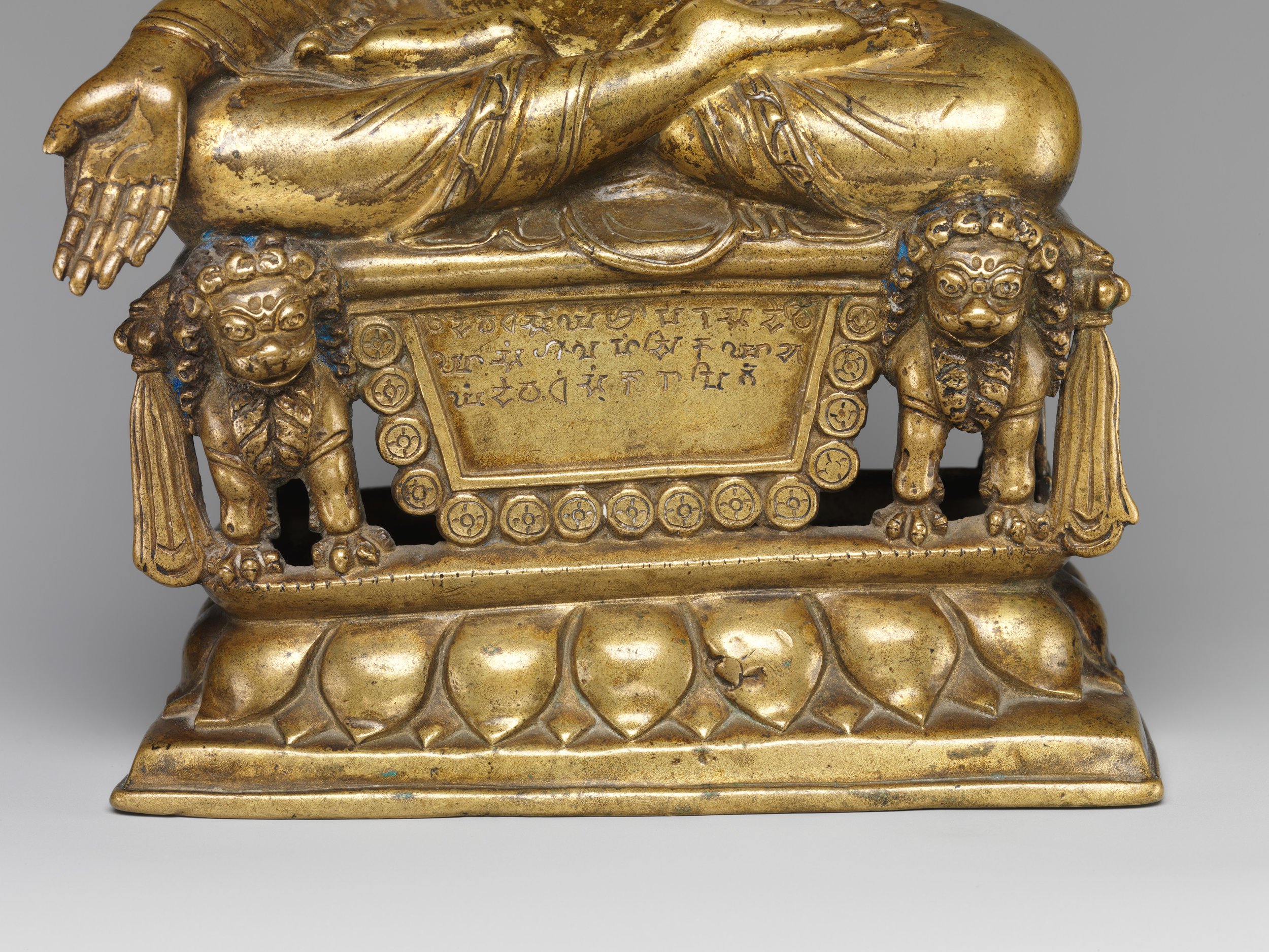
But little is actually known about the Patola Shahis except that they left as a legacy great pieces of art such as this Buddha inscribed with an ancient form of Sanskrit. Its presently in the Met Art Museum in New York and the Museum website describes it as such

Enthroned Buddha Granting Boons : Date to ca. 600. Gilt brass with silver and copper inlay. It also mentions this (sic) : This Buddha is one of the three earliest datable sculptures associated with the kingdom of Gilgit in northern Pakistan. All were commissioned by Queen Mangalahamsika, known from Gilgit manuscripts to have been the senior queen to King Vajraditayanandi (reigned ca. 600). The Sanskrit donor inscription engraved on the front cartouche states: “Om. This is a pious gift. This pious gift was ordered to be made by the Shri Paramadevi [Highest Queen] Mangalahamsika” (trans. O. von Hinueber).

Pics from the Met Art Museum, New York

Prev / Next

Kiki’s Blog

Stories from the Himalayas


Featured Posts

Featured
Kashmir_Region_November_2019.jpg
July 8, 2026
The Three Kashmirs
July 8, 2026
Read more →
July 8, 2026
chisotikkk.jpg
August 16, 2025
Chisoti : The Anatomy of a Disaster 
August 16, 2025
Read more →
August 16, 2025
A Journey to Galwan Valley
June 18, 2025
A Journey to Galwan Valley
June 18, 2025

Five years ago the Galwan Valley was in the News for the wrong reasons after a deadly clash between the Indian and Chinese Armies in the Valley located in Ladakh lead to many deaths on the contentious Border between the two countries in wake of continued Chinese intrusions into Indian territory. 


This area along the Shyok River, of which the Galwan Nallah or the Galwan River which forms the Galwan Valley has been off limits to Civilians since long but now the Indian Government has decided to open up the area for Civilians and we were amongst the First Civilians to venture into this beautifully desolate part of the Eastern Karakorams in Ladakh. Earlier Civilians could only venture upto the Village of Shyok from where the Shyok River takes a U turn and flows in a Northerly direction.

Read more →
June 18, 2025
January 29, 2025
Galwan Valley opened for Tourists
January 29, 2025
Read more →
January 29, 2025
Slide2.JPG
December 29, 2024
Ten Offbeat Locations in Kashmir
December 29, 2024
Read more →
December 29, 2024
18814512_10210684155593724_8491219869639660581_o.jpg
July 26, 2024
The Nanga Parbat from the Kashmir Valley
July 26, 2024
Read more →
July 26, 2024
A Culinary Holiday in Kashmir by Marryam Reshii
May 25, 2024
A Culinary Holiday in Kashmir by Marryam Reshii
May 25, 2024

A holiday in Kashmir involves much travelling around by car from Srinagar (not only the capital but the base of most visitors), a shikara ride, walking around markets and the Old City – a heritage site in its own right. That’s all very well, but it is convenient to know where you can grab a bite, preferably in the area where you are seeing the sights.

Read more →
May 25, 2024
Keran : Where a River Runs Through
December 17, 2023
Keran : Where a River Runs Through
December 17, 2023

A Photo Gallery of Keran along the Line of Control in Jammu and Kashmir

Read more →
December 17, 2023
Ten Offbeat Things to Do in Ladakh
October 19, 2023
Ten Offbeat Things to Do in Ladakh
October 19, 2023

Most People while visiting Ladakh just visit the same old Places, popular Tourist places and ones popularized by Bollywood and Influencers on Social Media. As a result a few Places bear the brunt of the Tourist footfalls which has serious Environmental and Social Impact.

I have always subscribed to the Philosophy that instead of sending 100 people to 5 places send 20 people to 25 places. Ecologically viable Tourism starts by spreading the load of the Tourists. And here is a list of Ten Things that I would recommend to do in Ladakh. And please remember that Ladakh is a large Region and most of it is rather unknown for most people. Ive added a Note on the Mountain Geography of Ladakh for easier understanding. You can also read my Ladakh Travel Guide for General Information.

So I have compiled a list of Ten Things that I would do in Ladakh, keeping in view all my Visits and Readings on Ladakh. They are in no particular order and each One is a Unique experience in its own.

Read more →
October 19, 2023
The Elusive Kaobal Gali
September 4, 2023
The Elusive Kaobal Gali
September 4, 2023

The Kaobal Gali stands at an Elevation of 4167 metres (app 13600 ft) on the main Great Himalayan Range has traditionally connected the Tulail and Gurez Valleys with the Mushkoh Valley in the Drass Region. Interestingly people on both sides of the Pass are Shina and speak Shina language just like their fellow Dardic Shina people in Gilgit. This is a peculiarity as usually when you cross a Pass on the Great Himalayan Range the Culture Language and People change. 

Read more →
September 4, 2023